


Fed by a decade-long economic boom, India's ever-growing appetite for energy is quietly reshaping the way it operates in the world, changing relations with its neighbors, extending its reach to oil states as far flung as Sudan and Venezuela, and overcoming Washington's resistance to its nuclear ambitions.
Hovering over India's energy quest is its biggest competitor: China, which is also scouring the globe to line up new energy sources. The combined appetite of the two Asian giants is raising oil prices oil prices and putting greater demands on world oil supplies.
Already India's energy ambitions have led to developments unthinkable just a couple of years ago: a proposed pipeline to ferry natural gas from Iran across Pakistan; a new friendship with the military government in gas-rich Myanmar, formerly Burma; and budding talks with the US to let India buy nuclear technology.
Nuclear power is expected to top the agenda when Prime Minister Manmohan Singh visits Washington to meet with US President George W. Bush in July. While India covets new equipment to strengthen its feeble nuclear energy program, the US has prohibited the sale of nuclear technology to India since it tested a nuclear bomb in 1998.
"International cooperation, international understanding of India's nuclear ambition, can help to ensure our nuclear energy program moves forward at a faster pace," Singh told foreign journalists on Monday.
To understand India's need for energy, consider the fate of its commercial capital, Mumbai, formerly Bombay. It was enveloped in darkness in May because of a severe power shortage.
political powder keg
These days, the prime minister is engaged in a politically explosive argument with left-wing parties after suggesting that the government curtail giving free electricity to farmers. As the world's fifth-largest consumer of energy, India used energy at the equivalent of 538 million tonnes of oil daily in 2002, the most recent year for which figures were available from the International Energy Agency. That demand is expected to nearly double by 2030.
Today, India imports about 70 percent of its oil; in another 20 years, the Indian government estimates, that will rise to 85 percent. India's demand for natural gas is also expected to grow, and most of it would have to be imported.
"Our dependence is rising," Mani Shankar Aiyar, India's petroleum minister, said during a recent interview. "I welcome that, because it reflects India moving on."
Indeed, it is. "Mutual dependencies" is the buzzword of the day, signaling the way oil and gas links among South Asian countries stand to rewrite the enmities of the past.
"The foreign policy of India will have a lot to do with energy," said Ashutosh Varshney, a political scientist at the University of Michigan. "That is a new imagination and one likely to stay."
That vision is not without its challenges. On the one hand, India seeks to cast itself as the model of democratic pluralism, as in its bid for a permanent seat on the UN Security Council.
On the other, its hunt for fuel is pushing it to reach out to authoritarian governments like those of Sudan and Myanmar, which the US has sought to isolate. In both of those countries, China's weight is also keenly felt.
But India is quickly making inroads. It has persuaded a wary Bangladesh to agree, at least in principle, to a pipeline that would ship gas from Myanmar to India.
Aiyar,the petroleum minister, has been shuttling to Saudi Arabia, India's largest oil supplier, to persuade it to invest in Indian oil and gas projects, among other things. He has also sought to lure foreign investors to explore for reserves in the Bay of Bengal, off India's eastern coast -- what he calls "the North Sea of South Asia."
By far, New Delhi's most ambitious proposal is a US$4 billion, 2,500km pipeline that would ferry natural gas from Iran across Pakistan to India, though a final deal is nowhere near fruition.
Talks resumed on Saturday, when Aiyar visited Islamabad. Pakistan stands to collect handsome transit fees from the pipeline. But how it would ensure its security across vast, restive Baluchistan Province, where disgruntled tribal armies routinely attack gas installations, remains a mystery.
Among Aiyar's "fanciful dreams," as he calls them, is a yet another pipeline that would dispatch gas from Turkmenistan through Afghanistan, then into Pakistan and India.
"We now realize we have to get a large part of our energy from our extended neighborhood, and that means we have to engineer and structure new relationships," said R.K. Pachauri, director general of Tata Energy Research Institute in Delhi.
The nonprofit institute estimates that India will need to invest US$766 billion in the energy sector to meet the growing demand over the next 25 years.
conflicting interests
India's changing relationships regarding energy are inspiring a delicate diplomatic dance with the US.
Publicly, Bush administration officials, including Secretary of State Condoleezza Rice on her visit here in March, have frowned on India's plans with Iran. India is pursuing nuclear technology as the US and European nations are trying to get Iran to give up its own nuclear program.
This week, a senior Indian official, Montek Singh Ahluwalia, was in Washington to meet with the secretary of energy, Samuel W. Bodman, to discuss, among other things, nuclear energy options. Whether the US will turn a blind eye to the Iran pipeline or consider selling nuclear reactors to India remains uncertain.
"In some sense there's a delicate tightrope walk that's going on," said Ashley J. Tellis of the Carnegie Endowment for International Peace in Washington. "The Indians are trying to push the limits on what they can get away with, and the US is trying to see how flexible India might be."
Aiyar did not miss an opportunity to remind the US that India would not countenance interference in one of its foreign policy priorities -- buying gas from Iran.
"We are sensitive to the concerns and interests of other nations," he said, "even as we expect other nations to be sensitive to our concerns and our requirements."
When it comes to molding and marketing India's energy needs, Aiyar -- a leftist at heart, a diplomat by training and possibly the biggest extrovert in India's Congress Party-led government -- likes to think grandly. He never tires of articulating a chief goal: to persuade China to cooperate rather than compete for oil and gas abroad. Some analysts greet the idea with skepticism.
Sundeep Waslekar, an analyst with Strategic Foresight Group in Mumbai, notes that China can offer a much more comprehensive and lucrative package -- including arms sales -- to energy-supplying countries like Iran, Sudan, or the former Soviet republics of Central Asia.
Unless India can offer something strategic to China -- food, for instance -- China would have little reason to join efforts.
China-India energy cooperation in the oil and gas sector is "a beautiful academic idea," Waslekar said. "I don't see how it could work politically."
Aiyar is unbowed. He offers the idea of an Asian gas grid that would stretch from former Soviet republics like Kazakhstan to the Persian Gulf all the way to China.
Every chance he gets, he pushes the analogy of the European coal and gas community, the precursor to the European Union. He demands to know why China and India cannot create the Eastern equivalent?
"An Asian oil and gas community, which could eventually blossom as an Asian identity in the politics of the world," he said.
Of course, for now, a majority of Indians continue to live in the dark -- that is to say, without electricity -- and the most common fuels for Indian households remain among the worst for respiratory health: charcoal and animal dung.

It seems every few days one bumps into one of those “real man” comments in which Taiwan is urged to “face reality” or similar, and “make a deal,” with the speaker implying that soon it will be too late. “Deal” advocates always present themselves as having a superior grip on reality, and the manly ability to make the “hard choice.” Their testosterone-laden language often echoes that of Taiwan sellout advocates. Note that such commentary always specifies a process (“make a deal, work with, make progress”), never the end state of what occupation by a violent authoritarian colonialist state will entail. In

There are shadowy cabals plotting to sell out Taiwan to be annexed by China, by invasion if necessary. Fortunately, they are buffoons. In 2019, former Bamboo Union gangster and founder of the China Unification Promotion Party (CUPP), Chang An-le (張安樂, colorfully known as “White Wolf”), led a protest at the Legislative Yuan against comments made by then-premier Su Tseng-chang (蘇貞昌) that in the event of an attack by China, he would never surrender, but would protect the nation by fighting to the end, even if he only had a broom. Chang had party members bring a wooden casket that they
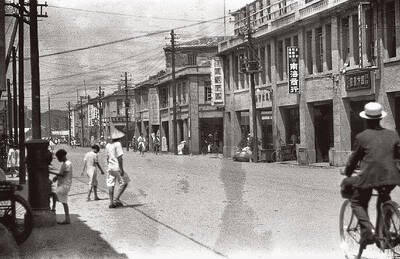
June 1 to June 7 "If all Taiwanese were as afraid of dying as you, then what would happen?” Physician Shih Chiang-nan (施江南) reportedly said this to his wife Chen Chiao-tung (陳焦桐) after she urged him to stop intervening on behalf of Taiwanese soldiers stranded overseas after serving in the Japanese Army during World War II. Shih had clashed with high-ranking officials over the issue, engaged in several heated arguments with Taiwan governor-general Chen Yi (陳儀) and allegedly shouted at general Ko Yuan-fen (柯遠芬), chief of staff of the Taiwan Garrison Command, over

Food prices have often played a major role in Taiwan’s history. The first major wave of migration from China occurred in 1628. A moderate drought, the Ming Dynasty maritime ban that prohibited fishing and trading (intended to reduce piracy) and a temporary tax, conspired to exhaust local resources, leading to famine in Fujian Province. The famed pirate and trader Zheng Zhilong (鄭芝龍), scooped up starving people from Fujian and transported them across the Taiwan Strait, where they settled under the Dutch. Two factors enabled Zheng. First, by 1624 he had settlements around today’s Beigang (北港) in Yunlin County with a small


 RSS
RSS