

Jin Auyeung knew it was coming. We had been at the Manhattan restaurant for a few minutes, talking about things that had nothing to do with race -- but, as with the proverbial 400kg gorilla, we both knew that it couldn't be ignored for long. "Ahh," he sighs as soon as I say the word "Chinese" -- "here we go again."
If Jin were in almost any other profession, the fact that his parents emigrated from Hong Kong to Miami would be neither here nor there. But Jin is a rapper -- and in hip hop, race always matters. He is the first Asian-American rapper with a major record deal, and now he's in a bind. Even though he wants to be known for his prodigious lyrical skills rather than his ethnicity, he knows it's the latter that has racked up the column inches -- and he even called his debut single Learn Chinese.
Not to discuss it with him would be like interviewing Eminem in 1999 and not mentioning that he's white.

PHOTO: MAX WOODWORTH, TAIPEI TIMESN
"I'm not mad," he says cheerfully. "How can I be mad? But let's be honest, if I wasn't Chinese, The New York Times wouldn't have wanted to write about me. So I take it for what it is."
In other ways, too, Jin can't ignore his roots. A month after the Indian Ocean tsunami, breakfast-show presenters at New York's leading hip-hop station, Hot 97, performed a jaw-droppingly ill-advised spoof of We Are the World, with lyrics such as: "You can hear God laughing, swim you bitches, swim." When the show's Korean-American entertainment reporter protested, the host (who is black) snapped: "I know you probably feel that you're superior because you're an Asian." Jin's response was to post a furiously eloquent song on his Web site.
"Since when was hip hop about being racist and ignorant?" he spat. Interviewed by a repentant Hot 97, who put the song on heavy rotation, Jin explained: "If I didn't do this, nobody would have."
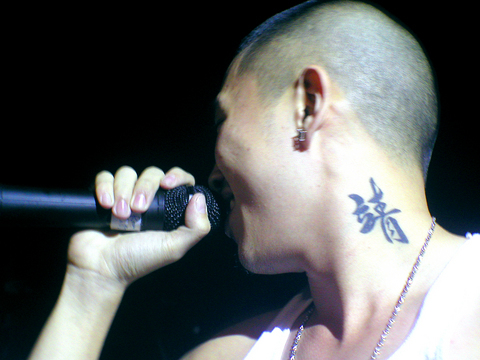
PHOTO: MAX WOODWORTH, TAIPEI TIMES
Hip hop has always been outraged at white-on-black racism, but rather less enlightened in its attitude towards Asians. Thirteen years after Black Korea, Ice Cube's notorious 1992 broadside against "oriental one-penny-countin' motherfuckers," Asians are still considered fair game in many quarters. As Jin raps on Tsunami Response: "Let it be any other race and the shit would have hit the fan."
The 22-year-old first encountered the double standard in his teens, as an aspiring MC competing in rap battles.
"I realized, and this was way before 8 Mile, that I should use the Asian jokes first so that they lost a lot of their value."
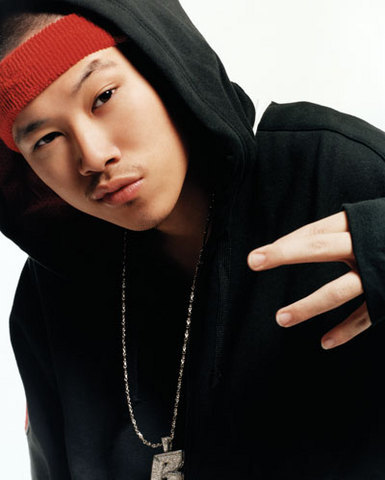
PHOTO COURTESY OF RUFF RYDER RECORDS
Using equivalent stereotypes against a black opponent was never an option. "Hell no! I wouldn't even last 10 seconds. If I had said one thing even remotely about him being African-American, it would be over. I'd have a lawsuit or something. I don't feel bitter about it. That's just how it is."
As a rule, rappers make lousy interviewees. Jin's conversation, however, is as sharp and engaging as his lyrics. He's also the first MC I've ever interviewed who turns up early.
The Japanese restaurant where we meet is a regular haunt of his. When his family moved to New York in 2001, he would stand outside nearby record shop Fat Beats trying to sell his self-produced tapes, then use the money to buy lunch.
Within a few months he had won a slot on Black Entertainment Television's popular battle show, Freestyle Friday. Correctly guessing that the reigning champion, Hassan, would resort to Asian gags, he struck first: "If you make one joke about rice or karate/NYPD be in Chinatown searching for your body."
Hassan was so wrongfooted he couldn't even finish his rap, and Jin became the new champion. He was eventually "retired," undefeated, after seven weeks to give other rappers a chance, by which time he had been snapped up by the Ruff Ryders label.
When people recognize Jin in the street, they tend to have a positive -- if peculiar -- reaction.
"For the most part people think I'm like a myth, not a real person," he says. "When they see me they're like, `Wow, you really exist.'"
No wonder the first line on his debut album, The Rest Is History, runs: "Look, I'm not a gimmick."
He explains: "It's easy sometimes for people to be like, `Oh, he's Chinese and he raps? That's a gimmick' -- before they even hear anything."
Anticipating that reaction, The Rest Is History is loaded with generic battle rhymes and club tracks. Only halfway through does it begin to tackle specifically Asian-American issues.
However much Jin wants to avoid racial pigeonholing, these are his most original and exciting tracks. Learn Chinese, produced by Wyclef Jean, may be playfully unsubtle but Same Cry deals articulately with sweatshops, China's one-child rule and the massacre at Tiananmen Square.
The most autobiographical song, Love Story, recalls Jin's parents reaction when, aged 13, he began dating a black girl. "My family was like, `Why are you dating a black girl? Do you forget who you are?' And then the same thing when they knew I was into hip-hop. `What are you doing? This is not you.'"
His family didn't mind Jin coasting academically, provided he helped out at the family restaurant, but they took a dim view of his musical aspirations.
"The only time the news ever talks about hip hop is when someone gets stabbed at a concert or some rapper gets caught in a drug scandal. You never see Rapper Starts Charity Drive. To them it was just noise, sex, drugs and violence. So it was tearing me up."
"When I bought CDs I had to hide them. If I was writing rhymes, I'd do them under the covers," he said.
These days, Jin's parents are very proud of their son ("They're going to read this article, trust me"), who still lives with them in Queens. "I'm a mama's boy," he readily admits. "This industry is so crazy, you need your family to keep you sane."
When Jin says the industry is crazy, you wonder if he's thinking about the events of Nov. 9, 2003. That night he was drinking at a Chinatown bar with friend and fellow rapper Christopher Louie, when an aspiring MC called Raymond Yu pulled a gun on Jin. Jin won't go into details about what happened, but Louie ended up in hospital with a bullet in his back. Yu, who fled after the shooting, was arrested last December at the Canadian border.
"It saddened me, because I always believed that you get the kind of energy you put out. The vibe that I give off is positive. I don't bother nobody. It was so stupid."
He shrugs off the subject. "My buddy's recovering and that's all that matters."
Nobody could accuse Jin of inviting violence. So diligently does he avoid gangster posturing that the only guns referred to on his album are the ones fired at Tiananmen Square.
Jin has performed in China, where he got away with playing Same Cry in relatively liberal Hong Kong and Taipei. In Shanghai and Beijing, however, he was told in no uncertain terms to drop it from the setlist. "Matter of fact, they didn't even want me mentioning that date, June 4 -- even though it's my birthday."
He is realistic about the hill he has to climb. The Rest Is History, released in the US last year, has not been a huge hit and there are no firm plans for a follow-up.
Having played a mechanic in last year's action flick 2 Fast 2 Furious, Jin is hoping to move into acting.
"This industry is so uncertain," he says. "It's hard to really plan what you want to do. But I've worked with Kanye (West), I've worked with Twista. That's a pretty big deal for someone who used to rhyme on the corner. I can tell my grandkids about this."
I wonder if his real ambition is one day to become known as Jin the rapper rather than Jin the Chinese rapper. "Yeah. That's what I want." His laugh is small and sad. "And I don't think it'll ever happen."

Mark Carney built a global profile this year by standing up to US President Donald Trump. If some prediction-market traders and prominent admirers are right, the Canadian prime minister could end the year with the Nobel Peace Prize and Time magazine’s Person of the Year. Carney briefly became the favorite Monday for the 2026 Nobel Peace Prize on Kalshi, a US-based prediction market, when traders on the exchange put his chances at 14 percent. His odds later fell, illustrating the highly speculative nature of the wagering. There is no public evidence Carney is on the Nobel Committee’s secret shortlist for the prize

The spectacular rise of the Taiwan Stock Exchange (TWSE) in recent months has fueled great excitement among individual stock traders. Gate News reported that the stock market swelled 59 percent in the first half of this year, with margin trading volume surging nearly 20 percent. Local newspapers tell stories of stock buying “on the margin” by individual investors, often with dire results. The implication is that small investors are teetering on the brink of disaster should there be a market “correction.” How real is this threat? This scenario actually occurred this summer. In July the market fell nearly 4,000 points. “The

Speculation started to fly last month that Chinese Nationalist Party (KMT) candidates running in the November elections wanted to keep their distance from party Chair Cheng Li-wun (鄭麗文). That some in the KMT were concerned that Cheng’s firm ideological adherence to the “one China principle” is no secret. There had already been pushback from within the party on issues ranging from the budget to defense, as well as over some of her more hardline comments. The timing made sense, however. The KMT party congress unity love fest wrapped up at the end of July. Through the primaries and up to
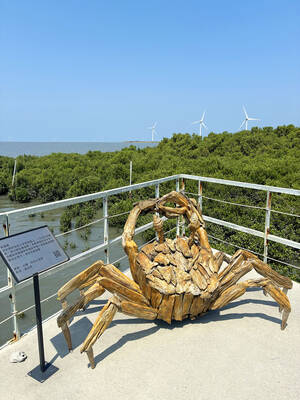
Fangyuan Township (芳苑) in Changhua County is a quiet, unassuming setting, known for its wetlands, eco tours and trained sea-ox that transport the oyster harvest in carts. Topographically speaking, it’s also enormously diverse, boasting a proud tradition of aquaculture and an ecologically rich coastline. Fertile fields abound with an abundance of crops from green onions to dragon fruit, with vineyards to the east in neighboring Erlin Township (二林鎮). WANGGONG FISHING PORT To the northwest of the township, flanked by the Wanggong Fishing Port (王功漁港) and harbor, stands the tall two-tone lighthouse. Built in 1983, this popular landmark is still fully operational. The Wanggong


 RSS
RSS