


Dragonfly is first and foremost a studio specializing in glass-bead artwork. It was founded 22 years ago as a means to employ local Paiwan Aboriginal women and to ensure that their centuries-old tradition of making and wearing glass beads could be brought to a larger cultural stage.
Not long after it opened its doors, though, the need among clients for a convenient place to eat became apparent and the artisans Dragonfly employed to make beads discovered another skill: cooking.
Of course this was no real discovery. "Before [Dragonfly] was a business, and long before we started getting clients to come, we would take turns cooking in the small kitchen in the back," one of the artisan-cum-cooks, Padagow (
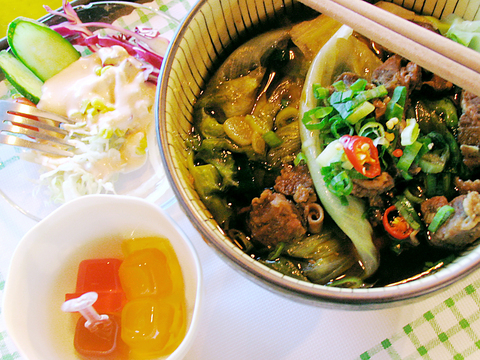
PHOTO: DAVID MOMPHARD, TAIPEI TIMES
"We all were taught by our mothers how to make traditional Paiwan dishes," she said.
Now Dragonfly is known almost as well for its pork chops fried on a slab of slate rock as it is for the beautiful glass beads it forges. There are also a variety of noodles on offer, with Dragonfly's beef noodles a favorite among the artisans of the studio.
"We're all Paiwan Aboriginals, but if every day we had the same traditional Paiwan dishes, we'd quickly become tired of them," Padagow said.
She said all the dishes on the limited menu run on the spicy side, but that any can be made less spicy as all the dishes are made fresh.
"We concentrate on making glass beads," Padagow said.
"We haven't put much thought into Dragonfly being a restaurant. We just keep on hand all the supplies necessary to make these few things and, when someone orders something, one of us will turn off our torch for a while and go make it," she said.
For not having put much thought into the restaurant, Dragonfly has some of the nicest ambiance you'll find at any eatery. This is, of course, thanks to the hundreds of thousands of beads that decorate the ceiling, the floor and the antique furnishings.
"We have a theory," Padagow said, "that everyone who comes here gets hungry after seeing the beads. They're all very colorful. Some people say they look edible!"

Taiwan’s English education system is being pulled apart by three opposing forces. Bilingual Nation 2030 pulls students toward English and global communication. Artificial Intelligence (AI) readiness pulls them toward digital judgment, verification and AI-mediated work. But Taiwan’s old exam culture pulls them back toward memorization, grammar drills, timed reading and correct answers. If the education system keeps using old exams to define success, it risks producing graduates who are neither genuinely bilingual nor genuinely AI-ready, but trained for tasks machines can already perform. The first force is Bilingual Nation 2030. Launched in 2018, the policy aimed to “help Taiwan’s workforce connect

It seems every few days one bumps into one of those “real man” comments in which Taiwan is urged to “face reality” or similar, and “make a deal,” with the speaker implying that soon it will be too late. “Deal” advocates always present themselves as having a superior grip on reality, and the manly ability to make the “hard choice.” Their testosterone-laden language often echoes that of Taiwan sellout advocates. Note that such commentary always specifies a process (“make a deal, work with, make progress”), never the end state of what occupation by a violent authoritarian colonialist state will entail. In

There are shadowy cabals plotting to sell out Taiwan to be annexed by China, by invasion if necessary. Fortunately, they are buffoons. In 2019, former Bamboo Union gangster and founder of the China Unification Promotion Party (CUPP), Chang An-le (張安樂, colorfully known as “White Wolf”), led a protest at the Legislative Yuan against comments made by then-premier Su Tseng-chang (蘇貞昌) that in the event of an attack by China, he would never surrender, but would protect the nation by fighting to the end, even if he only had a broom. Chang had party members bring a wooden casket that they
June 1 to June 7 "If all Taiwanese were as afraid of dying as you, then what would happen?” Physician Shih Chiang-nan (施江南) reportedly said this to his wife Chen Chiao-tung (陳焦桐) after she urged him to stop intervening on behalf of Taiwanese soldiers stranded overseas after serving in the Japanese Army during World War II. Shih had clashed with high-ranking officials over the issue, engaged in several heated arguments with Taiwan governor-general Chen Yi (陳儀) and allegedly shouted at general Ko Yuan-fen (柯遠芬), chief of staff of the Taiwan Garrison Command, over


 RSS
RSS