


Her arm locks like a robot's, then pops from the shoulder, sending a wave through her body. Michael Jackson's Don't Stop 'Til You Get Enough blares from a boombox in the Times Square subway station as a crowd of onlookers, heads bobbing, cheer on the performer.
The break dancer is female, which is unusual enough. Even more eye-opening is the fact that she is a 26-year-old Japanese woman with cornrows in Float Committee, the crew of young black men with whom she is performing on this day.
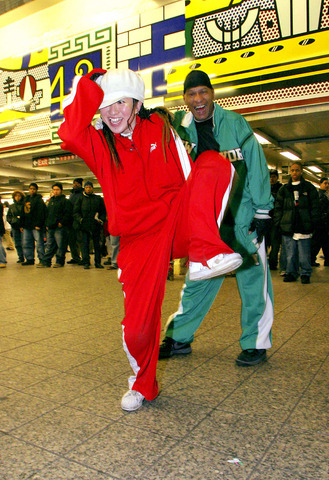
PHOTO: NY TIMES
Her solo builds as she glides around the concrete floor, limbs electric, torso fluttering as if from some subterranean wind. In another instant, she is back in line with her crew, grinning and rocking to and fro as sweat pours down her face.
PHOTOS: NY TIMES
To her family in the city of Nagoya, she is Kumi Naito. In her New York life and in the break-dance world, she is simply Q, and a wild departure from the stereotype of the Japanese immigrant, or issei, that New Yorkers have known in the past: the salaryman from a Japanese corporation with a wife in tow.
Q also typifies how the Japanese immigrant of today -- young, artistically inclined, open to risks and twice as likely to be female than male -- differs from the bulk of immigrants to New York, who come to take advantage of the city's economic opportunities.
These Big Apple issei, as they could be called, are cultural refugees, drawn to New York's creative clamor and in search of freedom for their spirits.
This was certainly true of Q, who is thrilled to be able to pursue her passion for dancing on the streets and in the city's subway stations; she even tours the country and Europe with a professional company.
For her, this independence is everything. "I can't imagine being in Japan," she said. "I couldn't break dance there."
A PLACE FOR PURPLE HAIR
In the last two decades, thousands of young Japanese like Q have come to New York in search of the custom-tailored lifestyles that are hard to carve out in a homeland, where johshiki -- traditional ways and morality -- still exert a powerful influence. Such young people make up the majority of their fellow countrymen, or rather, countrywomen, living in the city.
Census data from 2000 show that 63 percent of the 16,516 foreign-born Japanese living in New York are women, and 64 percent are 20 to 39 years old. That percentage of young people is nearly 23 percentage points higher than it is for Chinese or Koreans, the two largest Asian immigrant groups in the city.
Hiroko Kazama, who is 42 and came to the city in 1987, said that young Japanese, especially artistic types, come to New York because they find that other American cities are too much like Japan. "Japanese society doesn't have an understanding for art," explained Kazama, who lives in the East Village and works for City Lore, an urban folklore center on East First Street. "Traditional art is accepted, but edgy art is not. Hair that's red and purple is hard to accept. Young people are not comfortable with that."
This is probably an understatement; young Japanese have ample cause for wanting out. As early as fourth grade, many are sent to jukus -- cram schools -- to begin preparing for the country's highly competitive college entrance exams. A child's mother packs up two bento boxes each morning, one for lunch and one for dinner. When the regular school day is over at 3pm, the children are off to jukus, where they work until 10pm.
University years often provide the only break in a rigid educational regimen, because students need only to do well on final exams to pass their classes. But the rigid life track continues once they graduate from a university or junior college. They are expected to get jobs, working as salarymen or OL's -- office ladies -- where they stay, sometimes for a lifetime.
Japan has certainly benefited from this kind of rigor, and perhaps this is why, even with a shrinking population, the country is continually ranked among the top 10 nations in terms of gross domestic product. But for those who remain on the career track, the prospect of "finding your bliss" often becomes bleaker with each passing year. Koji Toyama, a photography major at Parsons School of Design who came to New York in 2000 and now lives in Williamsburg, Brooklyn, put it simply: "Young people in Japan don't care about the future." Women, especially, encounter stiff obstacles to forging their own path in Japan. Not only do they have a harder time developing professionally in a male-dominated society, they often face harsh judgments if they choose not to become a wife and mother at an early age.
"If you are an unmarried woman older than 25," said Jun Takama, a 41-year-old who has lived in New York, mostly in Chelsea, since 1996, "people refer to you as Niju-go nichi sugita Kurisumasu keiki." Translation: you're a Christmas cake, because no one wants you after "25."
Not wanting to be hemmed in by such conventional notions of how to live her life, Takama has remained in New York, where she finds it easier to pursue her personal and professional interests. She has worked as a hairstylist and wants to set up a cross-cultural consulting service for Japanese women coming to the city. When she spent a year as an OL at All Nippon Airways, in an office based at Kennedy Airport, she still felt confined by the strictures of Japan. Although she felt as if she performed better than some of her male colleagues, it seemed to her that they found it easier to move up. Many men she worked with also treated her as if she barely existed, she said. When she arrived at work on a typical morning, for example, the men would already be ensconced in their Yomiuri or Asahi Shimbun newspapers.
"Good morning," Takama trilled, imitating herself as the chipper OL arriving just in time to make coffee. "But the men only respond with a grunt."
"When I got my hair cut short," she added, "the only comment I got was `What are you trying to do, outdo us?"'
Simply coming to New York, of course, doesn't guarantee success, and the path to happiness here is as fraught with complications and pitfalls for young Japanese as for any immigrant. And though the first obstacle for many of them is the language barrier, learning English often helps them ease into the city's multicultural stew, and in fact can be a ticket to self-discovery.
In English-language classrooms around the city, Big Apple issei mix with Latin Americans, Africans, Europeans and other Asians. At many private language schools and those attached to universities, Japanese students typically make up about 30 percent of the student body.
Caitlin Morgan, assistant director of the English language studies department at the New School, has noticed the physical transformations that many Japanese undergo while they are studying English: They change hair colors, get tattoos, acquire multiple piercings, use hair extensions and grow dreadlocks.
Even without these extreme changes, the physical changes are visually dramatic. "The women especially," she explained, "their voices seem to get deeper, they put on a little weight and become fitter, they use less makeup, they become a little realer."
"These foreign explorers," she added, "seem to have an intuitive understanding that in New York, there are rewards to taking creative risks and trying new things."
Sometimes, a student's interests become a vehicle for personal change that would have been impossible in Japan. One afternoon, Morgan was advising a student who was so smitten with hip-hop culture, if you closed your eyes and listened to him talk, you'd have thought you were listening to a black hip-hop artist.
"I always got my rhymes in my head," the student said with a grin, hands splayed, "`cause on the mike I gotta sound fly."
Learning English also paved the way for 26-year-old Sayuri Tsuchitani, who felt the lure of the city all the way from her rural town of Anabuki on the island of Shikoku. New York, she said, had a "buzz kind of thing." She heard that it was dangerous here, that "you could get killed." And so, she added with a gleam in her eye, "I wanted to check it out."
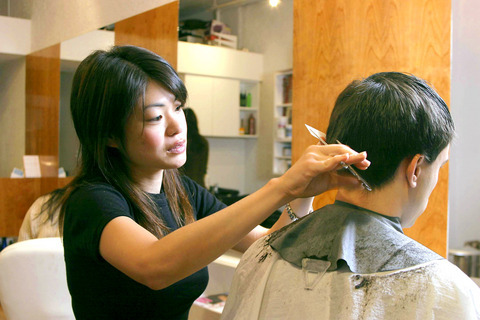
Attending Rennert Bilingual, a private language school, became the first stop on her road to independence and a job as a hairstylist, a career she had always yearned to pursue. After two years of full-time English study, her language skills were strong enough to allow her to enroll in Libs Beauty School in Midtown. Her defining moment came when she got work as a hairstylist at Damian West, a salon at Waverly Place and 10th Street.
"That was my real breakthrough," Tsuchitani said. "That and having really great, cool clients."
She often visited with local musicians and singers who came to the salon and turned her on to the neighborhood's jazz hot spots, like the Village Vanguard and Sweet Basil. As she trimmed hair one afternoon recently, she chatted animatedly about two concerts she attended recently at Irving Plaza -- the metal band Gwar, and the Afro-European music group Zap Mama.
Tsuchitani now works at a Japanese-owned hair salon, Hair Kuwayama, on East 10th Street. Since 10 percent of the clients are Japanese, the salon needs bilingual employees, and Tsuchitani finds herself in the position of being an American-trained stylist working with other Big Apple issei who underwent the more rigorous training that stylists receive in Japan.
"They can do anything," she said admiringly of her colleagues. "They blow my mind. I'm learning a lot from them."
`DAIFUKU' MEETS BAGEL
While the city has no real Japanese enclave, the largest percentage of them -- 16 percent, according to census data -- live in the Stuyvesant Town-Turtle Bay area on the East Side. But it is in the East Village that young Japanese are especially visible.
The area bounded by East Ninth Street, Stuyvesant Street and Second and Third avenues has become what some call Little Tokyo or J-Town, because it is so easy to get a fix of daifuku, a traditional pastry, and okonomiyaki, an Osakan-style seafood pancake. The venerable Sunrise Mart on East Ninth Street is stocked with Japanese delicacies, groceries and housewares. St. Mark's Place from Third Avenue to Avenue A is home to no fewer than nine Japanese restaurants as well as a new Japanese convenience store.
Hang around these places for even a little while, and you will see a full range of Big Apple issei -- reggae punks with dreadlocks tucked into knitted tams the colors of the Jamaican flag, hipsters smoking behind oversized shades, pairs of chatty young women with dainty shopping bags hanging from their arms.
Despite its flavors of home, Little Tokyo is no Japan. That is exactly the point for cultural refugees like Hanako Shimamoto, 37, who has lived in New York since 1992 and does not miss the constriction of her birthplace. She spends her days as a floral designer at Fantasia, a secret garden of a store on East 74th Street that is nestled on the ground floor of a two-story brick building. She left her native land, she said, because "in Japan, I could never go beyond my world."
Shimamoto, whose open smile shows no hint of the reserve typical of Japanese women, was born in Kyoto, a city renowned for its traditional beauty and customs, and a place where, Shimamoto said, "your neighbor knows everything about you."
"But at the same time," she added, "people don't talk much. They want to hide their emotions."
Here in New York, she enjoys the unexpected in her conversations. Because her employers are Catholics, their talks include God and religion, two topics that are conversational taboos in Japan. "In New York," she said, "you open a door to a different level of being with people."
When she was working in Japan at a factory that manufactured dental equipment, Shimamoto bristled at the routine of going out after work with colleagues for food, drink and small talk. So she went to the gym or took English lessons. Then she got interested in floral design. "But everyone was getting into it then," she said, "so I decided to come to the States to study."
She felt an especially strong connection to New York, and took an apartment in Woodside, Queens. Like many New Yorkers, she chose her neighborhood for the affordable rent, but she doesn't hang out there. In her free time, she wanders around Manhattan, particularly the West Village. Her favorite New York delicacy? The bagel, of course.
"It's hard to explain," Shimamoto said with a laugh as she put the finishing touches on a birthday bouquet of yellow, salmon and spray roses. "But my intuition just told me that this was the right place for me to be."
In the end, even New York may not be big enough for some Big Apple issei. Many aspire to become citizens of the world who can travel, work and live in a variety of locations. They are modern people born of an extremely traditional culture. This koan-like paradox is most clearly evident in the fact that, unlike their predecessors, most of these young Japanese immigrants are not trying to become US citizens. They like being Japanese; they simply prefer to live in New York.
So they visit Japan at least once a year. And while they admit that once there, they again feel the claustrophobia of being in a conservative, homogeneous culture, they also relish the comforts of the familiar in the form of family, friends, language, food, and being around people who, unlike many New Yorkers, go out of their way to be polite.
Q is typical in that she returns to Japan once a year. But when she describes what she does during her stay, she sounds like the New York artist she is. "I just try to chill."
Jiro Adachi is the author of the novel The Island of Bicycle Dancers.
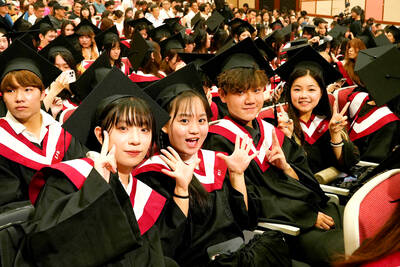
Taiwan’s English education system is being pulled apart by three opposing forces. Bilingual Nation 2030 pulls students toward English and global communication. Artificial Intelligence (AI) readiness pulls them toward digital judgment, verification and AI-mediated work. But Taiwan’s old exam culture pulls them back toward memorization, grammar drills, timed reading and correct answers. If the education system keeps using old exams to define success, it risks producing graduates who are neither genuinely bilingual nor genuinely AI-ready, but trained for tasks machines can already perform. The first force is Bilingual Nation 2030. Launched in 2018, the policy aimed to “help Taiwan’s workforce connect
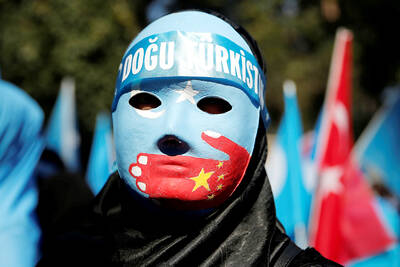
It seems every few days one bumps into one of those “real man” comments in which Taiwan is urged to “face reality” or similar, and “make a deal,” with the speaker implying that soon it will be too late. “Deal” advocates always present themselves as having a superior grip on reality, and the manly ability to make the “hard choice.” Their testosterone-laden language often echoes that of Taiwan sellout advocates. Note that such commentary always specifies a process (“make a deal, work with, make progress”), never the end state of what occupation by a violent authoritarian colonialist state will entail. In
June 1 to June 7 "If all Taiwanese were as afraid of dying as you, then what would happen?” Physician Shih Chiang-nan (施江南) reportedly said this to his wife Chen Chiao-tung (陳焦桐) after she urged him to stop intervening on behalf of Taiwanese soldiers stranded overseas after serving in the Japanese Army during World War II. Shih had clashed with high-ranking officials over the issue, engaged in several heated arguments with Taiwan governor-general Chen Yi (陳儀) and allegedly shouted at general Ko Yuan-fen (柯遠芬), chief of staff of the Taiwan Garrison Command, over

“Taiwan’s Opposition Leader Comes to US With a Message Straight Out of Beijing” read a May 31 headline in the Wall Street Journal. Top US administration officials and members of Congress almost certainly read the WSJ, and if there was a bullet point takeaway that people in Washington should absorb ahead of Chinese Nationalist Party (KMT) Chair Cheng Li-wun’s (鄭麗文) arrival in DC on June 9, that headline is it. The last few columns have discussed this very topic, and the timing is not coincidental. While those top officials likely do not read the Taipei Times, judging by the number


 RSS
RSS