


It was a very strange night last Friday at Taipei's cinemas. A sea of people were crammed in Ximending, Warner Village and Showtime Cinemas to see Kung Fu Hustle (功夫). Tickets for all screenings that night had been booked or were sold out. The huge crowd made Warner Village and Showtime Cinema show extra screenings until 3am.
A cinema owner said it had been a long time since they had stayed up so late for a film. Even more unusual was that was for a Chinese-language film.

Stephen Chow's (

PHOTO COURTESY OF FOX MOVIES
Kung Fu Hustle was the biggest dark horse movie this year. Before the film opened, the best-selling film in Taiwan this year had been the disaster film The Day After Tomorrow. Tomorrow, which grossed NT$180 million in Taiwan and set a first-day box-office record of NT$10 million. But this record was broken last Friday night by Kung Fu Hustle, with the crowds of people on Friday night causing a box office take of NT$15 million.
Kung Fu Hustle will not only beat Hollywood films and top the box office chart for 2004, but it has another record to break -- namely, to overtake the record of Crouching Tiger, Hidden Dragon (

PHOTO COURTESY OF FOX MOVIES
The 2004 box office in Taiwan has slightly improved from a SARS-stricken 2003. The second best-selling foreign film was Harry Potter and the Prisoner of Azkaban, grossing NT$134 million. Spiderman 2 stands at third, taking NT$132 million. And the fourth and fifth place was a battle between The Last Samurai and The Incredibles. The former took NT$102 million and the latter now has taken NT$95 million and is still on general release.

PHOTO COURTESY OF PANDASIA
Such a ranking is not so different from that of the US chart, except for The Last Samurai, which fell out of the top 10 in the US domestic chart but stayed high in Taiwan. Taiwanese audiences are loyal to Tom Cruise.
As for Chinese-language films, Kung Fu Hustle took top place, easily, and pushed Zhang Yi-mou's (
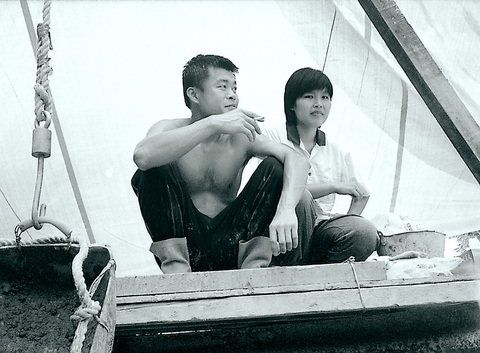
PHOTO COURTESY OF FULL SHOT FOUNDATION
Wang Kar Wai's (
The most surprising film was Taiwanese documentary Gift of Life (
Another source of Taiwanese pride is Formula 17 (
Formula 17 was made with a tiny budget of NT$6 million, but grossed NT$5.3 million in Taiwan. In addition to NT$8 million in overseas sales, selling rights to nine countries including US, Japan, Germany and Benelux, the film was, perhaps, the only profit-making Taiwanese film this year.
Apart from the two Taiwanese films, the rest of the films on the chart are all Hong Kong action or horror films. Horror and action continue to be the selling elements for Chinese-language films. The only exception is Silvia Chang's (
Top 10 Foreign Films
1. The Day After Tomorrow, NT$180 million
2. Harry Potter and the Prisoner of Azkaban,
NT$134 million
3. Spiderman 2, NT$132 million
4. The Last Samurai, NT$102 million
5. The Incredibles, NT$95 million
6. Troy, NT$94 million
7. I, Robot, NT$85 million
8. Shrek 2, NT$76 million
9. Van Helsing, NT$70 million
10. Resident Evil: Apocalypse, NT$49 million
Top 10 Chinese-language films
1. Kung Fu Hustle, NT$100 million (up to Dec. 27)
2. House of Flying Daggers, NT$35 million
3. 2046, NT$11 million
4. Gift of Life, NT$10 million
5. New Police Story (
6. The Eye 2 (
7. Three, Experiences (
8. Jiang Hu (
9. Formula 17, NT$5.38 million
10. 20, 30, 40, NT$4.45 million

What was the population of Taiwan when the first Negritos arrived? In 500BC? The 1st century? The 18th? These questions are important, because they can contextualize the number of babies born last month, 6,523, to all the people on Taiwan, indigenous and colonial alike. That figure represents a year on year drop of 3,884 babies, prefiguring total births under 90,000 for the year. It also represents the 26th straight month of deaths exceeding births. Why isn’t this a bigger crisis? Because we don’t experience it. Instead, what we experience is a growing and more diverse population. POPULATION What is Taiwan’s actual population?

For the past five years, Sammy Jou (周祥敏) has climbed Kinmen’s highest peak, Taiwu Mountain (太武山) at 6am before heading to work. In the winter, it’s dark when he sets out but even at this hour, other climbers are already coming down the mountain. All of this is a big change from Jou’s childhood during the Martial Law period, when the military requisitioned the mountain for strategic purposes and most of it was off-limits. Back then, only two mountain trails were open, and they were open only during special occasions, such as for prayers to one’s ancestors during Lunar New Year.

A key feature of Taiwan’s environmental impact assessments (EIA) is that they seldom stop projects, especially once the project has passed its second stage EIA review (the original Suhua Highway proposal, killed after passing the second stage review, seems to be the lone exception). Mingjian Township (名間鄉) in Nantou County has been the site of rising public anger over the proposed construction of a waste incinerator in an important agricultural area. The township is a key producer of tea (over 40 percent of the island’s production), ginger and turmeric. The incinerator project is currently in its second stage EIA. The incinerator

It sounded innocuous enough. On the morning of March 12, a group of Taichung political powerbrokers held a press conference in support of Deputy Legislative Speaker Johnny Chiang’s (江啟臣) bid to win the Chinese Nationalist Party (KMT) primary in the Taichung mayoral race. Big deal, right? It was a big deal, one with national impact and likely sent shivers down the spine of KMT Chairwoman Cheng Li-wun (鄭麗文). Who attended, who did not, the timing and the messaging were all very carefully calibrated for maximum impact — a masterclass in political messaging. In October last year, the Democratic Progressive Party (DPP)


 RSS
RSS