


The CO4 exhibition showcasing Taiwanese avant-garde arts opened Friday at the Huashan Cultural and Creative Industry Center. When it closes this January, so will Taipei's largest experimental art venue. The center will reopen next year, but how much of its original architecture will be preserved after NT$8 billion is spent on renovations has become a searing debate between local artists and government officials.
In theory, both sides have the same vision: an environment for artists to exhibit their work and attract a wider audience -- but their approaches are different and only complicated by rumors and limited dialogue.
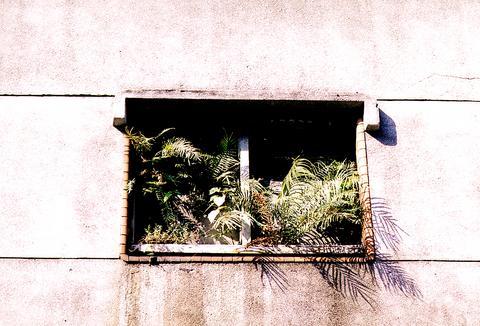
PHOTO COURTESY OF BEN ZULLO
In early November, the Council for Cultural Affairs (CCA) released a press statement indicating it would not renew its current management contract with L'Orangerie International Art Consultants so that it could establish its own foundation to run Huashan.
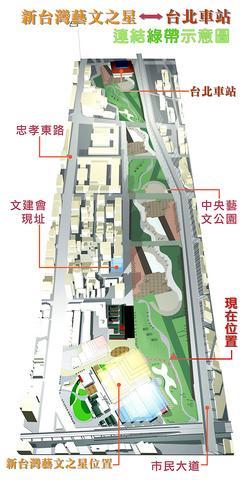
PHOTO COURTESY OF COUNCIL FOR CULTURAL AFFAIRS
The news triggered a series of public demonstrations led by artist Tang Huang-chen (
Margaret Lai-Huang Shiu (
Minister Chen Chi-nan (
The area currently in use occupies only 12 percent of the 7.21 hectares owned by the central government. According to Chiao Lin (
Because it was declared a cultural site, however, it cannot be sold to a commercial developer. Although Lin could not give any exact figures, he said the land would be valued similar to that in the Zhongxiao East Road district, which is estimated at NT$1 million per ping (3.3m2).
In an attempt to prevent the site from going to waste, the CCA, under Chen, intends to "turn it into a landmark of contemporary culture in Taiwan," Lin said.
"We believe that providing a creative-industry center for artists to showcase their work will give birth to a new contemporary culture in Taiwan. We are desperately in need of a space to establish this culture and there is no need to congest it in the small space being used now," he added.
Chen defines a creative-industry center as "a special site for artists from many media including performance arts, visual communications, architecture, textiles and design to exchange ideas and work on joint projects."
The CCA's blueprint plan does not alter any of the three heritage sites, but instead proposes to build three additional buildings among the old ones. These will include an international hostel to house visiting artists, a performance hall to hold some 2,000 people, and a high-rise building with floors for studio and exhibition space, a coffee shop and bookstore and administration office space for the CCA.
Demand in Question
Shiu questions the CCA logic that suggests if they build it, people will come. As an avant-garde artist with a background in economics, she said: "Why build these enormous facilities until we are sure there is a demand for them? There should be research first to see if there is a need for such a creative industry park in Taipei city. If not, we will end up with three beautiful empty buildings that cannot be maintained by taxpayer money. And then what is stopping the CCA from selling the public space off to developers?"
Tang, the Huashan activist, is equally concerned about whether a bigger venue will attract a large audience.
"The most important thing is to first have quality performances that attract people and then if there is enough demand, expand the site," she said.
Tang and members of the Golden Bough Theater (
For the next five years, Shiu and former minister of the CCA Tchen Yu-chiou (
Before renovations could get started, plans were brought to a stop, not because of sensationalized and unfounded reports of drug parties, which made headlines in newspapers in mid-2002, but because in June Tchen was replaced by Chen, the new minister with a new vision.
Under the "Creative Taiwan: Creativity and Culture Industry Development Project" (
Five months later, Chen replaced Tchen, but plans to "revitalize the space and make it more appealing to the general public" were maintained, he said.
In 2003, he opened bidding on a management contract and in January this year, the CCA tenured out a one-year contract to L'Orangerie. That contract ends in January.
During the past year, Huashan has changed immensely and most will agree it's exterior is easier on the eye. Internal changes have also emerged with more commercial exhibits, in addition to a gift store and retail coffee shop.
At present Huashan operates at 90 percent government and 10 percent commercial funding. Rose Hsu (
Hsu's idea is to have roughly 65 percent or less government funding, with the rest coming from the private sector. This does not mean the site will be overrun by retail chains, she said.
Accessibility
Hsu agrees with Chen that to reach a wider audience it is necessary to establish spaces separate from the arts, such as cafes, bookstores or independently run shops by local artists and designers.
"Experimental arts do not have a large following, but if we can attract people with a nice environment then hopefully it will let more people know about avant-garde art in Taiwan," she said.
Hsu doesn't agree with Chen, however, that a venue with full government funding will give freedom to the artists to experiment. "If the government controls too much do you think the arts will be able to criticize the government? Huashan should not become a showcase for the government," she said.
When asked if the CCA would be in charge of appointing the employees of the proposed Huashan Arts Foundation that will run the center starting next year, Chen was firm. "That's a ridiculous idea. We are administrators. We don't have the qualifications to determine who is best to run this facility. We just provide the space and resources."
He did not, however, provide any confirmation on who or how the CCA's foundation will be formed.
Shiu and Tang said the best way to manage the site is to first establish a board composed of the CCA, artists and corporate officials who elect a chairperson, as was done at the wildly successful Esplanade Cultural Arts Center in Singapore.
As far as external renovations are concerned, the proposal for three new buildings is part of a long-term plan that includes removal of the dilapidated buildings along Beiping Road (behind Huashan) to create a large park. There is no set date for completion of the plan, but more than 10 architects have been invited to see the space.
Before any major construction begins, by law the CCA must open bidding to the public on the contract.
Huashan will close its doors this winter, but who will run the venue as part of the new Huashan Arts Foundation when it reopens remains a point of heated debate, although the similarities of both sides' wishes for the site suggest that if the parties were to engage in dialogue about the issue then it might not be a major issue at all.
Facts and fictions about Huashan:
★Fiction: The CCA will build a 28-floor government office building
★Fact: This is not in the proposal, although there is a plan to erect a high-rise (10 floors) that will include studios and an exhibition floor for public art projects. One floor will also be used for the CCA administration.
★Fiction: The CCA will build three new buildings on top of the three heritage buildings.
★Fact: There are three new buildings in the proposal, but in no proposal blueprint are they shown on top of existing buildings. Before any development takes place, a bidding on the contact must be open to the public.
★Fiction: Huashan will become a commercial theme park for tourists.
★Fact: Chen stressed that Huashan will not be a commercial venture with franchise shops and restaurants. Whether retail chains will be permitted to open on-site will be left to the management.
★Fiction: Huashan will be run by government employees under the pretext of an arts foundation.
★Fact: Yes, a new arts foundation will be established by the CCA. According to Chen, it will run independently of the government. He has not said how or who will elect this foundation.
★Fiction: Huashan is one of five creative industry art parks to be established by the CCA over the next few years
★Fact: There are no plans to turn the other four cultural heritage sites into creative industry centers. When asked about the issue, Chen replied: "There is not enough interest in Taiwan to sustain five."
For further information on the debate, check online at www.happyart.idv.tw and www. CCA.gov.tw.

Last week the government announced that by year’s end Taiwan will have the highest density of anti-ship missiles in the world. Its inventory could exceed 1,400, or enough for the opening two hours of an invasion from the People’s Republic of China (PRC). Snark aside, it sounds impressive. But an important piece is missing. Lost in all the “dialogues” and “debates” and “discussions” whose sole purpose is simply to dawdle and delay is what the Chinese Nationalist Party (KMT) alternative special defense budget proposal means for the defense of Taiwan. It is a betrayal of both Taiwan and the US. IT’S
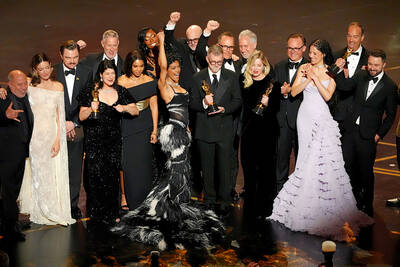
Paul Thomas Anderson’s “One Battle After Another” was crowned best picture at the 98th Academy Awards, handing Hollywood’s top honor to a comic, multi-generational American saga of political resistance. The ceremony Sunday, which also saw Michael B. Jordan win best actor and “Sinners” cinematographer Autumn Durald Arkapaw make Oscar history as the first female director of photography to win the award, was a long-in-coming coronation for Anderson, a San Fernando Valley native who made his first short at age 18 and has been one of America’s most lionized filmmakers for decades. Before Sunday, Anderson had never won an Oscar. But “One Battle
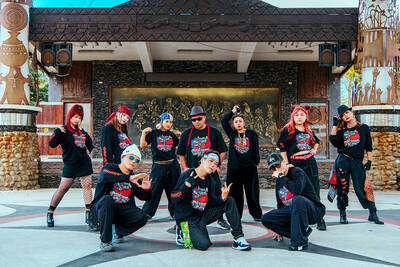
In Kaohsiung’s Indigenous People’s Park (原住民主題公園), the dance group Push Hands is training. All its members are from Taiwan’s indigenous community, but their vibe is closer to that of a modern, urban hip-hop posse. MIXING CULTURES “The name Push Hands comes from the idea of pushing away tradition to expand our culture,” says Ljakuon (洪濬嚴), the 44-year-old founder and main teacher of the dance group. This is what makes Push Hands unique: while retaining their Aboriginal roots, and even reconnecting with them, they are adamant about doing something modern. Ljakuon started the group 20 years ago, initially with the sole intention of doing hip-hop dancing.

You would never believe Yancheng District (鹽埕) used to be a salt field. Today, it is a bustling, artsy, Kowloon-ish “old town” of Kaohsiung — full of neon lights, small shops, scooters and street food. Two hundred years ago, before Japanese occupiers developed a shipping powerhouse around it, Yancheng was a flat triangle where seawater was captured and dried to collect salt. This is what local art galleries are revealing during the first edition of the Yancheng Arts Festival. Shen Yu-rung (沈裕融), the main curator, says: “We chose the connection with salt as a theme. The ocean is still very near, just a


 RSS
RSS