


Coming hot on the heels of the Taichung Jazz Festival, which ended only last weekend, the city will play host to yet another jazz event, this time a one-off, but no less anticipated for the talent sweeping through town.
The concert tomorrow, called Classic Meets Cuban, is a union of the Klazz Brothers from Germany and two outstanding jazz percussionists from Cuba. As a marriage of styles, the Klazz Brothers bring a longstanding reputation for their work in classical music for the Dresden Philharmonic Orchestra, while Alexis Herrera Estevez and Elio Rodriguez Luis add the diversity of styles for which their native Cuba is so well known.
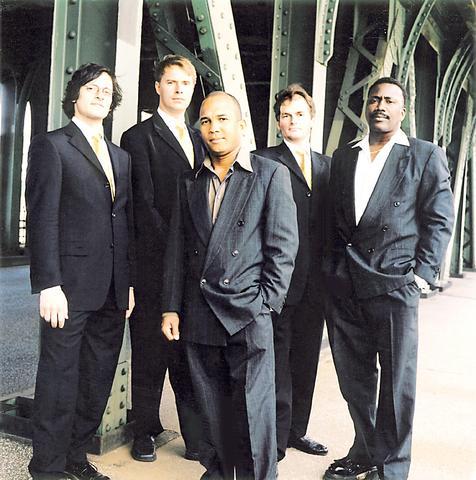
PHOTO COURTESY OF ARTISTS
The ensemble has gained its acclaim since its founding a few years ago for Cuban jazz-inspired reworkings of classical pieces by Mozart, Beethoven, Brahms, Schubert, Bach, Bizet and other masters.
It may sound like a clash of styles, especially when conceptualizing Mozart's Symphony No. 40 in Latin form with the blatantly latinized title Mambozart, but the results are surprisingly pleasant. For one, the Cuban element dominates and brings a level of energy that lovers of the original pieces will be unaccustomed to hearing.
Underpinning each song is the strength of the Klazz Brothers, who are made up of Kilian and Tobias Forster and Tim Hahn. The solid classical formations of these three are evident in the easy manner in which the latin fusions sound improvised -- as if recorded on a Havana sidewalk. It's not just anyone, after all, who can turn Beethoven's Fur Elise into a riling salsa number, or Chopin's Tristesse Etude into a sexually super-charged rumba.
For that kind of originality, the music relies heavily on the Cuban percussion provided by some of the strongest talents from that country. Estevez has been a member of Cuba's premier Latin Jazz group, the Havana Ensemble, since 1997 and has cooperated with Compay Segundo of the Buena Vista Social Club along with other Cuban jazz masters. He is the timbalist in the Classic Meets Cuban lineup. Luis is the band's conga player and, like Estevez, has been a part of the Havana Ensemble since 1997.
All the tinkering with classical masterpieces could make the Klazz Brothers and Cuban Percussion group either hopeless apostates or radical luminaries of musical and cultural interaction. That depends on how sacrosanct one views classical masterpieces to be. But most importantly, the energy of the band is genuine and the joining of styles comes across as complementary instead of grating or specious, as it does in other fusion experiments such as Bond or China's 12 Girls Band.
The band will be swinging their way to Taiwan on a quick leg of an Asian tour for one show that should provide a nice bookend to Taichung's short jazz season.
The Classic Meets Cuban is tomorrow at Taichung Chungshan Hall, 98 Hsuehshih Rd, Taichung (台中市學士路98號). Tickets are NT$300 to NT$2,500, available through Era ticketing outlets or at www.ticket.com.tw.

Taiwan’s overtaking of South Korea in GDP per capita is not a temporary anomaly, but the result of deeper structural problems in the South Korean economy says Chang Young-chul, the former CEO of Korea Asset Management Corp. Chang says that while it reflects Taiwan’s own gains, it also highlights weakening growth momentum in South Korea. As design and foundry capabilities become more important in the AI era, Seoul risks losing competitiveness if it relies too heavily on memory chips. IMF forecasts showing Taiwan widening its lead over South Korea have fueled debate in Seoul over memory chip dependence, industrial policy and
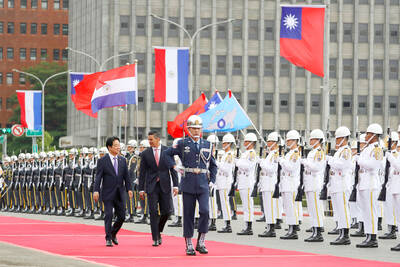
“China wants to unify with Taiwan at the lowest possible cost, and it currently believes that unification will become easier and less costly as time passes,” wrote Amanda Hsiao (蕭嫣然) and Bonnie Glaser in Foreign Affairs (“Why China Waits”) this month, describing how the People’s Republic of China (PRC) is playing the long game in its quest to seize Taiwan. This has been a favorite claim of many writers over the years, easy to argue because it is so trite. Very obviously, if the PRC isn’t attacking Taiwan, it is waiting. But for what? Hsiao and Glaser’s main point is trivial,
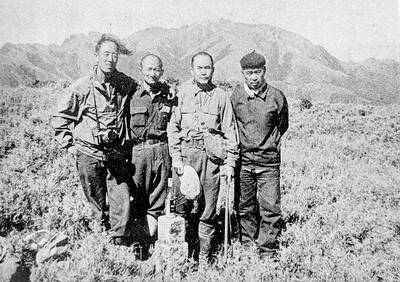
May 18 to May 24 Gathered on Yangtou Mountain (羊頭山) on Dec. 5, 1972, Taiwan’s hiking enthusiasts formally declared the formation of the “100 Peaks Club” (百岳俱樂部) and unveiled the final list of mountains. Famed mountaineer Lin Wen-an (林文安) led this effort for the Chinese Alpine Association (中華山岳協會). Working with other experienced climbers, he chose 100 peaks above 10,000 feet (3,048m) that featured triangulation points and varied in difficulty and character. The list sparked an alpine hiking craze, inspiring many to take up mountaineering and competing to “conquer” the summits. A common misconception is that the 100 Peaks represent Taiwan’s 100 tallest

And so, in the wake of US President Donald Trump’s trip to the People’s Republic of China (PRC), all the experts on the Strait of Hormuz suddenly became experts on US-China-Taiwan relations. The Internet has certainly expanded human knowledge. Lots of these sudden experts made noise this week about Trump’s words after the meeting with PRC dictator Xi Jin-ping (習近平). Trump is going to sell out Taiwan! Longtime Taiwan commentator J. Michael Cole summed the situation up neatly in the Guardian: “We need to keep in mind that he has a tendency to say many things — sometimes contradicting himself within


 RSS
RSS