


Elton John took the stage and belted out The Bitch is Back at Chungshan Stadium on Thursday night. But the first round of applause came afterward at the expense of the press.
"I've been to more than 60 countries and I've never experienced such a rude welcome," he said of the photographers and television crews that descended on him at the airport. "They shouldn't be allowed to disturb people like that."
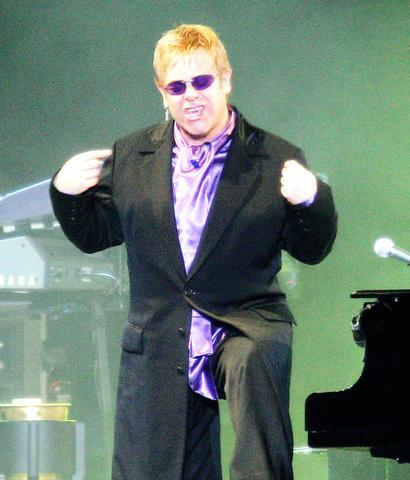
PHOTO: REUTERS
The audience couldn't have agreed more, they cheered and those journalists at the airport John had ealier termed "vile pigs," they presumably snorted.
Then we were all treated to a helluva rock-and-roll show that demonstrated why Elton John has been drawing audiences for longer than many of his fans have been alive.
He took his place behind the piano and ripped into Bennie and the Jets, Levon, Daniel and Philadelphia Freedom, warming up a crowd that sat in a steady drizzle.
Next he worked through a lengthy jam of Rocket Man complete with a Far Eastern Air jetliner flying meters overhead to land at Songshan Airport. It was a magic moment that couldn't have been timed better and it earned John his first standing ovation. He thanked the crowd and all that business at the airport was forgotten.
Elton John's next record, Peachtree Road, will be released in November and he treated the crowd to the album's first single, which is already getting radio airtime in the US and England, Answer in the Sky. He wrote it with long-time collaborator, Bernie Taupin, and it was the first song the audience didn't sing back to him lyric-for-lyric, though it won't take long before that changes.
There's a loyalty among fans of Elton John that seems to transcend the man and his music. His fan club recently completed its second annual charity drive, Lunches Around the World, and collected nearly US$40,000 to give to the Elton John AIDS Foundation.
There's loyalty among his band members, too, whom he introduced partway through the evening. His drummer, Nigel Olsson, played on his first album, Empty Sky. Guitarist Davey Johnstone signed on with Madmad Across the Water in 1971. Keyboardist Guy Babylon and bass player Bob Birch both joined in the early 1990s. And percussionist John Mahon is the new guy, having played on John's 31st album, One Night Only.
After the introductions, there was another two hours of songs starting with Take Me to the Pilot, Sorry Seems to be the Hardest Word, Sacrifice and Candle in the Wind and then Funeral for a Friend and Love Lies Bleeding. If there was anyone still sitting at the keyboard introduction of Funeral for a Friend, they were dancing in the aisles by the end of Love Lies Bleeding and didn't stop dancing through I'm Still Standing, Saturday Night's Alright (for Fighting) and Crocodile Rock.
Elton John ducked backstage to change into a blue track suit while the audience chanted for an encore. They got it in the form of Pinball Wizard and Don't Let the Sun Go Down on Me but wanted more. The rain had stopped -- at least for a short time at least -- and Elton John signed autographs for the folks in the NT$6,000 front-and-center seats while the rest of the house called out for more.
"Thank you, Taiwan," Elton John told the crowd. "Thanks for being such a great audience, for staying through the rain and for being so understanding. I wish you all love, health and happiness. I can't wait to see you next time."
This is Your Song was the penultimate number of the evening and brought tears to the eyes of many in the audience. He said afterward he had one last song that he felt "summed up the evening," Can You Feel the Love Tonight?
A lot of people could. A group of elderly ladies swaying in a group hug in section C, a row of young girls holding hands in the bleachers, even a few photographers were feeling the love.
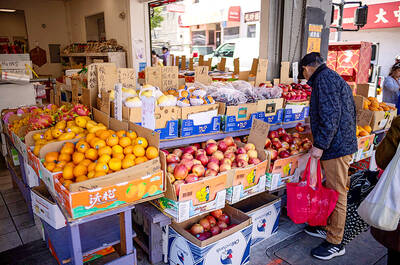
Ajay Verma, a consultant gastroenterologist at Kettering general hospital in Northamptonshire, says our gut is a “complex machine.” “It is constantly providing us with the nutrition we need, initially to grow and develop, and then for us to survive, thrive and repair from injury and illness.” How can we keep it functioning well? Put simply: “Make sure what you put into it is balanced, and that you clear out its waste products adequately,” Verma says. “In a general gastroenterology clinic, the most common conditions we see are irritable bowel syndrome (IBS), gastroesophageal reflux disease, inflammatory bowel disease and constipation,” says Nisha
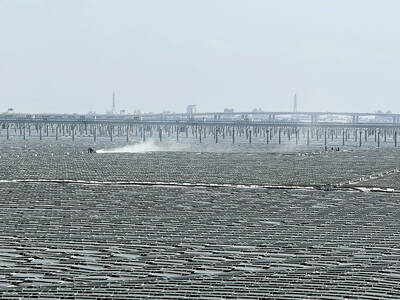
The arithmetic is straightforward and uncomfortable. By the end of 2025, Taiwan had committed itself to a 50-30-20 electricity mix — half natural gas, 30 per cent coal, 20 per cent renewables. The Ministry of Economic Affairs’s (MOEA) own monthly energy reports tell a different story. Natural gas reached 47.8 per cent of generation last year. Coal stood at 35.4 per cent, comfortably above its target ceiling. Renewables came in at 13.1 per cent, well short of the 20 per cent Taipei had pledged a decade earlier. Installed renewable capacity reached roughly half of the 12 gigawatts (GW) the government

Last week US President Donald Trump was asked by a reporter whether he would speak on the phone to the President of Taiwan. “l’ll speak to him. I speak to everybody. We have that situation very well in hand,” Trump said. This marked the second time in a couple of weeks he had said he would talk to the President of Taiwan. In 2016 he famously took a call from then-president Tsai Ing-wen (蔡英文), when he was president-elect. Despite warnings that the apocalypse was nigh because of a phone call, the world quickly forgot about the conversation between two democratically-elected presidents.
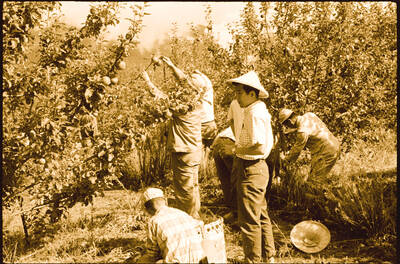
May 25 to May 31 Few believed that apples could be cultivated on a commercial scale in Taiwan’s high mountains. When horticulturalist Cheng Chao-hsiung (程兆熊) first proposed the idea in 1955, both American and Taiwanese colleagues dismissed it as implausible, arguing that temperate fruit could not be reliably grown on a subtropical island, especially on rugged terrain. However, it was this terrain in the Central Mountain Range where many Chinese Civil War veterans were resettled in the late 1950s. With limited job prospects and no family in Taiwan, they were placed on cooperative farms aimed toward self-sufficiency. Some say the conditions


 RSS
RSS