


Literary traditions are subjective things and the various merits of "canonical" writers are something that scholars have spent lifetimes arguing over. Tu Kuo-ching (
The definition of Taiwanese literature is a fraught question, seeing as it invokes linguistic, ethnic and nationalist sentiments, and also rubs up against the overwhelming presence of the literature of China. Tu boldly sweeps aside much of the debate when he states "Taiwanese literature is literature that deals with Taiwan, with this island and its experience."
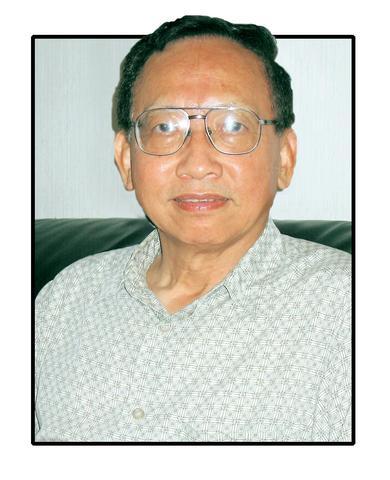
"We simply cannot have a linguistic definition of Taiwanese literature," he said during an interview last week when visiting Taiwan to give a seminar on the various projects that he hopes to initiate as the Lai Ho and Wu Cho-liu Professor of Taiwan Studies. "If we say that Taiwanese literature must be written in Chinese, then we cut out many writers of the [Japanese] occupation."
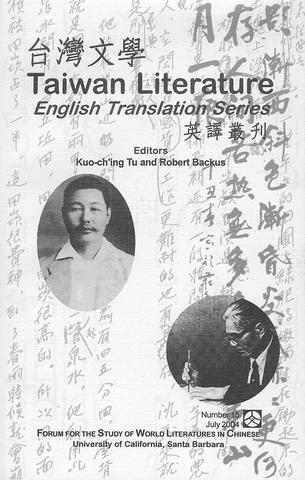
PHOTO: IAN BARTHOLOMEW, TAIPEI TIMES
The question is quite fundamental for Tu, who dates Taiwanese literature from the Japanese occupation period, during which some seminal figures wrote in Japanese. Tu sees Taiwan's experience as unique and separate from that of its giant neighbor China, and therefore worthy of separate study.
"The impact of various foreign influences on Taiwanese literature have made it an important subject for comparative study from an international perspective, and have also warranted its study on a theoretical basis for eventual evaluation within a global vision," was how Tu put it during his inaugural speech on Aug. 30, this year. But it has been a long process to have Taiwan recognized as a separate field of academic study, especially within the international community. Against China's strongly nationalistic definition of what constitutes Chinese literature, Tu promotes a broader idea of Chinese literatures (with an emphasis on the plural), of which Taiwanese literature is a branch.
In 1996, Tu launched the Taiwan Literature English Translation Series published by Forum for the Study of World Literatures in Chinese, a scholarly journal dedicated to introducing Taiwan's literature to a broader academic community. The name of the publisher reflects Tu's desire to distance Chinese literature from a narrowly linguistic definition. "There is no reason why Chinese literature must come out of China," Tu said. "What about Chinese writers in Singapore and other Southeast Asian countries? What about literature in other languages about the Chinese experience?"
So within this broad context, Taiwanese literature can take its place among world literatures written in or by Chinese without any direct reference to the political entity of the People's Republic of China (PRC). "This is an idea that the PRC probably doesn't much like, for the Chinese tend to see such things in terms of monolithic unity -- we are the only one, we are the center -- but Chinese literatures are branches of the main body."
But ultimately, Tu wants to get away from seeing Taiwan literature too tightly linked to the Chinese language in any shape or form. "The ethnicity of the author is not really relevant, and the language he or she writes in can be transcended through translation. What is important is the world of that literature. This is an absolute." Taiwanese literature is about this island and its experience in the world, and rises above the popular debate about Chinese, Hokkien, Hakka and even Aboriginal languages. "It is about this land, its society, its people and its history. It doesn't matter if the author is Taiwanese or not."
As far as his insistence that Taiwan literature should be written in Hokkien, Tu says that this is simply "another chauvinism." Tu takes this further to say "what we call Taiwanese should include Mandarin, Hakka and even Aboriginal languages as well as Hokkien."
For Tu, the final arbitrator of literature is quality, and it really doesn't matter which of the Taiwanese languages are used. "I respect people who are trying to create a Hokkien literature, and if they can produce a book like Dream of the Red Chamber then many people will refer to it as the bible of Hokkien literature. If such a great writer did emerge in Hokkien, he or she could open up a new tradition within Taiwanese literature. But this is easier said than done."
While decrying the parochialism that has caused Taiwan literature to descend into bitter and often meaningless arguments over politically correct usage -- a tangled debate that is best know for the tortuous issue of Romanization of Chinese and Hokkien place names -- Tu insists that the only way out is through taking an international perspective, something he is well-placed to do in his new position. Starting next year, Tu will be launching a series of collected works by various major Taiwanese authors in English translation, including Yeh Shih-tau's (葉石濤) History of Taiwanese Literature (臺灣文學史綱). "This is very important for there is no good introduction to Taiwanese literature in English," Tu said. While some Taiwanese works have been translated into English, there is still an absence of a systematic body of work in translation. Howard Goldblatt, a distinguished translator who has worked on some of Taiwan's most important contemporary writers, has complained that there is a lack of interest in publishing Taiwanese works. Even though Tu's interest is primarily academic, saying that he will leave the study of writers from the 1980s on to others, knowing where Taiwanese literature came from is probably a good idea if we want to speculate about where it might be going. This can be seen clearly in the two writers whose names are attached to the endowed chair. Tu sees Lai Ho (賴和) as "the father of Taiwan's new literature," a pioneer who used literature as a means of resistance and struggle, in a way not dissimilar to the May Fourth New Literature Movement in China by which he was influenced. He insisted on using colloquial Chinese as his medium, equally rejecting the classical forms imposed by tradition and Japanese, imposed by an occupation government. Wu Cho-liu (吳濁流), the author of Asia's Orphan (亞細亞的 孤兒), the acknowledged masterpiece of Taiwanese literature, was born of Hakka parents and started his literary career writing in Japanese. These two authors perfectly showcase the unique and diverse qualities that have formed Taiwan's literature.
As recognition of Taiwan's unique experience grows, the field of Taiwan studies has also expanded in the international community. Important centers of study have such as the Society for Taiwan Studies at Tenri University and the Japan Association for Taiwan Studies in Japan, the Research Unit on Taiwan Culture and Literature at the Ruhr University in Bochum, Germany and others have been established to reflect the interest and importance attached to this new field. This is a great step forward from the situation little more than a decade ago when few would have acknowledged the separateness of what Taiwan represents. Tu's work carries on a process that can only gather momentum.

Taiwan’s English education system is being pulled apart by three opposing forces. Bilingual Nation 2030 pulls students toward English and global communication. Artificial Intelligence (AI) readiness pulls them toward digital judgment, verification and AI-mediated work. But Taiwan’s old exam culture pulls them back toward memorization, grammar drills, timed reading and correct answers. If the education system keeps using old exams to define success, it risks producing graduates who are neither genuinely bilingual nor genuinely AI-ready, but trained for tasks machines can already perform. The first force is Bilingual Nation 2030. Launched in 2018, the policy aimed to “help Taiwan’s workforce connect
It seems every few days one bumps into one of those “real man” comments in which Taiwan is urged to “face reality” or similar, and “make a deal,” with the speaker implying that soon it will be too late. “Deal” advocates always present themselves as having a superior grip on reality, and the manly ability to make the “hard choice.” Their testosterone-laden language often echoes that of Taiwan sellout advocates. Note that such commentary always specifies a process (“make a deal, work with, make progress”), never the end state of what occupation by a violent authoritarian colonialist state will entail. In
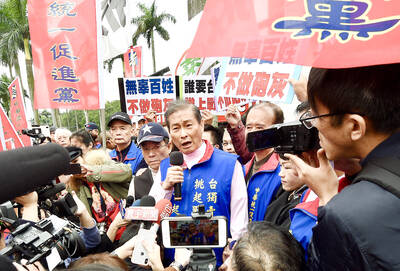
There are shadowy cabals plotting to sell out Taiwan to be annexed by China, by invasion if necessary. Fortunately, they are buffoons. In 2019, former Bamboo Union gangster and founder of the China Unification Promotion Party (CUPP), Chang An-le (張安樂, colorfully known as “White Wolf”), led a protest at the Legislative Yuan against comments made by then-premier Su Tseng-chang (蘇貞昌) that in the event of an attack by China, he would never surrender, but would protect the nation by fighting to the end, even if he only had a broom. Chang had party members bring a wooden casket that they
June 1 to June 7 "If all Taiwanese were as afraid of dying as you, then what would happen?” Physician Shih Chiang-nan (施江南) reportedly said this to his wife Chen Chiao-tung (陳焦桐) after she urged him to stop intervening on behalf of Taiwanese soldiers stranded overseas after serving in the Japanese Army during World War II. Shih had clashed with high-ranking officials over the issue, engaged in several heated arguments with Taiwan governor-general Chen Yi (陳儀) and allegedly shouted at general Ko Yuan-fen (柯遠芬), chief of staff of the Taiwan Garrison Command, over


 RSS
RSS