


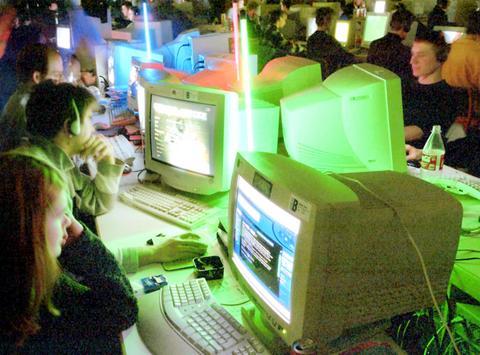
Computer, headphones, pizza, soda, and a functional network cable: these are the ingredients for a successful LAN party. Less important is the stamina to go for three days at a stretch in front of the computer.
"Few of us are that foolish, fortunately," says Guido Seifert, himself a gamer and the operator of a Web site dedicated to the subject of LAN parties.
PHOTOS: DPA
These kinds of parties take place on almost every weekend in computer-savvy cities around the world. They primarily involve young men hooking up their computers into local area networks (LAN) in order to challenge each other at computer games.
"One thing is certain: If the network goes down, there are revolts in the auditorium," says Hans-Juergen Werner, of chip manufacturer Intel. The firm supports individual "clans" -- as clubs run by gamers are called.
"There are the Friday Night Games where people can go up against one another," explains Werner. These aren't just focused on the games themselves, but also on the "cool locations" that are chosen to draw lots of spectators. "It's comparable to soccer: you go there, are familiar with the rules, and can discuss what's happened."
So-called first-person shooter games like Counterstrike are the most popular titles at the parties. In the end, though, the players play whatever they are in the mood to try out and whatever they have enough CD copies of.
Warcraft, Battlefield, Quake, Need for Speed, Command and Conquer, Age of Empires and Starcraft are just a few of the other favorites. "We really play any games that have a multi-player mode, from strategy to racing and sports games," Seifert says.
Competitors sometimes come from places far away just to be part of a LAN party. A computer of one's own is a must.
"You can't get around having your own machine. You're only at home on your own computer," Seifert claims.
This just isn't a question of what's under the hood, but also how the computer looks. "There are real modeling competitions to see who can make the prettiest machine," says Nico Weustenberg, who sets up LAN parties in his home town of Schwerin, Germany. "This branch can be compared with show tuning for automobiles," Seifert reports.
There are several points the LAN players must keep in mind when checking the power on their PC. "Complex games need the latest technology: Pentium 4, 3.0 Gigahertz processors are required for the new games," says Julia Christophers, dubbed Miss LAN 2004 in her LAN party circle.
Weustenberg rallies for "a lot of fresh air for the computers." The casings must be well ventilated if the PCs are put to extended use. The CPU power and graphics cards must also be adapted to the requirements of a given game.
"Every gamer has his own preferences in terms of mouse, mouse pad, and monitors," says Intel's Werner. Some participants refuse to play with TFT monitors, for example. They claim that these are too slow in drawing the images.
And since every player knows how to get a LAN party up and running, it generally takes only a few hours from unpacking the machines to the start of play.
Networks are pre-configured. "Everything is plugged in and set up, and the party is pretty much up and running," says Wuestenberg, who runs an Internet cafe. Most of the advanced work is handled by the event operators.
Yet LAN parties still need a bit more than just a computer and the phone number of the nearest pizza parlor that delivers.
Julia Christophers runs down the list of needs: "A computer, monitor, power cord, network cable, food, drink, padding, sleeping bag, grill, darts."
LAN parties involve more than just sitting around a computer. They also involve building friendships, many of which are created over the Internet.

Yesterday, the Democratic Progressive Party (DPP) nominated legislator Puma Shen (沈伯洋) as their Taipei mayoral candidate, the Chinese Nationalist Party (KMT) put their stamp of approval on Wei Ping-cheng (魏平政) as their candidate for Changhua County commissioner and former legislator Tsai Pi-ru (蔡壁如) of the Taiwan People’s Party (TPP) has begun the process to also run in Changhua, though she has not yet been formally nominated. All three news items are bizarre. The DPP has struggled with settling on a Taipei nominee. The only candidate who declared interest was Enoch Wu (吳怡農), but the party seemed determined to nominate anyone

In a sudden move last week, opposition lawmakers of the Chinese Nationalist Party (KMT) and Taiwan People’s Party (TPP) passed a NT$780 billion special defense budget as a preemptive measure to stop either Chinese leader Xi Jinping (習近平) or US President Donald Trump from blocking US arms sales to Taiwan at their summit in Beijing, said KMT heavyweight Jaw Shaw-kong (趙少康), speaking to the Taipei Foreign Correspondents Club on Wednesday night in Taipei. The 76-year-old Jaw, a political talk show host who ran as the KMT’s vice presidential candidate in 2024, says that he personally brokered the deal to resolve

What government project has expropriated the most land in Taiwan? According to local media reports, it is the Taoyuan Aerotropolis, eating 2,500 hectares of land in its first phase, with more to come. Forty thousand people are expected to be displaced by the project. Naturally that enormous land grab is generating powerful pushback. Last week Chen Chien-ho (陳健和), a local resident of Jhuwei Borough (竹圍) in Taoyuan City’s Dayuan District (大園) filed a petition for constitutional review of the project after losing his case at the Taipei Administrative Court. The Administrative Court found in favor of nine other local landowners, but

The Chinese Nationalist Party (KMT) and its sock puppet, the Taiwan People’s Party (TPP), passed their version of the government’s proposed supplementary defense spending bill last week, engendering much commentary. While all eyes were on the defense budget, the PRC’s assault on Taiwan was advancing on other fronts. The removal of domestic drone production and other technologies critical to the nation’s asymmetrical defenses from the list of items purchased in the “compromise” bill shows how the KMT-TPP alliance appears to be serving the People’s Republic of China (PRC). Ironically, the cuts will impact industries heavily represented by tech firms in areas run


 RSS
RSS