


Everyone loves Will Smith. Even the cynical show business journalists who (secretly) wish him to fail, to see him somehow trip up, succumb to temptation, develop a drink problem or a drug habit. Anything. Anything but the relentless success and supercharged charisma that has the whole world eating out of his hand.
It was on display again last week. Hosting a London press conference before the opening of his latest blockbuster, I, Robot, Smith looked briefly annoyed with the lackluster applause offered by assembled British hacks. "Come on, people," he cried. Soon he had the press pack acting like any other crowd of celebrity-stunned well-wishers, clapping and happily whistling at their hero. You see, everyone does love Will Smith.
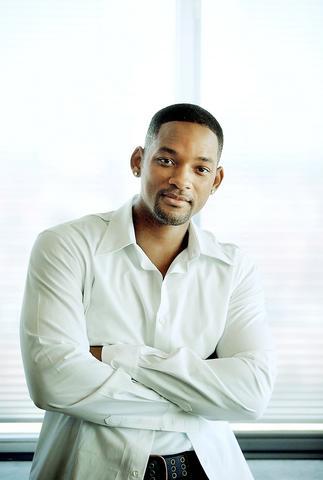
PHOTO: AP
Smith is uniquely powerful among the current crop of Hollywood stars. He is incredibly bankable. His brand of big budget action films gross hundreds of millions of dollars. Even when they are bad. Smith has become, at the age of just 35, an American institution. In the US the July 4 holiday is now dubbed "Big Willie Weekend" for the annual Smith movie that will have crowds flocking to the multiplex. He is America's favorite film star.
But Smith is also black. It seems an obvious point, but its importance cannot be underestimated. The lines of ethnicity and skin color are still sharply drawn across America and that is reflected in the mirror of Hollywood. Black actors often get paid less than white counterparts. Their roles are more narrowly defined. They are often black first, actors second.
But for Smith, none of that matters. His success is color-blind and for the privilege he is paid US$20 million a movie. Audiences love him in equal measure, whether they are men or women, black or white.
In I, Robot, his love interest is a white actress. Even now pairing a black man and a white woman is rare in Hollywood. But for Smith it hardly rated a mention. Smart, rich, polite and endlessly charming, Smith is the black man that white America wishes its daughter brought home to meet the family. He is the ultimate in cross-over appeal. The one man in America for whom race does not matter.
Willard Christopher Smith Jr was born in 1968 in West Philadelphia to a middle-class home in a nice neighborhood. It was a time of race riots in America. It was the year of the Poor People's March on Washington and Martin Luther King was killed. But for anyone looking for a rags to riches story, or a rise from the ghetto, then Smith is going to disappoint.
The Smiths were not a rich family. They were comfortable. Willard Smith Sr was a former air force pilot who now had his own refrigerator business. His mother, Caroline, worked for the Philadelphia school board. It was a strict household (his father's stint in the military meant his four children faced a disciplined home regime).
It was also a racially mixed neighborhood. As Smith later said: "I grew up in a Baptist household, went to a Catholic school, lived in a predominately Jewish neighborhood and hung with the Muslim kids."
Smith went to good local schools (one mostly white and then one all black) and his parents drummed the value of education into him. It almost worked. On graduation Smith earned the offer of a place at the prestigious Massachusetts Institute of Technology. He turned it down to pursue what had by then become a promising music career (his geeky past survives, however, in an abiding love of chess and mathematics).
There is no doubt his childhood left a strong legacy. Smith does not swear and is a stickler for grammar and proper pronunciation. Friends call him Captain Correction.
He tells the story that if he ever used black slang such as "Where y'all going to be at?" his mother would tell him: "We're going to be behind that preposition."
By all accounts, Smith is raising his three children the same way. In 1997, when California moved to teach children a black dialect dubbed "ebonics" he took the trouble to protest by writing to the schools affected.
But it was not Smith's parents who turned him to entertainment. That was his grandmother. She was a devout Christian and he played the piano and read from the Bible at her church. It was the look of pride in his grandmother's eyes that drove him to the public stage.
He probably would have ended up there anyway. Smith's ability to charm his way out of any given situation had already seen one high school teacher nickname him The Fresh Prince. That became his rap persona when, aged 15, he hooked up with childhood friend Jeffrey Townes. As DJ Jazzy Jeff and The Fresh Prince the pair took the rap world by storm.
Smith says rap music is still his first love and he is still releasing music. But it was for acting that America was to truly fall for Smith. First came the television sitcom The Fresh Prince of Bel-Air, that became the most successful black comedy since the Cosby Show.
Smith's success on television ensured his first big acting role was not far away. It was perhaps the only serious artistic risk he has ever taken. It was also probably his best role. As a young gay conman in Six Degrees of Separation Smith excelled, showing a broad range of acting skills.
His next role was as a wise-cracking cop in Bad Boys. For movie audiences and critics alike, it was as if Smith emerged onto cinema screens fully formed. It was all there. A blockbuster hit. Smith's wisecracks and wit. Explosions and guns. That was 1995. The next nine years were a roll call of summer smashes. From Independence Day (which was the first "Big Willie Weekend" on July 4, 1996) to 2004, hardly a summer has gone by without a huge Smith movie. From Wild Wild West through to I, Robot via Men In Black (one and two), Smith has been dominant. On the way he has cinematically saved the world five times. And each summer Smith transcended his race.
After Bad Boys (which was a black buddy movie which white audiences adored), his blockbuster roles were not defined by being black. His part in Men in Black was originally slated for Chris O'Donnell, a white actor. He even turned down the role of Neo in The Matrix, which then went to the very white Keanu Reeves.
But things are changing now. Smith is getting older. He is rich beyond most people's dreams and his second marriage, to actress Jada Pinkett Smith, has produced two children and is known in Hollywood only for being blissful. In short, Smith has the chance to extend his range.
I, Robot offers a glimpse of that Smithian future. It is no doubt a blockbuster. It fulfills a modern audience's expectations of big bangs for their bucks. But it is also a clever film. It has things to say on morality and the nature of consciousness. "I, Robot is almost like a small art film wrapped up as a big summer movie," Smith has said.
But it is a small beginning. It is noticeable that in Smith's many huge films, it is hard to remember any of his characters' names. He is not Agent J, or James West or Detective Del Spooner. He is always just Will Smith and audiences love him for it.
Doubtless that means there are more "Big Willie Weekends" ahead. However, Smith probably knows his greatest achievement is still to come. It will be when he is known not for being his likeable self, or for being a black triumph in a white world, but when he is known simply for the part he plays. Smith for Hamlet one day?
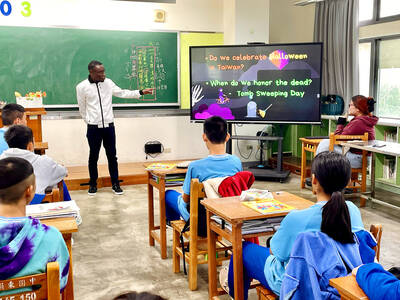
For many people, Bilingual Nation 2030 begins and ends in the classroom. Since the policy was launched in 2018, the debate has centered on students, teachers and the pressure placed on schools. Yet the policy was never solely about English education. The government’s official plan also calls for bilingualization in Taiwan’s government services, laws and regulations, and living environment. The goal is to make Taiwan more inclusive and accessible to international enterprises and talent and better prepared for global economic and trade conditions. After eight years, that grand vision is due for a pulse check. RULES THAT CAN BE READ For Harper Chen (陳虹宇), an adviser
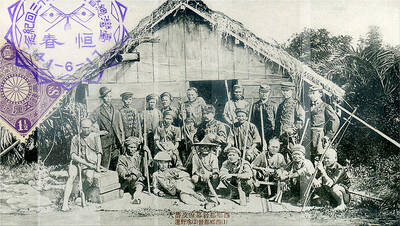
Traditionally, indigenous people in Taiwan’s mountains practice swidden cultivation, or “slash and burn” agriculture, a practice common in human history. According to a 2016 research article in the International Journal of Environmental Sustainability, among the Atayal people, this began with a search for suitable forested slopeland. The trees are burnt for fertilizer and the land cleared of stones. The stones and wood are then piled up to make fences, while both dead and standing trees are retained on the plot. The fences are used to grow climbing crops like squash and beans. The plot itself supports farming for three years.

The breakwater stretches out to sea from the sprawling Kaohsiung port in southern Taiwan. Normally, it’s crowded with massive tankers ferrying liquefied natural gas from Qatar to be stored in the bulbous white tanks that dot the shoreline. These are not normal times, though, and not a single shipment from Qatar has docked at the Yongan terminal since early March after the Strait of Hormuz was shuttered. The suspension has provided a realistic preview of a potential Chinese blockade, a move that would throttle an economy anchored by the world’s most advanced and power-hungry semiconductor industry. It is a stark reminder of

May 4 to May 10 It was once said that if you hadn’t performed at the Sapphire Grand Cabaret (藍寶石大歌廳), you couldn’t truly be considered a star. Taking the stage at the legendary Kaohsiung club was more than just a concert. Performers were expected to entertain in every sense, wearing outlandish or revealing costumes and staying quick on their feet as sharp-tongued, over-the-top hosts asked questions and delivered jokes that would be seen as vulgar, even offensive, by today’s standards. Opening in May 1967 during a period of strict political and social control, Sapphire offered a rare outlet for audiences in


 RSS
RSS