


Leather, pebbles, fish ... not quite what comes to mind when you think of mobile phones.
Japan's operators, however, believe they can ring up quite a few more customers by using those ideas to tap into the country's keen sense of fashion and offer phones that look -- and feel -- cool.
KDDI Corp's candy bar-shaped mobile phone with a keypad reminiscent of shiny bathroom tiles could be a supermodel's accessory item in a fashion show.
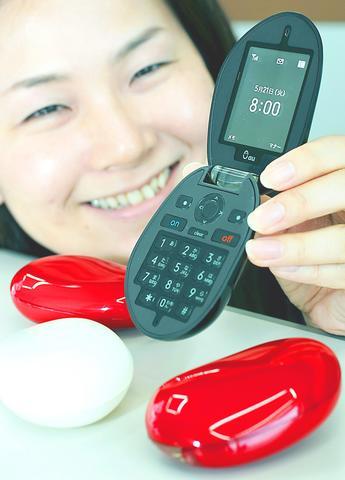
PHOTO: REUTERS
A phone with a changeable leather exterior by Vodafone Holdings KK looks like a chic compact wallet while NTT DoCoMo Inc's tiny aluminum phone would look completely at home in the palm of James Bond's hand.
After years of relying on the latest high-tech features to lure consumers into replacing their old phones, Japanese mobile operators are going back to the basics and looking at design.
"Phones generally look very similar in Japan," said Yoshihiro Uramoto, manager in Vodafone's product management department.
"They fold in half like a clamshell and are generic in design. That captures the mass market, but that's no longer enough ... my perception is that consumers are unhappy with existing phone designs."
Japanese operators and manufacturers are only now latching onto a strategy that has always been a key element for European and US makers.
Nokia, the world's largest mobile handset maker, launched its lightweight 8210 phone in 1999 at a fashion show in Paris. Motorola Inc provided one of its latest phones to acting and directing nominees at this year's Academy Awards.
"Overseas markets have always had more variety because that's what they used to differentiate themselves," said Nahoko Mitsuyama, a Tokyo-based telecoms analyst with Gartner Japan.
Not so in Japan where now essential features such as integrated cameras and high-quality screens large enough to easily surf the mobile Internet have turned phones into dull, metallic or plastic clones of each other.
A dearth of new compelling features and services have also kept consumers away from stores. The latest industry data showed April mobile phone shipments dropped nearly 20 percent from a year ago.
Kazuyo Katsuma, a telecoms analyst with JP Morgan, says operators are turning to design as a way to differentiate themselves, especially as services and features become increasingly alike.
One design hit can have a lasting positive impact, as KDDI's main mobile phone unit "au" discovered late last year.
Instead of giving handset makers the customary discretion, the number two mobile operator took design into its own hands, creating a special project team that hired internationally renowned industrial designers like Japan's Naoto Fukasawa and Australia's Marc Newson.
The first of these phones was a slim candy bar-shaped phone with shiny red, white, and blue tile-like keypads that evoked the image of a colorful carp. It was initially priced at ?16,800 (US$154), cheaper than the company's most advanced models.
The phone, known as the INFOBAR, strengthened au's brand image almost overnight as proud owners showed off their phones by hanging them on a strap around their necks. Au itself became identified as a cutting-edge company with stylish phones.
"Modern Japan has been known for its high-tech gadgets, but we should combine high-tech with a high fashion sense," said Satoshi Sunahara, assistant manager in au's marketing strategy department.
"We wanted to create a product that customers were excited to hold."
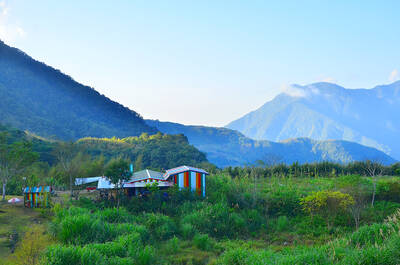
If one asks Taiwanese why house prices are so high or why the nation is so built up or why certain policies cannot be carried out, one common answer is that “Taiwan is too small.” This is actually true, though not in the way people think. The National Property Administration (NPA), responsible for tracking and managing the government’s real estate assets, maintains statistics on how much land the government owns. As of the end of last year, land for official use constituted 293,655 hectares, for public use 1,732,513 hectares, for non-public use 216,972 hectares and for state enterprises 34 hectares, yielding
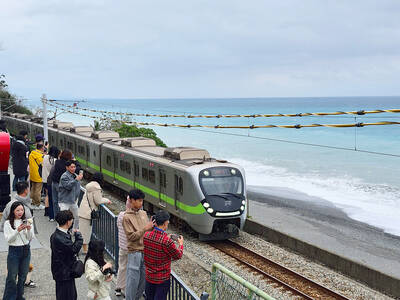
The small platform at Duoliang Train Station in Taitung County’s Taimali Township (太麻里) served villagers from 1992 to 2006, but was eventually shut down due to lack of use. Just 10 years later, the abandoned train station had become widely known as the most beautiful station in Taiwan, and visitors were so frequent that the village had to start restricting traffic. Nowadays, Duoliang Village (多良) is known as a bit of a tourist trap, with a mandatory, albeit modest, admission fee of NT$10 giving access to a crowded lane of vendors with a mediocre view of the ocean and the trains

One of the challenges with the sheer availability of food in today’s world is that lots of us end up spending many of our waking hours eating. Whether it’s full meals, snacks or desserts, scientists have found that it’s not uncommon for us to be mindlessly grazing at some point during all of our 16 or so waking hours. The problem? As soon as this food hits the bloodstream in the form of glucose, it initiates the release of the hormone insulin. This in turn activates a switch present in every one of our cells, which is responsible for driving cell

What do cocky gods, ghosts, hell contracts, temple charms and bubble tea have to do with young adulthood in Taiwan? Quite a lot, if Netflix’s Agent from Above (乩身) is any guide. Released on April 2, the Taiwanese supernatural drama rose to No. 1 on Netflix in Taiwan and Hong Kong within 48 hours and climbed to No. 6 on the platform’s global non-English TV ranking. At its center is Han Jie, a young man locked into service as the spirit medium, or jishen, of the deity San Taizi (三太子) after a tragic mistake. He must fight, repay and atone in a


 RSS
RSS