


Semyon Tokmakov stretches out his hand and points to a thick scar he got from assaulting a black US Marine six years ago. The attack cost him one-and-a-half years in jail, but Tokmakov says he has no regrets.
``We are waging a racial holy war,'' said Tokmakov, 28, an informal leader among Moscow's skinheads, whose violence appears to be rising.
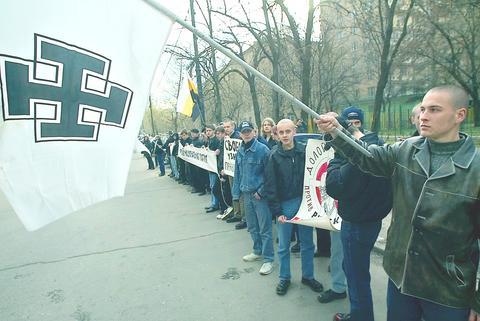
PHOTO: AP
Over the last several years, Russia has become a strikingly hostile place for all those with African, Asian or so-called Caucasian features -- the dark skin and dark hair typical for the peoples of the mountainous Caucasus region.
The US Marine was badly beaten in 1998 in a Moscow market, one of several foreigners targeted in recent years. The last few months have seen an especially shocking series of brutal racial attacks, such as the stabbing of a Guinea-Bissau student in the central Russian city of Voronezh, the killing of an Afghan asylum seeker in Moscow, and the slaying of a nine-year-old Tajik girl in St. Petersburg by suspected skinheads.
Ethnic minorities in Moscow complain that beatings and insults are almost a daily occurrence.
``Racially motivated crimes are growing in number and brutality by the year,'' Alexander Brod, head of the Moscow Bureau for Human Rights, said in an interview.
According to a two-year study conducted by Brod's bureau and a few other groups, there are about 50,000 skinheads in Russia, with the two biggest cities, Moscow and St. Petersburg, home to about 1,500 each. It said 20 to 30 people have died in such attacks annually in the past few years, and the number of such crimes is growing by 30 percent per year.
``When you kill cockroaches, you don't feel sorry for them, do you?'' Tokmakov said, when asked whether he felt sorry for the slain Tajik girl.
The growing extremist sentiments are rooted in Russia's economic problems, including high unemployment in many regions, and the collapse of the Soviet Union, which sent hundreds of thousands of migrants from poorer former Soviet republics to Russia seeking jobs.
``Why have they all come here?'' Tokmakov said. ``They bring nothing but drugs and AIDS. Every day they harass and steal our women.''
Ethnic tensions are also fueled by Russia's nearly decade-long military conflict in the mostly Muslim province of Chechnya. Since shortly before the start of the second war in 1999, Moscow and several southern Russian cities have been shaken by a series of deadly blasts and suicide bombings authorities blame on Chechen rebels, which have further intensified xenophobic
sentiments.
Political parties and politicians openly played the nationalist card in the December parliamentary vote, calling for the ouster of migrant workers and promoting Russia for Russians. Two such parties enjoyed victory in the election.
Tokmakov said he and his associates had been on the ballot of one of these parties, the Homeland bloc, but their names were later crossed out. Party officials have denied that.
``When there are such economic and other hardships, there are usually two ways of dealing with it -- the first is that of contemplating, the second is looking for an enemy and blaming him for your problems. Unfortunately Russia has chosen the second path,'' Brod said.
Rafael Arkelov, a 47-old Armenian singer who has spent all his life living in Moscow and for whom Russian is his first language, has experienced it all.
He was in a grocery store buying a chocolate bar and a bottle of champagne to visit his friends for a New Year's celebration when a man asked him for some change. After Arkelov refused to give him money, he saw the man approach two youths with shaved heads whom he identified as skinheads standing nearby and whispered something. Several minutes later, after Arkelov walked out of the store, he was jumped from behind.
``They punched me on my eyes, my face, and all of a sudden I couldn't see anymore. Then I collapsed to the ground and they started beating me with their feet,'' Arkelov recalled. ``If it weren't for a woman across the street who screamed 'What are you doing?' If it weren't for this scream of hers, I think they would have beaten me to death.''
Brod's study predicted that the number of skinheads could grow to 80,000 to 100,000 within the next two years if authorities don't take measures to combat xenophobia. Interior Ministry officials have said they were closely watching 10,000 suspected members of extremist groups, but all too often racially motivated attacks are dismissed as hooliganism.
``Racism isn't unique to Russia, I know it exists in Europe and America,'' Arkelov said. ``But unlike Russia, in those countries it is prosecuted and the state pursues specific policies to combat it.''

Taiwan’s overtaking of South Korea in GDP per capita is not a temporary anomaly, but the result of deeper structural problems in the South Korean economy says Chang Young-chul, the former CEO of Korea Asset Management Corp. Chang says that while it reflects Taiwan’s own gains, it also highlights weakening growth momentum in South Korea. As design and foundry capabilities become more important in the AI era, Seoul risks losing competitiveness if it relies too heavily on memory chips. IMF forecasts showing Taiwan widening its lead over South Korea have fueled debate in Seoul over memory chip dependence, industrial policy and

And so, in the wake of US President Donald Trump’s trip to the People’s Republic of China (PRC), all the experts on the Strait of Hormuz suddenly became experts on US-China-Taiwan relations. The Internet has certainly expanded human knowledge. Lots of these sudden experts made noise this week about Trump’s words after the meeting with PRC dictator Xi Jin-ping (習近平). Trump is going to sell out Taiwan! Longtime Taiwan commentator J. Michael Cole summed the situation up neatly in the Guardian: “We need to keep in mind that he has a tendency to say many things — sometimes contradicting himself within

It took 12 years and months of standing in the same mountain location for director Liang Chieh-te (梁皆得) to capture a few seconds of footage: Taiwan’s largest resident raptor locking talons with its mate and spinning through the air in a courtship ritual. With only about 1,000 left in the wild and very short flight windows, the mountain hawk-eagle remains among Taiwan’s most elusive birds. The species generally produces only one offspring per year. Using forest cameras, the film crew and research teams document the arduous process the monogamous pairs go through for the chick to hatch and grow up, weathering

There is considerable frustration and confusion among many, both in Taiwan and abroad — including in Washington — as to why the Chinese Nationalist Party (KMT) seems so dead set on using their legislative leverage to slash defense spending and disrupt the ability of the ruling Democratic Progressive Party (DPP) administration to function. Are they pawns of the Chinese Communist Party (CCP)? Are they traitors? In reality, there are multiple reasons. In the first column in this series on this subject, “Donovan’s Deep Dives: How and why the TPP and KMT help Beijing” (Sat May 16, page 12), we examined three


 RSS
RSS