


Her prom was fast approaching, and Alexandra Ruddy, a senior at Harvard-Westlake High School in Los Angeles, was in a quandary about what to wear. She wavered briefly between two dresses, one a sexy, low-cut number, the other more demure, an ivory gown with a boat-shaped neckline and sweet cap sleeves. "I chose that one," Ruddy said. "It was more classy, I thought."
As she spoke on the phone, a hoot of laughter erupted in the background. "That's my mom," Ruddy offered. "She is saying that `classy' is a new word for a 17-year-old girl to use."
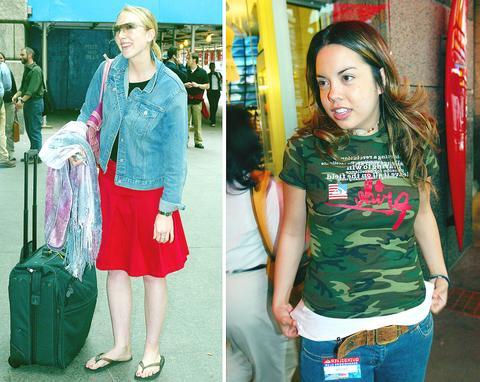
Maybe, but in recent months that is just the term that has been entering the vocabulary of American teenagers and college-aged women to describe a shift in how they dress -- exposing less skin; ditching the micro-minis, cropped tops and thong-baring jeans of previous summers. In the streets and in stores like the Limited and Quicksilver, these items are being replaced by demure knee-length skirts, high-waisted jeans, layered T-shirts and flat shoes, paraded as a badge of hip.
PHOTOS : N Y TIMES
The shift from strident sexuality to a more decorous look is also reflected in young women's choice of role models. Some who a year ago looked up to sultry stars like Jennifer Lopez and Christina Aguilera have transferred their allegiance to sweet-faced new personalities including Mischa Barton, who wears pert headbands and flat shoes on the the television hit The O.C.; Fantasia Barrino, the American Idol winner, who favors conservative trouser suits and sundresses; and the 17-year-old twins Mary-Kate and Ashley Olsen, who like virginal calf-length dresses and buttoned-up jackets.
Teenagers' devotion to these celebrities sends a signal that "they want to be feminine and ladylike more than they want to be trashy and sexy," said Jane Rinzler Buckingham, the president of Youth Intelligence, a New York consulting company that sends reports to clients like Levi's and L'Oreal based on surveys of teenagers interviewed in the street and random telephone interviews.
Her latest report, to be mailed in August, indicates that "we are finding that there are signs of more covering up" by teenage girls, Buckingham said. "Right now for many of them," she added, "sexy feels too vulnerable, too over-the-top, too cheesy."

PHOTOS: NY TIMES
Tina Wells, a partner in Blue Fusion, another youth-trend consulting company, cites teenagers' current taste for knee-length skirts and dainty camisoles worn under jean jackets and seersucker blazers as evidence of a shift in the wind. Of 200 young women aged 14 to 18 polled by Blue Fusion last month, many said they had relegated risque clothes to the back of their closets in favor of more modest looks.
In the minds of many trend spotters, a backlash seems to have set in against episodes like the Janet Jackson breast-baring at the Super Bowl and the Paris Hilton sex tape. "Girls find them gross," Wells said. "In a lot of ways, they feel that these things are being pushed down their throats, and there are some things that they would just rather not know."
Retailers are showing signs of responding. Express, the mass-market chain, has begun to cater to career-minded young men and women. "We've changed a lot of our merchandising and buying so it's not about little skimpy tops anymore," said Pam Seidman, a spokeswoman for the company. At Express, high-waisted jeans and blazers, and T-shirts meant to be layered, covering the midriff, are outperforming last year's more abbreviated styles, Seidman said, adding, "I think there is a certain femininity our customers crave. If they don't find it with us, they will move on."
Teenage girls are just as likely to take their style cues from magazines like Seventeen and Teen Vogue, which are promoting a more discreet look.
Robyn Duda, 22, an event coordinator in New York, said her contemporaries had become more conservative. "But some of this is just fashion," she said. "Whatever is in the magazines, that's what we're going to wear. If the magazines are showing skin, we're wearing skin. If it's a jeans jacket with the collar up, that what we're wearing."
A concern with propriety suggests an effort by many of her peers to distance themselves from their younger siblings and "tween" classmates, for whom Malibu Barbie remains the last word in chic. "When you're seeing a 10-year-old with a belly ring, it's just not that cool anymore," Buckingham said.
In a post-Janet Jackson world, it seems, fewer women would wittingly risk the kind of scorn heaped on Alexandra Kerry, the daughter of John Kerry, when she wore a sheer top to a screening at Cannes last month. "It could be that girls are trying to distance themselves from those bad media images," said Lyn Mikel Brown, an associate professor of women's gender and sexuality studies at Colby College in Maine.
Consider Melanie Lopez. On a class trip to Manhattan last week with her senior class from Carthage High School in upstate New York, Lopez, 18, wore a chiffon blouse that veiled her camisole and waistline. "We're getting a message, even in the media, that celebrities are being looked down upon for the way they dress," she said, "so a lot of us don't want to look like them. We're creating a style that's more unique."
Some, like Edwina Faulk, who strolled in Times Square last Friday afternoon dressed in a crisp fitted blouse that grazed the top of her hip, are using fashion to register their discomfort with the status quo. "Last year, a lot of women were wearing a lot of skimpy things because they have the body, they're gonna wear it," said Faulk, who is 20. "But I don't like showing my body in something that's provocative."
Kristina Valencia, 19, a sales associate at the Quicksilver store on Times Square, has likewise shied away from an overtly sexy look. "A year ago, my shirt might actually have been up to here," Valencia said, cupping one hand just below her bosom. But instead she wore an elongated camouflage shirt that covered her midriff, the uniform of the store's sales staff. She had pulled it on over an even longer white T-shirt that veiled her belly. "I'm just more secure covered up," she said. Quicksilver, she added, has stocked its store this summer with longer T-shirts that cover the midsection. And en route to the Times Square store are jeans with a higher waistline, Valencia said.
Ruddy, the Harvard Westlake senior, would certainly qualify as one of the chain's target customers. She said she has abandoned her skin-baring tank tops, relics of the days when she revered Britney Spears. "That look called for a lot more pulling down at your shirt and tugging at your pants." she said. "All that makes you really uncomfortable."
Comfort and age-appropriate style increasingly take precedence over sexiness for many young women. Some experts expect the trend to gather momentum, based on teenagers' age-old susceptibility to peer pressure. Last month Wells, the trend consultant, attended a prom at Winslow Township high school in Atco, New Jersey. as part of her research. "All the girls were parading around in their outfits," she recalled. "It was so interesting watching the popular girls stick up their noses at the girls who were showing too much skin." One girl whose dress was slashed at the sides to expose a tattoo on her hipbone stopped the in-crowd in its tracks, Wells said. "Two years ago the other girls would have told themselves she's being cool, like Britney Spears." Now, she added in a mock teenage drone, "It's like, `Oh, my God, who would wear that?'"

And so, in the wake of US President Donald Trump’s trip to the People’s Republic of China (PRC), all the experts on the Strait of Hormuz suddenly became experts on US-China-Taiwan relations. The Internet has certainly expanded human knowledge. Lots of these sudden experts made noise this week about Trump’s words after the meeting with PRC dictator Xi Jin-ping (習近平). Trump is going to sell out Taiwan! Longtime Taiwan commentator J. Michael Cole summed the situation up neatly in the Guardian: “We need to keep in mind that he has a tendency to say many things — sometimes contradicting himself within

There is considerable frustration and confusion among many, both in Taiwan and abroad — including in Washington — as to why the Chinese Nationalist Party (KMT) seems so dead set on using their legislative leverage to slash defense spending and disrupt the ability of the ruling Democratic Progressive Party (DPP) administration to function. Are they pawns of the Chinese Communist Party (CCP)? Are they traitors? In reality, there are multiple reasons. In the first column in this series on this subject, “Donovan’s Deep Dives: How and why the TPP and KMT help Beijing” (Sat May 16, page 12), we examined three

It took 12 years and months of standing in the same mountain location for director Liang Chieh-te (梁皆得) to capture a few seconds of footage: Taiwan’s largest resident raptor locking talons with its mate and spinning through the air in a courtship ritual. With only about 1,000 left in the wild and very short flight windows, the mountain hawk-eagle remains among Taiwan’s most elusive birds. The species generally produces only one offspring per year. Using forest cameras, the film crew and research teams document the arduous process the monogamous pairs go through for the chick to hatch and grow up, weathering

May 25 to May 31 Few believed that apples could be cultivated on a commercial scale in Taiwan’s high mountains. When horticulturalist Cheng Chao-hsiung (程兆熊) first proposed the idea in 1955, both American and Taiwanese colleagues dismissed it as implausible, arguing that temperate fruit could not be reliably grown on a subtropical island, especially on rugged terrain. However, it was this terrain in the Central Mountain Range where many Chinese Civil War veterans were resettled in the late 1950s. With limited job prospects and no family in Taiwan, they were placed on cooperative farms aimed toward self-sufficiency. Some say the conditions


 RSS
RSS