


For Asia's hip and swanky, carrying a mobile phone with a cracked screen and a tatty plastic cover is tantamount to a crime against fashion.
Instead, a Prada ensemble with Gucci loafers or Manolo Blahnik stilettos demands nothing less than a diamond-encrusted handset from China's TCL Mobile Communication Co Ltd or an 18-carat white gold mobile with a sapphire crystal face by Nokia unit Vertu.
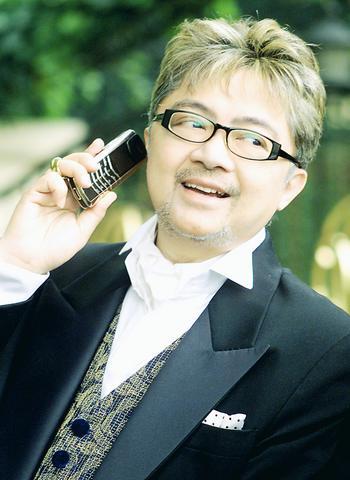
Indonesian haute couture designer Harry Darsono, 54, carries a US$26,550, 215-gram platinum Vertu cellphone to match his Lanvin shirts and Hugo Boss shoes when he entertains customers.
"I am very fussy. My handphone, handbag and attire must be part of the overall art of presentation to the clients -- you need to use their language so you can be close to them," said Darsono, who was educated in France and collects vintage pianos and luxury cars.
While mobile makers are tight-lipped on revenues from their luxury segments, analysts say high-end sales could provide a lift as penetration rates level off and the take-up of high-speed data services remains lackluster.
"Luxury and glamor models offer a different level of interest and engagement for consumers, which would spur them on to buy more new and beautiful phones," said Ian Woodward, a consumer behavior researcher at Australia's Griffith University.
London-based Vertu and Finnish parent Nokia, the world's top handset maker, began developing the luxury models as early as 1997, Vertu President Nigel Litchfield said.
"As the industry became increasingly saturated in the last few years, manufacturers were compelled to discover new markets and identify upcoming trends in mobile phone consumption."
At the end of last year, Asia accounted for a third of Vertu's total business, Litchfield said, adding that Hong Kong was its largest single market.
Shiv Putcha, senior analyst with The Yankee Group, believes fashion phones could invigorate sales for handset makers, as slow data download speeds, poor content and handset glitches leave users disappointed with 2.5G and third-generation (3G) networks.
"Most of the models in the market do not address the consumer's need for increased personalization, and I believe this to be a significant driver of growth," he said.
Given Asia's high cellphone replacement rate -- every nine to 18 months compared with about two years for Europe and the US -- the region is the logical market to launch iconic handsets, Putcha said.
Motorola Inc, the world's second-largest cellphone maker, said its line of fashion phones enjoyed triple-digit growth rates in the first quarter of this year over the final three months of 2003 in Southeast Asia, Australia, New Zealand, India, Bangladesh and Pakistan.
"In Asia, phones are much more of an aspirational statement about who you are and who you want to be," Scott Durchslag, a Motorola corporate vice president said.
Motorola recently launched a clamshell V600 model that offers interchangeable covers studded with clear Swarovski crystals, and Nokia's new 7200 model offers fabric covers that have analysts calling it the Louis Vuitton phone.
Gem-encrusted handsets also became the rage in China, the world's largest wireless market, after TCL Mobile made waves in 2000 with the launch of its diamond-studded mobile phones.
Its limited edition range with genuine gemstones costs up to 20,000 yuan (US$2,400).
TCL Mobile, which is seeking a separate listing in Hong Kong and is 40.8 percent-owned by TCL International Ltd, controls about one-tenth of China's cellphone market.
"Attaching jewellery on the phone adds a cultural and spiritual dimension to the product," TCL Mobile's managing director, Wan Ming Jian said.
"To many Chinese, precious stones symbolize esteem, good fortune, peace and love. So jewelled mobile phones are not just communication tools, they also act as lucky charms," he said.
TCL Mobile sold more than 12 million jewelled phones -- most of which had fake gems -- between 2001 and the first six months of last year.

Taiwan’s English education system is being pulled apart by three opposing forces. Bilingual Nation 2030 pulls students toward English and global communication. Artificial Intelligence (AI) readiness pulls them toward digital judgment, verification and AI-mediated work. But Taiwan’s old exam culture pulls them back toward memorization, grammar drills, timed reading and correct answers. If the education system keeps using old exams to define success, it risks producing graduates who are neither genuinely bilingual nor genuinely AI-ready, but trained for tasks machines can already perform. The first force is Bilingual Nation 2030. Launched in 2018, the policy aimed to “help Taiwan’s workforce connect

It seems every few days one bumps into one of those “real man” comments in which Taiwan is urged to “face reality” or similar, and “make a deal,” with the speaker implying that soon it will be too late. “Deal” advocates always present themselves as having a superior grip on reality, and the manly ability to make the “hard choice.” Their testosterone-laden language often echoes that of Taiwan sellout advocates. Note that such commentary always specifies a process (“make a deal, work with, make progress”), never the end state of what occupation by a violent authoritarian colonialist state will entail. In
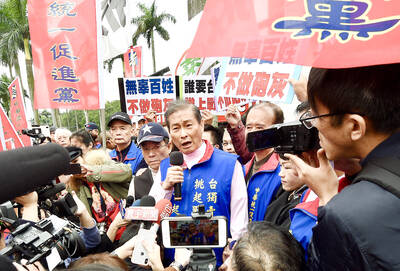
There are shadowy cabals plotting to sell out Taiwan to be annexed by China, by invasion if necessary. Fortunately, they are buffoons. In 2019, former Bamboo Union gangster and founder of the China Unification Promotion Party (CUPP), Chang An-le (張安樂, colorfully known as “White Wolf”), led a protest at the Legislative Yuan against comments made by then-premier Su Tseng-chang (蘇貞昌) that in the event of an attack by China, he would never surrender, but would protect the nation by fighting to the end, even if he only had a broom. Chang had party members bring a wooden casket that they
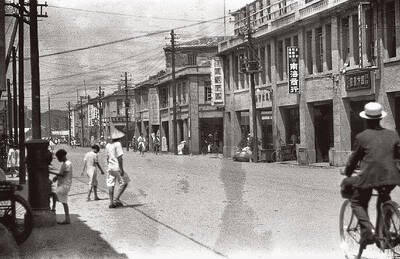
June 1 to June 7 "If all Taiwanese were as afraid of dying as you, then what would happen?” Physician Shih Chiang-nan (施江南) reportedly said this to his wife Chen Chiao-tung (陳焦桐) after she urged him to stop intervening on behalf of Taiwanese soldiers stranded overseas after serving in the Japanese Army during World War II. Shih had clashed with high-ranking officials over the issue, engaged in several heated arguments with Taiwan governor-general Chen Yi (陳儀) and allegedly shouted at general Ko Yuan-fen (柯遠芬), chief of staff of the Taiwan Garrison Command, over


 RSS
RSS