


In a suite high above Columbus Circle, New York, Rob LaPlante is looking for next season's breakout TV star. There is no agent hovering nearby, no technical crew, just LaPlante, his assistant and a digital video camera, auditioning Laura Fluor, a car saleswoman from Monmouth County, New Jersey.
"Let's talk about the sharks," LaPlante, the casting producer of The Apprentice, said, referring to Fluor's colleagues on the showroom floor.
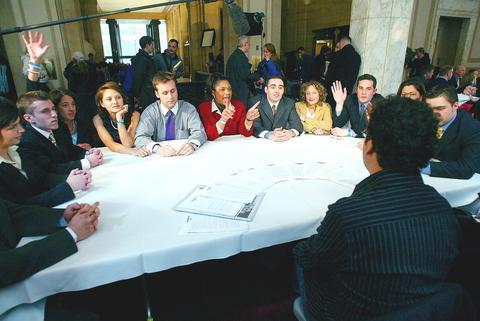
PHOTO: NY TIMES
"Car salesmen are not known for their gentility," Fluor acknowledges demurely, before happily relating a recent donnybrook with a co-worker who accused her of poaching a client.
LaPlante is clearly pleased with Fluor's moxie. But for Fluor to be cast in the second season of The Apprentice this fall, she will have to make it through six rounds of cuts, two extensive questionnaires, a medical exam, an intelligence test and the kind of background check usually reserved for secret agents.
The casting of reality shows, once an intuitive, on-the-fly endeavor, has become much more of a science, with its own growing set of protocols and rituals. Several producers have hired psychologists to help them with the vetting process. And to avoid the unscripted scandals that could run afoul of the decency standards of an increasingly agitated public and the Federal Communications Commission, both producers and networks are investing more time and money into systematically investigating their contestants' backgrounds.
All the due diligence is not surprising. The reality genre, viewed not so long ago as a somewhat tawdry sideline, has become a main event for the networks. With few new scripted shows, particularly comedies, connecting in a meaningful way with audiences, and the likes of American Idol, Survivor and The Simple Life thriving, the networks are increasingly leaning on the reality genre for both ratings and profits.
The Apprentice -- with its majestic views of the New York skyline and lingering shots of the show's other superstructure, Donald J. Trump's hair -- is built on a seemingly can't-miss concept, a seductive weave of aspiration and Darwinism. But to make it one of the most-watched and most-profitable shows on NBC, LaPlante and his staff must first winnow at least a quarter of a million applicants down to 16 potential apprentices the masses will adopt as their own. In reality programming, the cast is the thing.
"These are the people who are the narrators of our show," LaPlante said. "They have to look into the camera and be believable and interesting."
At 28, LaPlante is already a veteran, having honed his casting skills on the progenitors of the reality show trend, MTV's The Real World and Road Rules.
His talent: finding regular people who, trapped in artificial constructions with cameras rolling, are abnormally interesting. He is not precisely looking for next year's Omarosa Manigault-Stallworth, the pot-stirrer of the first season who antagonized fellow cast members with her constant carping and enthusiastic back-stabbing.
But he uses the research results, opinions of others, mock exercises, and finally, his gut, to decide who he wants audiences to learn to hate or love.
In this new kind of TV drama, the reality contestant serves as muse, actor, narrator and, every so often, punch line.
"If film is a director's medium, and television drama is a writer's medium, reality TV is without question a casting director's medium," said Robert J. Thompson, a professor of TV and popular culture at Syracuse University.
Sasha Alpert, the vice president for casting for Bunim/Murray Productions, which produces The Real World, said: "In casting, you want to see how far people will go in terms of opening up -- how much they will tell you about the guy they have a crush on or their confusing relationship with their father. You need people who are open, enigmatic and unpredictable."
Casting for TV's new way of telling stories requires stamina. By the time LaPlante has finished casting the second season of The Apprentice, he will have visited 13 cities and conducted hundreds of group interviews at open casting calls.
At New York's casting call on March 18, more than 1,400 contestants stood for hours in sub-zero temperatures at 40 Wall Street, the Trump-owned building in downtown Manhattan.
Inside, LaPlante served as the host at table after table, listening to hyperventilated conversations among each set of 12 participants, the marketing aphorisms flitting around the table like so many feeding swallows. When LaPlante spotted a prospect -- about every third table -- he secretly signaled an assistant who led the candidate away to be photographed while the rest of the candidates mobbed him. (He said not all decisions are made on the spot.)
Only 50 people were called back for on-camera interviews at the New York auditions. Of the tens of thousands who will apply across the country in the next few months, 50 will be invited to a mock version of the show in Los Angeles, and 16 will make the cut.
"Many shows are looking for what they think would make good television, but my primary concern is authenticity," said Mark Burnett, the man who conceived The Apprentice and Survivor. "When it comes to Survivor, you are looking for adventurers and for The Apprentice, you want people who are genuine entrepreneurs."
Despite the precise casting, Burnett says he never knows how a show is going to turn out.
"The unpredictability of my shows is why people watch," he said. "On our shows, you might completely buy into someone, and they are gone the next week."
Of course, there is another, less pleasant, side to the unpredictability of the genre. "I don't want to get to the second-to-last episode of the season," Burnett said, "and find out that one of my contestants is on the Internet with a goat or something terrible like that."
The increasing ubiquity of reality programming has been accompanied by a raft of miniscandals about the contestants. More recently, an American Idol contestant was dropped after being arrested on drunken driving charges after a party celebrating a victory on the show.
"A couple of shows got burned, and they didn't like the publicity, so they began asking us to look into people's backgrounds," said Elaine Carey, national director of investigations for the Control Risks Group, which has done work for ABC and CBS. The company has a 20-page questionnaire that it tailors to particular shows in consultation with the network's lawyers and standards executives.
The candidates' answers are then compared with findings from online databases, court records and interviews with friends and former associates.
But the vetting of contestants can create tensions between the creative executives and the executives in charge of standards.
"Producers are all about the characters," said Ben Silverman, chief executive of Reveille, a production company that produced The Restaurant for NBC, Nashville Star for USA Networks and the forthcoming Blowout, a reality series about a hair salon in Beverly Hills, California, for Bravo. "But networks have to look after their advertisers and affiliates. There have been times when I fought for contestants, but have not won the argument."
It is an odd line to walk and one that seems to keep moving. In 2000, the producer Mike Fleiss had a hit for Fox called Who Wants to Marry a Millionaire. But after the season ended, it was discovered that the prospective groom was named in a restraining order obtained a decade earlier by an ex-girlfriend who claimed he threatened her.
"It really damaged my career," said Fleiss, who found himself temporarily exiled from network television but is back in the thick of it with the ABC hit The Bachelor. "But I think people are realizing now that if you put anybody under that kind of presidential scrutiny, you are going to find out something weird about them."
Sometimes, a seamy background story can add to the tang of the show. Before The Simple Life was even broadcast on Fox, it was revealed that one star, Nicole Richie, had pleaded guilty to heroin possession and that Paris Hilton had played a starring role in a pornographic video on the Internet made by a former boyfriend. The revelations did little to hamper the show's success.
Finding the right mix of authenticity and contrivance in a candidate can be a touchy-feely exercise. "A big part of what we do is giving the producers a big enough palette, enough diversity, to tell a story," LaPlante said. "I think people turn on the television and like watching these people, but they have no idea what we went through to find them. Our job is to work through the layers that people have and see if they have something special."

Taiwan’s overtaking of South Korea in GDP per capita is not a temporary anomaly, but the result of deeper structural problems in the South Korean economy says Chang Young-chul, the former CEO of Korea Asset Management Corp. Chang says that while it reflects Taiwan’s own gains, it also highlights weakening growth momentum in South Korea. As design and foundry capabilities become more important in the AI era, Seoul risks losing competitiveness if it relies too heavily on memory chips. IMF forecasts showing Taiwan widening its lead over South Korea have fueled debate in Seoul over memory chip dependence, industrial policy and

“China wants to unify with Taiwan at the lowest possible cost, and it currently believes that unification will become easier and less costly as time passes,” wrote Amanda Hsiao (蕭嫣然) and Bonnie Glaser in Foreign Affairs (“Why China Waits”) this month, describing how the People’s Republic of China (PRC) is playing the long game in its quest to seize Taiwan. This has been a favorite claim of many writers over the years, easy to argue because it is so trite. Very obviously, if the PRC isn’t attacking Taiwan, it is waiting. But for what? Hsiao and Glaser’s main point is trivial,
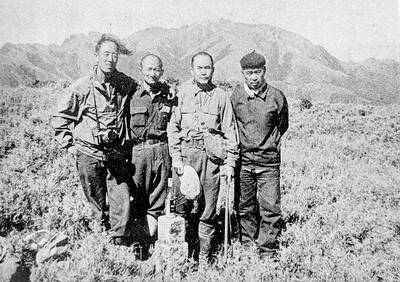
May 18 to May 24 Gathered on Yangtou Mountain (羊頭山) on Dec. 5, 1972, Taiwan’s hiking enthusiasts formally declared the formation of the “100 Peaks Club” (百岳俱樂部) and unveiled the final list of mountains. Famed mountaineer Lin Wen-an (林文安) led this effort for the Chinese Alpine Association (中華山岳協會). Working with other experienced climbers, he chose 100 peaks above 10,000 feet (3,048m) that featured triangulation points and varied in difficulty and character. The list sparked an alpine hiking craze, inspiring many to take up mountaineering and competing to “conquer” the summits. A common misconception is that the 100 Peaks represent Taiwan’s 100 tallest

And so, in the wake of US President Donald Trump’s trip to the People’s Republic of China (PRC), all the experts on the Strait of Hormuz suddenly became experts on US-China-Taiwan relations. The Internet has certainly expanded human knowledge. Lots of these sudden experts made noise this week about Trump’s words after the meeting with PRC dictator Xi Jin-ping (習近平). Trump is going to sell out Taiwan! Longtime Taiwan commentator J. Michael Cole summed the situation up neatly in the Guardian: “We need to keep in mind that he has a tendency to say many things — sometimes contradicting himself within


 RSS
RSS