

Astronomers using the Hubble Space Telescope say they have reached far enough out in space and back in time to be within "a stone's throw" of the Big Bang itself.
In a ceremony that was part science workshop, part political rally and part starting gun for an astronomical gold rush, astronomers at the Space Telescope Science Institute on the Johns Hopkins campus unveiled what they said was the deepest telescopic view into the universe ever obtained.
Along with detecting roughly 10,000 galaxies, the million-second exposure of a small patch of dark sky in the constellation Fornax captured objects a quarter the faintness of previous surveys.
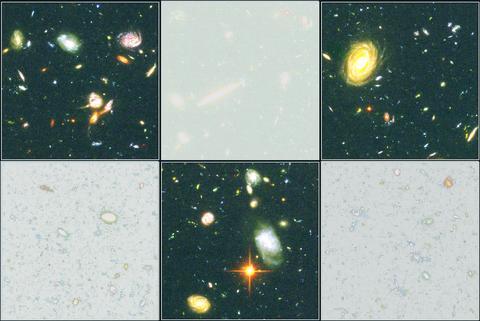
PHOTO: NY TIMES
Several dozen faint reddish spots, the astronomers said, could even be infant galaxies just emerging from the "dark ages" that prevailed in the first half billion years after the Big Bang, when stars were just beginning to form.
"We might have seen the end of the beginning," said Dr. Anton Koekenoer of the institute, who was part of the project.
He and others cautioned, however, that more work will be required before astronomers know if their surmises are correct. Astronomers will not be able to take a deeper picture until the James Webb Space Telescope goes into orbit in 2011.
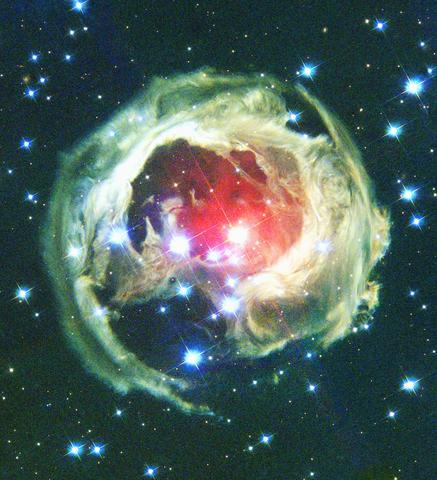
PHOTO: NY TIMES
When the new image, known officially as the Hubble Ultra Deep Field, has been studied, said Dr. Steven Beckwith, the director of the Space Telescope Science Institute, "we expect it to reveal new secrets to the origin of stars and galaxies, and ultimately ourselves."
The first bits of that work began with a frenzy on Tuesday morning, when the space telescope institute simultaneously unveiled the images and made the raw data available to the world at hubblesite.org.
Before Tuesday morning, Beckwith said, only four people had seen the image and they had pledged among themselves not to work on it ahead of time, so as not to give the "home team" an advantage.
"I wanted it to be like the great land rush where the gun is fired and everybody takes off," said Beckwith, who devoted his discretionary budget toward the immense amount of telescope time needed for the project -- 800 separate exposures spread out over four months.
The occasion also served as a reminder of the plight of the Hubble telescope, which is operating under a controversial death sentence.
Since 1990, it has floated above Earth's murky atmosphere, providing astronomers with peerless views of the heavens, with the help of periodic refurbishments by astronauts. But on Jan. 17, just one day after the Hubble had completed its marathon squint, NASA's administrator, Sean O'Keefe, said that any further space shuttle missions to the telescope would be unsafe and canceled them, dooming Hubble to die in orbit within three years. The decision caused an outcry among scientists, the public and on Capitol Hill. In response to a protest by Senator Barbara Mikulski, of Maryland, home of the space telescope, O'Keefe agreed to get a "second opinion" from Admiral Harold Gehman, who led an investigation into the loss of the shuttle Columbia last year. His response is expected soon.
Last week, Republican Mark Udall of Colorado and seven colleagues introduced a resolution in the House Science Committee calling on NASA to establish an independent panel to study the question.
The astronomers denied that Tuesday's event was timed to capitalize on the uproar over Hubble's fate -- but Mikulski walked in unannounced to the telescope institute on Tuesday to applause, then helped pull the curtain to unveil the new picture. She declared she would not stop her efforts to save Hubble after Gehman's opinion was delivered. "The future of the Hubble," she said to another round of applause, "should not be decided by one man in a NASA back room without a transparent process."
Because light travels at a finite speed, the farther away a detected object is, the longer it has taken the light to get here.
The ultra deep survey surpasses two earlier surveys, known as the Hubble Deep Fields, which revealed thousands of new galaxies dating back as far as when the universe was only a billion years old. Last week, astronomers using the Very Large Telescope at the European Southern Observatory said they had discovered a galaxy from when the galaxy was just 470 million years old. Its incredibly faint light had been amplified by the curvature of space around a giant cluster of galaxies. If confirmed, that would be the record.
But the ultra deep field has the sensitivity to reach back to galaxies when the universe was only 300 million years old, without the aid of any gravitational amplification. The Hubble thus opens to exploration the period of time from 300 million to 700 million years of age, when, theorists suggest, the first galaxies were burning themselves out of the murk that descended when the fires of the initial Big Bang cooled. Dr. Massimo Stiavelli, of the telescope institute, called those years a crucial period in the early life, "a teething for the universe." He added, "Hubble takes us to within a stone's throw of the Big Bang itself."
The new survey actually has two parts: the million-second exposure with Hubble's jazzy new Advanced Camera for Surveys, installed in 2002, led by Stiavelli, and a shorter exposure of the same patch of sky with another camera sensitive to infrared light, the Near Infrared Camera and Multiobject Spectrometer, Nicmos, led by Dr. Roger Thompson of the University of Arizona.
Another team, led by Dr. Sangeeta Malhotra of the telescope institute, is still reducing data from a spectrograph on the Advanced Camera for Surveys, which will help astronomers eventually identify the distances and types of objects in the picture.
Like the earlier deep fields, the ultra deep field shows that the early universe was littered with galaxies of oddball shapes and colors, but astronomers homed in on a few dozen soft reddish dots, which appear on the Nicmos image but not on the visible-light image.
While these might turn out to be dim nearby stars known as brown dwarfs, some astronomers were excited about the possibility that they might be the most distant objects ever seen, galaxies just emerging from the dark ages. Because the universe is expanding, galaxies at great distances are being carried away at high speeds and their visible light is lengthened and stretched -- "redshifted" in the jargon -- to longer wavelengths. The farther away they are, the more of their light becomes infrared radiation. Galaxies when the universe was only 300 million years old would be moving so fast that all their light would be invisible infrared radiation.
If the red dots are distant galaxies, then the Hubble might finally have hit the wall. Hubble's successor, the Webb telescope, is being built to observe infrared radiation in order to pursue such galaxies. "The dark ages are James Webb territory," Thompson said.

The Han Kuang exercises in August simulated the repelling of attackers from the People’s Republic of China (PRC). One scenario saw the PRC seizing Taipei International Airport (Songshan airport) in a daring helicopter assault. The airport is a key military operations center, and its seizure or destruction in a PRC invasion would be inevitable. Yet that is hardly the only conflict involving Songshan. Taipei Mayor Chiang Wan-an’s (蔣萬安) recent, surprising suggestion that the airport be converted to an AI park is just the latest variation on an old theme. Replacing Songshan airport with some kind of green or park space

Oct. 19 to Oct 25 For many in Hsinchu, the cold, dry October winds bring uncomfortable weather. But in the past, rice noodle makers waited all year for these winds. Laid out on bamboo racks by the Keya River (客雅溪), freshly made noodles dried in the wind without compromising their quality or texture. The ideal conditions, it was once said, were 70 percent wind and 30 percent sun. Most producers were concentrated in the Nanshih (南勢) area, which became known as Mifenliao (米粉寮, literally “rice noodle shed”). The work in the early days was entirely manual and physically grueling, often starting
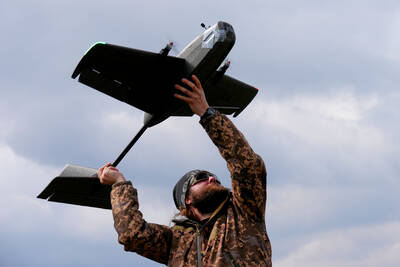
Since Russia invaded more than four years ago, Ukraine has become a global leader in military drone innovation, enabling its forces to grind a much larger enemy to a stalemate. But this technological force multiplier has come with an unsettling vulnerability: Ukrainian drone makers are highly dependent on electronics made by China, a key Russian ally. Ukraine’s greatest fear is that the Chinese government could severely restrict its access to these critical parts. It also worries that Russian defense companies that need these same supplies could be given preferential treatment by Chinese factories. Over the past two years, Ukraine has sought to break

Minister of Foreign Affairs Lin Chia-lung (林佳龍) was in Arizona on Oct. 5, to launch the Taipei Economic and Cultural Office (TECO) in Phoenix, the 14th such de facto Taiwanese consulate in the US. In response, Liu Chang (劉暢), a spokesperson for China’s embassy in the US, said in a statement the same day: “China firmly opposes official interactions of any form between China’s Taiwan region and the US, including its federal and state governments.” After the office plans were announced in July, Arizona Governor Katie Hobbs received two letters from China’s consulate general in Los Angeles asking her to


 RSS
RSS