


Since the start of the year the world's major film festivals have been celebrating the 100th birthday anniversary of Japanese master filmmaker Yasujiro Ozu, who pioneered Japanese cinema from the 1930s to 1960s. From the Berlin Film Festival to the New York Film Festival, from the Pusan Film Festival in South Korea to the Tokyo Film Festival last month, there have been special screenings, seminars and events to pay tribute to the late artist. Taiwan, of course, is not absent from such a world-wide trend. Especially when so many Taiwanese directors have been inspired by him, starting with Hou Hsiao-hsien (
Yasujiro Ozu and Japanese Masters Film Festival (
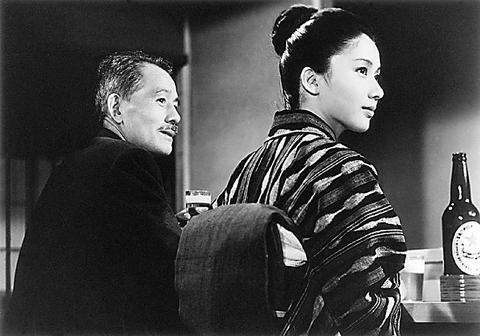
PHOTO COURTESY OF SPOT
For movie lovers, this festival, beginning Tuesday, has a strong line-up and tickets have been selling out. The organizer has prepared a full collection of Ozu films. Thirty six of Ozu's films have been shipped to Taiwan, in addition to seven films from Ozu's colleagues Kenji Mizoguchi and Mikio Naruse, that will all be screened over the next two months. The films include Ozu's most recognized masterpiece Tokyo Story (1953) and An Autumn Afternoon (1962), which are, respectively, the opening and closing films for the festival.
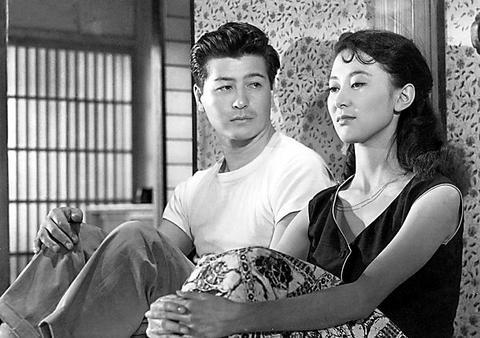
PHOTO COURTESY OF SPOT
To expand the scale of the festival, Showtime Cinema (欣欣晶華影城) in Taipei and Taoyuan Performance Hall will join the list of screening places, in addition to SPOT, Hsin-chu Municipal Image Museum and Kaohsiung City Film Archive.
"In Ozu's films, he places human relations and subtly savors these human relations, aligned with a sense of time. He has an insight about the world and human feelings and notes thoroughly the ever-changing quality of human life," Taiwanese director Hou Hsiao-hsien said.
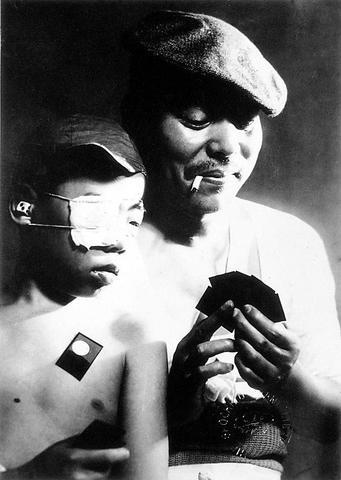
PHOTO COURTESY OF SPOT
Ozu is best known for his highly personal and rigorous visual style that is considered "most-Japanese" among directors. In his films, the camera shots are always planned meticulously and there are invariably elegant and precise compositions. He never panned, faded in or out, and employed virtually no dollies or tracking shots. Thus film critics have often labeled his film as minimalist. In Ozu's last movie, the camera did not move at all.
Another unique Ozu trait is the way he always places his camera at a lower angle, taking shots from the view of a person seated on a tatami mat, thus being symbolic of a Japanese "viewpoint."
Film scholar Stanley Kauffmann describes Ozu as "a lyric poet whose lyrics swell quietly into the epic."
Tensions between the younger and older generations and the subtle dynamics of the Japanese middle-class are the major topics of Ozu's movies. Tokyo Story is a story about an elderly couple paying a visit to their uncaring children in Tokyo. An Autumn Afternoon is a film exploring father-daughter relations and the loneliness of midle-aged father. Both films presented the melancholy situation of post-war Japan.
The festival also shows many of Ozu's pre-war movies, including I Was Born, But, a story about two kids' adventures in a new neighborhood. Where Now Are the Dreams of Youth is about college friends turning enemies and Dragnet Girl is about a vamp and her gangster boyfriend.
Recognized as one of the three great Japanese masters of film, Kenji Mizoguchi is often mentioned in the same breath as Ozu and Akira Kurosawa. He gained his reputation for grand tragic stories about geishas. The festival will showcase Mizoguchi's Sister of Gion, about two sisters both working in Kyoto's geisha region of Gion, but who express different attitudes toward their male clients. Osaka Elegy is about a woman who sells her body to raise money for her father and brothers.
There will also be five films from Mikio Naruse, who excels at depicting strong and determined modern women characters in his movies. Apart from movie screenings, there will be eight seminars on Yasujiro Ozu from Saturday, Dec 13 at SPOT.
A Chinese-language film theory book about Yasujiro Ozu will also be published during the festival. For more program information, check www.spot.org.tw.

Yesterday, the Democratic Progressive Party (DPP) nominated legislator Puma Shen (沈伯洋) as their Taipei mayoral candidate, the Chinese Nationalist Party (KMT) put their stamp of approval on Wei Ping-cheng (魏平政) as their candidate for Changhua County commissioner and former legislator Tsai Pi-ru (蔡壁如) of the Taiwan People’s Party (TPP) has begun the process to also run in Changhua, though she has not yet been formally nominated. All three news items are bizarre. The DPP has struggled with settling on a Taipei nominee. The only candidate who declared interest was Enoch Wu (吳怡農), but the party seemed determined to nominate anyone

In a sudden move last week, opposition lawmakers of the Chinese Nationalist Party (KMT) and Taiwan People’s Party (TPP) passed a NT$780 billion special defense budget as a preemptive measure to stop either Chinese leader Xi Jinping (習近平) or US President Donald Trump from blocking US arms sales to Taiwan at their summit in Beijing, said KMT heavyweight Jaw Shaw-kong (趙少康), speaking to the Taipei Foreign Correspondents Club on Wednesday night in Taipei. The 76-year-old Jaw, a political talk show host who ran as the KMT’s vice presidential candidate in 2024, says that he personally brokered the deal to resolve
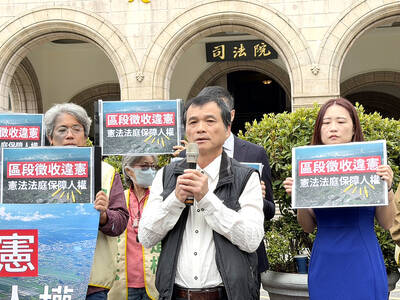
What government project has expropriated the most land in Taiwan? According to local media reports, it is the Taoyuan Aerotropolis, eating 2,500 hectares of land in its first phase, with more to come. Forty thousand people are expected to be displaced by the project. Naturally that enormous land grab is generating powerful pushback. Last week Chen Chien-ho (陳健和), a local resident of Jhuwei Borough (竹圍) in Taoyuan City’s Dayuan District (大園) filed a petition for constitutional review of the project after losing his case at the Taipei Administrative Court. The Administrative Court found in favor of nine other local landowners, but

The Chinese Nationalist Party (KMT), alongside their smaller allies the Taiwan People’s Party (TPP), are often accused of acting on behalf of the Chinese Communist Party (CCP). Some go so far as to call them “traitors.” It is not hard to see why. They regularly pass legislation to stymie the normal functioning of the ruling Democratic Progressive Party’s (DPP) administration, and they have yet to pass this year’s annual budget. They slashed key elements of the government’s proposed NT$1.25 trillion (US$40 billion) special military budget, and in the smaller NT$780 billion package they did pass, it is riddled with provisions that


 RSS
RSS