


Taiping Mountain National Forest Recreation Area, located about two hours drive out of Ilan, is Taiwan's kingdom above the clouds. The former logging center was converted into a conservation area for Taiwan's hardwood trees, and is currently being developed into a full-service recreational resort.
It is famous for its picturesque mists, which seem to gather around the huge cryptomeria (also known as Japanese cypress) and Chinese cedar, and for a climate as unlike that of Taipei's as it's possible to get. The Taiwan Forestry Bureau, which manages the resort, has created accommodation for around 230 at this mountain getaway, and the difficulty in getting bookings is a testament to the appeal of the place for locals wanting to get away from it all.
Like Alishan (Ali Mountain) and Pahsienshan (Eight Immortals Mountain), Taiping Mountain was one of three major centers of the logging industry from the Japanese colonial period until the 1970s. According to Lin Hong-chung (林鴻忠), chief of the Lotung Forest District Office (羅東林區管理處), under whose mandate the forests of Taiping Mountain fall, this shift in utilization can be found in many former logging areas around the world.
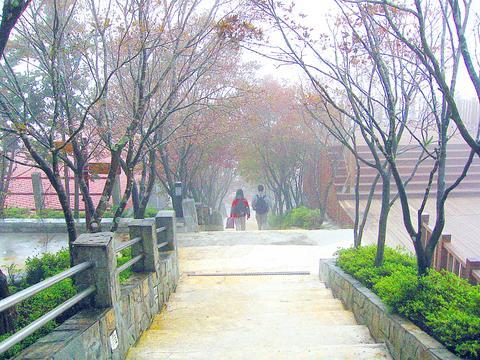
PHOTO: IAN BARTHOLOMEW, TAIPEI TIMES
"At first, the lumber is used directly for an economic return. Then, as environmental awareness increases, these precious reserves of centuries-old hardwood are preserved, and finally, the beauty of these areas is brought to a wider public through the creation of recreation areas such as this one," he said.
The area's logging past is something that he feels can be celebrated for the economic boost it gave to Taiwan, without encouraging the activity further. For him, logging has played its part in history, and now Taiwanese can start putting resources back into the forests that it has depleted.
It is something of an irony that one of the four major attractions, the primeval forest of Chinese cedar, has been preserved until today. "The trees in this area were not very attractive, many of them twisted and gnarled by climatic conditions, but for that reason, they avoided the saws of the lumberjacks, said a guide surnamed Jien.
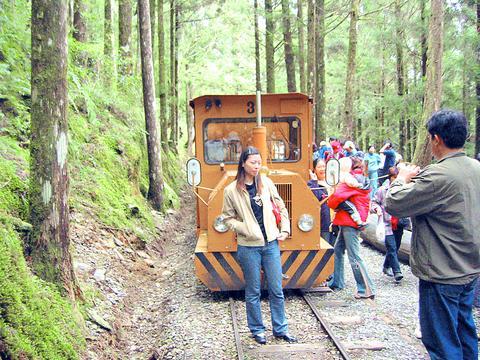
PHOTO: IAN BARTHOLOMEW, TAIPEI TIMES
The primeval forest, with its raised walkway, is a brilliant location for a stroll or what is described as a "green shower," in which the fragrant oils of the cedar and the negative ions in the air are supposed to produce all kinds of healthy effects. Lit until 11pm (though unfortunately not very evenly, making the walk a little more of an adventure than some might want), it is delightful to walk there in the evening -- and a number of lookout points provide good views of the sunrise, which has been called one of the 12 wonders of Formosa.
Another big draw at Taiping Mountain is the mountain rail that takes visitors to a spot called Maohsin (茂興), nothing more than a railway platform in the forest, where there are nature trails introducing a wide variety of ferns that grow in this land of mists.
This is also the departure point for the three-tier waterfall. It is currently the longest official nature trail in the Taiping Mountain resort, although according to Lin, at least five others are scheduled to begin construction, with government plans to create a national trail network. Currently, Taiping Mountain resort has been set up with the interests of the sedentary traveler foremost.
There are plenty of opportunities to sit on terraces and sip coffee, but you will be hard put to find any information for a bracing one-day trek. A longer trail is currently under construction through yet another ancient forest, this time of beech, but this is 16km from the resort, with a start-off point at Tsuifeng Lake (翠峰湖).
Another popular spot for visitors to Taiping Mountain are the hot springs at Rentse (仁澤), which are 20km or so from the resort proper. This location is currently closed for reconstruction, however, after extensive damage by Typhoon Nari in 2001 and is scheduled to open by the end of the year.
Taiping Mountain tends to attract a higher proportion of bus tours, which suits the model of the domestic tourist business, but makes it difficult for independent travelers without their own transport. With the limited accommodation provided, many travelers use Taiping Mountain as a one-day stop, choosing to stay at one of the many other resort towns or even in Lotung or Ilan.
"In operating this recreational park, we have decided that we will not bring in any financial groups to build big luxury hotels. With limited accommodation, we are able to control the impact on the environment, and also it keeps the money we earn in the community," said Lin of the Luotung Forest District Office plan.
To some degree, this fact is reflected in the facilities that Taiping Mountain resort offers, for neither the food nor the accommodation is five-star. It would be better described as homely and is perfectly comfortable if a little over priced, as double rooms start at NT$2,200 a night.
As with most of Taiwan's mountain resorts, facilities are constantly at the mercy of the elements, and these take a harsh toll, so that at any time, there is always maintenance going on, which rather detracts from the pristine beauty of Taiping Mountain's image.
To visit Taiping Mountain, bookings can be made at the Taipingshan National Forest Recreation Area, call (03) 9809 806-8.

Taiwan’s overtaking of South Korea in GDP per capita is not a temporary anomaly, but the result of deeper structural problems in the South Korean economy says Chang Young-chul, the former CEO of Korea Asset Management Corp. Chang says that while it reflects Taiwan’s own gains, it also highlights weakening growth momentum in South Korea. As design and foundry capabilities become more important in the AI era, Seoul risks losing competitiveness if it relies too heavily on memory chips. IMF forecasts showing Taiwan widening its lead over South Korea have fueled debate in Seoul over memory chip dependence, industrial policy and

“China wants to unify with Taiwan at the lowest possible cost, and it currently believes that unification will become easier and less costly as time passes,” wrote Amanda Hsiao (蕭嫣然) and Bonnie Glaser in Foreign Affairs (“Why China Waits”) this month, describing how the People’s Republic of China (PRC) is playing the long game in its quest to seize Taiwan. This has been a favorite claim of many writers over the years, easy to argue because it is so trite. Very obviously, if the PRC isn’t attacking Taiwan, it is waiting. But for what? Hsiao and Glaser’s main point is trivial,

And so, in the wake of US President Donald Trump’s trip to the People’s Republic of China (PRC), all the experts on the Strait of Hormuz suddenly became experts on US-China-Taiwan relations. The Internet has certainly expanded human knowledge. Lots of these sudden experts made noise this week about Trump’s words after the meeting with PRC dictator Xi Jin-ping (習近平). Trump is going to sell out Taiwan! Longtime Taiwan commentator J. Michael Cole summed the situation up neatly in the Guardian: “We need to keep in mind that he has a tendency to say many things — sometimes contradicting himself within

It took 12 years and months of standing in the same mountain location for director Liang Chieh-te (梁皆得) to capture a few seconds of footage: Taiwan’s largest resident raptor locking talons with its mate and spinning through the air in a courtship ritual. With only about 1,000 left in the wild and very short flight windows, the mountain hawk-eagle remains among Taiwan’s most elusive birds. The species generally produces only one offspring per year. Using forest cameras, the film crew and research teams document the arduous process the monogamous pairs go through for the chick to hatch and grow up, weathering


 RSS
RSS