


"Mirror, mirror, am I the most perfect woman of all? Should I make my nose just a bit higher? Maybe do the eyelids again? Oh! look at the wrinkles, maybe I should have my face lifted some time ..."
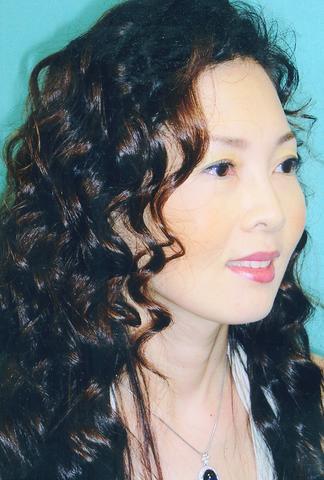
Rosalyn Ku (顧婕) is the kind of woman who likes to look in the mirror every day and examine her face to figure out what procedure she should undergo next. Since the age of 15, she has has had plastic surgery 25 times. Now 37 years old, her friends have given her the nickname the "queen of plastic surgery."
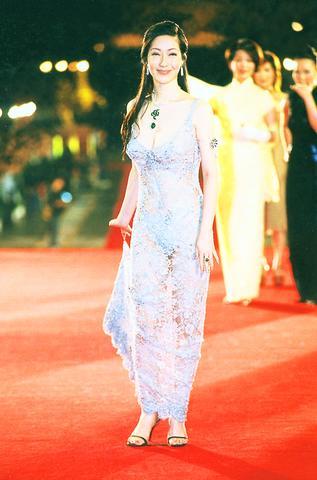
PHOTO COURTESY OF ARTIST PLASTIC SURGERY CLINIC
To make her originally single-lidded eyes double-lidded, like Caucasians, she has had nine operations over the last 10 years. "The first time the doctor used the `sewing' method. But the crease was not so obvious. The second time another doctor used the `cutting' method. The third time, however, the doctor made the crease too high on my right eye. It was horrible, so I had to do the surgery many more times," Ku said.
To make her face look like Brooke Shields -- her idol when she was young -- Ku began "fixing" her teeth at the age of 15, getting rid of three "tiger teeth." She also started on her nose by inserting artificial cartilage to pad out her nose column. The second time the artificial cartilage was replaced by a small piece of cartilage from her ear. In total she has had surgery four times on her nose and five times on the teeth.
In Ku's own words, her journey of discovery into the world of plastic surgery was "like Dr. Sun Yat-sen's revolution." in that she experienced 10 failures. "I'm not afraid of making public all these experiences. I pursue beauty and I have made full use of the technologies in the beauty industry. I believe that times have changed and there's nothing that can't be talked about," Ku said.
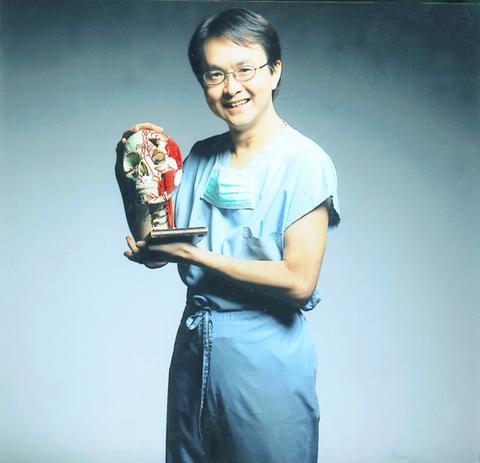
The ROC Plastic Surgery Association said there were 1 million procedures done last year, double the amount five years ago. "Among my patients, more and more of them are being open about having plastic surgery. They admit to their friends and relatives, `Yes, I've done it, and more than once,'" said Dr. James Chang (張炯銘), a surgeon from the Artist Plastic Surgery Clinic (藝術家整形外科診所).
Walking into Chang's clinic on Taipei's busy Zhongxiao East Road, the elegantly appointed reception room is filled with patients and surgery nurses with green uniforms. "Look at this picture of Nicole Kidman. Her cheekbone is up here, but her cheeks are still skinny," said a beauty consultant trying to persuade a client to undergo liposuction on her cheeks and create more definition on her face.
"On busy days I have five to six operations a day," said Dr. James Chang. "We even have midnight surgery appointments." In total, the clinic does 3,000 surgery procedures a year.
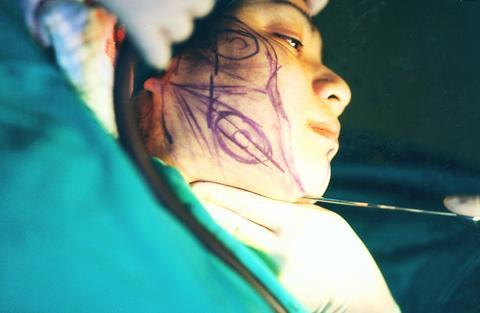
Following Chang's advice, Ku underwent what Chang calls "lipo-sculpture" to make her face slimmer. That is, the surgeon sucks out fat from the face and uses his hands to mould the adipose tissue remaining. The lipo-sculpture procedure has finally given the round-faced Ku a defined face and sharper chin. "Now my body and face are all perfect. I have to thank Dr. Chang for all this," she said.
Ku may may have been a trail blazer with plastic surgery and has even published a book about her experiences, the Queen of Plastic Surgery, but a new generation of Taiwanese are now getting in on the act. At Artist Plastic Surgery Clinic, the youngest patient was 16 years old, asking for advice to re-shape her face.
"Changing their facial features is in vogue among the younger generation," Lin Chin-yun (林靜芸), the founder of Jane's Clinic of Plastic Surgery was quoted as saying in local media.
A survey conducted by the Department of Journalism at Chinese Culture University (文化大學) found 55 percent of respondents, of both genders, were willing to have cosmetic surgery simply in order to improve their appearance and increase self-confidence.
Taiwan is well placed to take advantage of these trends. According to Chang Kuo-hua (張國華), another Taipei-based cosmetic surgeon, the price for double eyelids and a higher nose are cheaper than in South Korea, the country that has recently gained notice for its "plastic surgery street" in Seoul. "They cost nearly half the price of [competitors] in Korea," Kao said.
Many hospitals in Taipei have now opened special plastic surgery clinics (distinct from plastic surgery clinics for medical purposes), such as Taipei Municipal Wan Fang Hospital and Taipei Municipal Chinese Medicine Hospital.
There has also been an increase in the number of medical school students who choose plastic surgery. "Plastic surgery is among the top five choices for surgery-major students," said Chang. "In a way, it's riskless and high profit. Compared to doing surgery on the brain or the heart, you are liable to make less fatal mistakes in plastic surgery," he said.
Looking at the "nationwide movement" towards plastic surgery, some scholars reason that it's not because Taiwanese look at themselves in the mirror too much, but rather they are too influenced by the beautified and commodified images in the mass media.
Professor Chang Chin-hua (張錦華) from the Institute of Journalism at National Taiwan University has done long-term research on cosmetic and body-slimming advertisements in all media. She found that over the last eight years, cosmetic ads have been among the five most popular types, with spending above NT$3 billion a year in 1994 and 1995.
Her conclusion is that Taiwanese women have become major consumers and have boosted the business of body-slimming, cosmetics and plastic surgery immensely.
"When women gain economic clout and social independence, they don't necessarily give up traditional values," Chang said. "Instead, they can be more drawn to the images brought by media culture."
For example, less than 15 percent of Taiwanese women take exercise or go to gyms, Chang said. "That is, they don't resort to exercise, instead, they choose a method with more immediate results," she said.
Also, Chang said, the images of American popular culture promoted by the powerful Hollywood machine, was another factor for Taiwanese pursuing beauty.
"The beauty industry mobilizes stars, celebrities and the fashion industry to promote the business," she said. "What's worse is you never get satisfied. You never know what really is a perfect image," she said.
As for Rosalyn Ku, after going under the knife 25 times in search of beauty? "I'm pretty satisfied with my looks and body now. I think if there are any small flaws, it will be at least five to six years later. And at that time, we will see," she said.

Michael slides a sequin glove over the pop star’s tarnished legacy, shrouding Michael Jackson’s complications with a conventional biopic that, if you cover your ears, sounds great. Antoine Fuqua’s movie is sanctioned by Jackson’s estate and its producers include the estate’s executors. So it is, by its nature, a narrow, authorized perspective on Jackson. The film ends before the flood of allegations of sexual abuse of children, or Jackson’s own acknowledgment of sleeping alongside kids. Jackson and his estate have long maintained his innocence. In his only criminal trial, in 2005, Jackson was acquitted. Michael doesn’t even subtly nod to these facts.

Writing of the finds at the ancient iron-working site of Shihsanhang (十 三行) in New Taipei City’s Bali District (八里), archaeologist Tsang Cheng-hwa (臧振華) of the Academia Sinica’s Institute of History and Philology observes: “One bronze bowl gilded with gold, together with copper coins and fragments of Tang and Song ceramics, were also found. These provide evidence for early contact between Taiwan aborigines and Chinese.” The Shihsanhang Web site from the Ministry of Culture says of the finds: “They were evidence that the residents of the area had a close trading relation with Chinese civilians, as the coins can be
The March/April volume of Foreign Affairs, long a purveyor of pro-China pablum, offered up another irksome Beijing-speak on the issues and solutions for the problems vexing the People’s Republic of China (PRC) and the US: “America and China at the Edge of Ruin: A Last Chance to Step Back From the Brink” rang the provocative title, by David M. Lampton and Wang Jisi (王緝思). If one ever wants to describe what went wrong with US-PRC relations, the career of Wang Jisi is a good place to start. Wang has extensive experience in the US and the West. He was a visiting

The January 2028 presidential election is already stirring to life. In seven or eight months, the primary season will kick into high gear following this November’s local elections. By this point next year, we will likely know the Democratic Progressive Party (DPP) candidate and whether the Taiwan People’s Party (TPP) will be fielding a candidate. Also around this time, the Chinese Nationalist Party (KMT) will either have already completed their primary, or it will be heading into the final stretch. By next summer, the presidential race will be in high gear. The big question is who will be the KMT’s


 RSS
RSS