


Priya was just 12 when she was drugged by an aunt and dumped at a brothel in New Delhi. "I thought it was a cinema hall but then I realized they wanted me to do bad things," said the young Nepali woman, now 21, who was brought from her poverty-stricken village with the promise of a job as maid.
Priya spent the next three years in the Indian capital's red-light district where she says she was forced to have sex with "all kinds of men from 13-year-olds to old men with no teeth".
"They threatened me, saying they'd let me go if I worked for three years and earned 50,000 rupees (US$1,070) for them," Priya told Reuters. "Otherwise, they said they'd send me to a brothel in Bombay where I'd be locked in a room until I was old."
Today, she's one of a lucky few to be rescued from sexual slavery -- in fact she now works with police, saving other women from brothels. But thousands of Nepali girls are trafficked across the 1,580km India-Nepal border and sold to brothels.
Social workers say the number of girls being trafficked from Nepal has increased in recent years because of AIDS.
"There's a myth that having sex with a virgin can cure you of AIDS," said Roma Debabrata, president of STOP, a group that rescues girls from brothels.
She said some men with AIDS fork out up to 100,000 rupees (US$2,126) -- almost an entire year's starting salary for an executive -- for a virgin.
There are from 200,000 to 375,000 Nepali women in Indian brothels, according to a report the Indian non-governmental organization Prayas helped compile.
About 30 to 40 percent of the total number of women in India's red-light districts are Nepali, Ravi Nair, executive director of the South Asia Human Rights Documentation Centre, told Reuters.
Trafficking of women from Nepal's hill communities began in the 19th century, when feudal lords recruited girls from the Helambu region north of Kathmandu to work as concubines. Owning "Helambu girls" became a mark of high social status.
Today, the practice of keeping concubines has ended but the recruitment of women continues -- only now they are sold to Indian brothel owners who like them because of their fair complexions.
"There are organized gangs and it's a multi-million-rupee trade," Nair said. "The problem is cross-border trafficking is not given the same importance as cross-border terrorism or trafficking of drugs."
Almost always the story is the same -- poor and illiterate girls as young as nine are sold by their families or lured to India with the promise of well-paid jobs as domestic or factory workers.
Once there, activists say they are sold to middlemen for US$200 to US$500 and then they must resign themselves to life as a prostitute or face gang rape and torture until they submit.
"Their spirit gets destroyed," said Nair.
A US-based non-governmental group, Coalition Against Trafficking in Women, recounts the story of 13-year-old Mira from Nepal who arrived at a brothel on Bombay's Falkland Road, where thousands of women are displayed in zoo-like cages.
"When she refused to have sex, she was dragged into a torture chamber in a dark alley used for breaking in new girls. She was locked in a narrow, windowless room without food or water," the report said.
After she refused to have sex for a fourth day, she was wrestled to the floor and her head was smashed against concrete until she passed out. When she awoke, she was raped. "Afterwards, she complied with their demands," the report said.
Some girls are rescued and some manage to escape but the numbers are few and far between. Many contract AIDS in India and are then sent back to Nepal where they are dismissed as "India's soiled goods."
India has nearly four million people suffering from HIV/AIDS -- second only to South Africa -- and health experts warn the numbers could spiral if steps are not taken to control it.
"Since 1997 we have rescued about 400 girls from brothels in New Delhi, Bombay and Calcutta," said Bishwa Khadka, an official at Maiti Nepal, a group helping rescue and rehabilitate trafficked girls.
"Forty of them are still with us with AIDS and 10 have already died of AIDS while with us."
Faced with the prospect of social ostracism at home, one 16-year-old Nepali who STOP rescued from a Delhi brothel said she didn't want to go home.
"She said she did not want to be rescued because she had nowhere to go," said Debabrata.

Taiwan’s English education system is being pulled apart by three opposing forces. Bilingual Nation 2030 pulls students toward English and global communication. Artificial Intelligence (AI) readiness pulls them toward digital judgment, verification and AI-mediated work. But Taiwan’s old exam culture pulls them back toward memorization, grammar drills, timed reading and correct answers. If the education system keeps using old exams to define success, it risks producing graduates who are neither genuinely bilingual nor genuinely AI-ready, but trained for tasks machines can already perform. The first force is Bilingual Nation 2030. Launched in 2018, the policy aimed to “help Taiwan’s workforce connect
It seems every few days one bumps into one of those “real man” comments in which Taiwan is urged to “face reality” or similar, and “make a deal,” with the speaker implying that soon it will be too late. “Deal” advocates always present themselves as having a superior grip on reality, and the manly ability to make the “hard choice.” Their testosterone-laden language often echoes that of Taiwan sellout advocates. Note that such commentary always specifies a process (“make a deal, work with, make progress”), never the end state of what occupation by a violent authoritarian colonialist state will entail. In
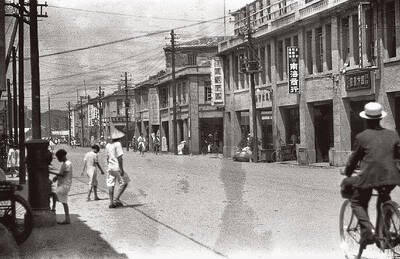
June 1 to June 7 "If all Taiwanese were as afraid of dying as you, then what would happen?” Physician Shih Chiang-nan (施江南) reportedly said this to his wife Chen Chiao-tung (陳焦桐) after she urged him to stop intervening on behalf of Taiwanese soldiers stranded overseas after serving in the Japanese Army during World War II. Shih had clashed with high-ranking officials over the issue, engaged in several heated arguments with Taiwan governor-general Chen Yi (陳儀) and allegedly shouted at general Ko Yuan-fen (柯遠芬), chief of staff of the Taiwan Garrison Command, over

“Taiwan’s Opposition Leader Comes to US With a Message Straight Out of Beijing” read a May 31 headline in the Wall Street Journal. Top US administration officials and members of Congress almost certainly read the WSJ, and if there was a bullet point takeaway that people in Washington should absorb ahead of Chinese Nationalist Party (KMT) Chair Cheng Li-wun’s (鄭麗文) arrival in DC on June 9, that headline is it. The last few columns have discussed this very topic, and the timing is not coincidental. While those top officials likely do not read the Taipei Times, judging by the number


 RSS
RSS