


It's only after reading this book for some time that you realize what makes it special. It's a selection of the academic papers read to a conference held at Kaohsiung's National Sun Yat-sen University in May 2000 on the subject of travel. But where is the hideous post-structuralist gobbledygook, the predictable sub-Marxist party line, the familiar intellectual package deal, the wheeling out of mutually self-referring texts by Foucault, Derrida, Lacan, Althusser, Jakobson, Kristeva and the rest (names that will be all too familiar to students who have submitted themselves to this life-threatening straightjacket)? The answer is -- nowhere in sight.
Instead, here are writers who refer to the kind of books disinterested writers write and readers in search of pleasure actually go out and buy. The dank odor of publications produced by academics for their career advancement, and destined to be bought only by reluctant university libraries, and then selectively photocopied and memorized by students with no knowledge of the primary imaginative literature these critics refer to, and so often aim to subvert, undermine and malign, is totally missing from this excellent and fascinating collection.
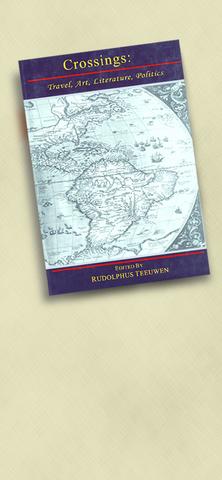
The illiberal, anti-humanist propaganda that has spread like a cancer through the humanities departments in the past 15 years was either miraculously not represented at this Kaohsiung conference two summers ago, or else -- rather more probably -- has been edited out by this book's enlightened and independent-minded editor.
That Rudolphus Teeuwen is enlightened and independent-minded is made clear by the two items he contributes to the book -- an introduction, and a discerning and very readable essay on Paul Fussell, author of The Great War and Modern Memory and (of more particular reference to the theme of the conference and this book) Abroad: British Literary Traveling Between the Wars.
These 15 essays have been selected by Teeuwen from over 70 papers given at the conference and no doubt some dross (probably a great deal, and real dross given the current state of academia) has been scythed away. Indeed the book is notable, among many other things, for the absence of any lament, which in the circumstances you might expect, for the many other worthy contributions the limited space made it impossible to include. Fairly clearly Teeuwen found just enough jargon-free material to fill his volume, and seized his preferred material with the single-minded doggedness of an enemy of intellectual junk food in all its (actually markedly unvaried) forms.
The result is that you have contributions from -- ?wonder of wonders! -- ?an academic who also writes fiction (Deborah A. Gordon of Wichita State University), another who sees images of journeys in the evolving forms of classical music (George B. Stauffer of Rutgers University), and another, Robin Gerster from Melbourne, who has written a book on Japan marvelously entitled Legless in Ginza (the reference is to Milton's famous line about the blinded and shorn Biblical figure Samson: "Eyeless in Gaza, at the mill with slaves").
Professor Stauffer's essay may be about nothing more complex that setting forth and then returning as a common musical pattern, and Gerster's about Australia's new-found affinity with Asia, together with the phenomenon of "boomerang travel" (half the point of leaving Oz being the pleasure of getting back home again). But the point is that these are independent readers and thinkers writing about Bach cantatas, Asia as a sex destination, John Lennon, Paul Theroux, early Swedish travelers to China -- ?all fascinating subjects, and a million miles from the hermeneutics of the transcendental ego, phenomenology, semiotics and the like. Goodbye to all that, Teeuwen seems to be saying.
Not that this is to be seen as a confrontational volume. Rather, it just quietly goes its own way. Some of what must unfortunately, for the time being at least, be called the "mainstream" writers and their books do appear here, notably Edward Said's Orientalism, which a majority of these authors cite somewhere or other, though frequently to dissent from its conclusions. But Said is the best of a bad lot, as the British say -- ?cogent and manifestly sincere, and keeping jargon to an absolute minimum (the possibility of its being dispensed with altogether is never countenanced).
Teeuwen's independence of mind is never in question. His introduction, for example, openly champions the Enlightenment -- ?the 18th century movement that sought to educate ordinary people in the principles of reason, truth and justice -- ?when it has been ferociously attacked by the politically correct (their term for themselves) as being Euro-centric and racially exclusive. In fact it spawned innumerable reforms including the abolition of the slave trade and laws (in some countries) against excessive, or at least public, cruelty to animals, albeit advances that scientific vivisection has effectively, and all but silently, reversed.
But "Essentialist!" scream the know-nothing students, meaning their victim dares to suggest some values might be good in all places and at all times. Such puritan pieties clearly cut no ice with Teeuwen, however. "For such as me," he writes, "postcolonialism often feels like a voluntary-compulsive trip to an Orwellian Room 101 where we go to squirm, to be confronted with out guilt, and to confess -- ?but we hardly ever come to love Big Brother".
There are many other interesting things in this varied and stimulating book. Two contributors look at the work of the Chinese commentator on Western countries Chiang Yee, author of several "Silent Traveler" books on his visits to different parts of the US and UK in the 1930s and later. Another asks why so many early British travelers in North America claimed that nature was somehow lacking there -- ?the elephant, tiger, lion, rhinoceros, hippopotamus, camel and buffalo were none of them found -- ?and went on to claim that democracy itself, which in those days the US was pioneering, was somehow therefore flawed.
This, then, is an altogether excellent book, and Bookman in Taipei are to be congratulated on publishing it. There is also a companion volume containing selected papers in Chinese from what was in fact a bilingual conference.

Yesterday, the Democratic Progressive Party (DPP) nominated legislator Puma Shen (沈伯洋) as their Taipei mayoral candidate, the Chinese Nationalist Party (KMT) put their stamp of approval on Wei Ping-cheng (魏平政) as their candidate for Changhua County commissioner and former legislator Tsai Pi-ru (蔡壁如) of the Taiwan People’s Party (TPP) has begun the process to also run in Changhua, though she has not yet been formally nominated. All three news items are bizarre. The DPP has struggled with settling on a Taipei nominee. The only candidate who declared interest was Enoch Wu (吳怡農), but the party seemed determined to nominate anyone
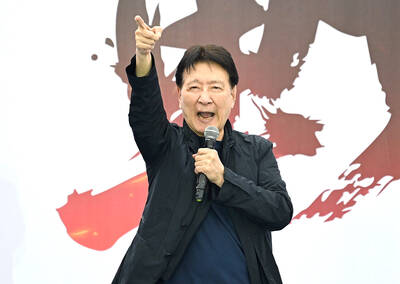
In a sudden move last week, opposition lawmakers of the Chinese Nationalist Party (KMT) and Taiwan People’s Party (TPP) passed a NT$780 billion special defense budget as a preemptive measure to stop either Chinese leader Xi Jinping (習近平) or US President Donald Trump from blocking US arms sales to Taiwan at their summit in Beijing, said KMT heavyweight Jaw Shaw-kong (趙少康), speaking to the Taipei Foreign Correspondents Club on Wednesday night in Taipei. The 76-year-old Jaw, a political talk show host who ran as the KMT’s vice presidential candidate in 2024, says that he personally brokered the deal to resolve
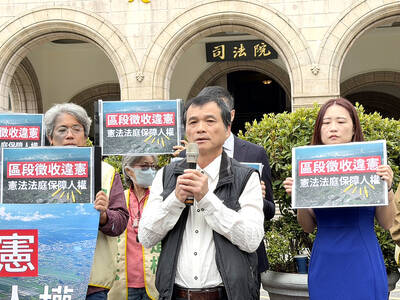
What government project has expropriated the most land in Taiwan? According to local media reports, it is the Taoyuan Aerotropolis, eating 2,500 hectares of land in its first phase, with more to come. Forty thousand people are expected to be displaced by the project. Naturally that enormous land grab is generating powerful pushback. Last week Chen Chien-ho (陳健和), a local resident of Jhuwei Borough (竹圍) in Taoyuan City’s Dayuan District (大園) filed a petition for constitutional review of the project after losing his case at the Taipei Administrative Court. The Administrative Court found in favor of nine other local landowners, but
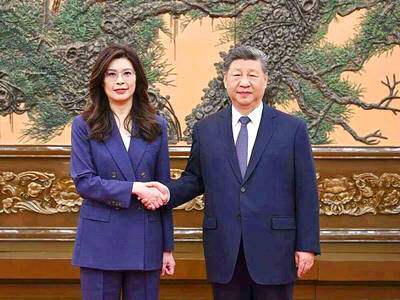
The Chinese Nationalist Party (KMT), alongside their smaller allies the Taiwan People’s Party (TPP), are often accused of acting on behalf of the Chinese Communist Party (CCP). Some go so far as to call them “traitors.” It is not hard to see why. They regularly pass legislation to stymie the normal functioning of the ruling Democratic Progressive Party’s (DPP) administration, and they have yet to pass this year’s annual budget. They slashed key elements of the government’s proposed NT$1.25 trillion (US$40 billion) special military budget, and in the smaller NT$780 billion package they did pass, it is riddled with provisions that


 RSS
RSS