


Fruit Chan (
But he's also the filmmaker who takes home international prizes most every time he makes a film. Chan's Durian Durian (榴槤飄飄) was the biggest winner at this year's Golden Horse Awards (金馬獎), taking Best Picture, Best Original Screenplay, Best Actress and Best New Performer. Chan is also the only Hong Kong director to be invited to the Venice Film Festival for two consecutive years. Without a doubt, he is Hong Kong's most prolific filmmaker.
"I grew up watching mainstream films, but when I start making a film, I'm a freak who goes against all the rules," Chan said.
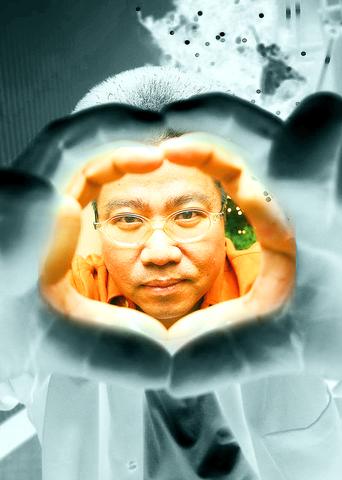
A student of scriptwriting and film production, Chan began work at the Hong Kong Film Center organizing exhibitions of "contemporary classic" films. At first he only ran errands, but was later promoted and took over the glorious responsibility of keeping production logs. Later he became an assistant producer and finally worked for some 10 years as an assistant director. It was during this time that Chan decided to take his own turn at the helm.
His first film, Made In Hong Kong, was shot using 24,000m of left-over film he'd collected from cutting room floors. He employed five crews, paid no one, and spent HK$500,000 (US$64,000) in post production. But the fast-paced social critique about a drop-out teenager, garnered a total of eight awards at festivals in Locrano, Pusan, France, Vancouver, Hong Kong and Taiwan.
Some critics describe Chan as a realistic director, others say he is grassroots. Chan himself eschews categories, focusing instead on the method he uses to develop a story -- which is itself a departure from Hong Kong and Hollywood norms.
To get a story, Chan says, he would stroll around the low-rent areas of Kowloon, hand camera in tow, to get a feel for the environment. Sometimes he would squat on a street corner and chat with the locals: kids, old people, drop-outs and street girls from the mainland. These people constitute the backbones of all his stories.
Two little kids in a small tea restaurant became the inspiration for Little Cheung (
It was during the shooting of Little Cheung that Chan began noticing the mainland prostitutes wandering about the streets of Wong Kwok. "I began interviewing them, those who came regularly from Shengzhen (near Hong Kong's border with the mainland) with only a three-month visa. They'd work hard and then go back," he said. As a result, Durian Durian began taking shape.
"It is hard to catch real feelings and to set up an atmosphere to make [people] feel real," he said.
So in preparing for Durian Durian, he would sometimes set hidden cameras to film working girls, observing how they talk, walk and what schedules they keep. He went to the so-called mistress house neighborhoods (
"And then I showed these clips to Qin Hailu (
All the work paid off. Durian Durian is a convincing story which brilliantly contrasts the leading girl's life in Hong Kong with her ironically better life back in northern China. In the process, Chan made Qin this year's brightest star, taking both Best Actress and Best New Performer at the Golden Horse Film Festival, and more prizes in Hong Kong and overseas.
But Durian Durian is just the first in what Chan calls his Prostitute Trilogy. "I've interviewed around a hundred ladies and I've just finished two stories. I still have a long way to go!" he said.
Hong Kong Hollywood (香港有個好 塢) is the second installment in the trilogy, and just screened at both the Venice and Golden Horse film festivals. It tells a cruel and humorous story of two poor brothers in Hong Kong and a wicked mainland prostitute. The film's color and dramatic effects are even stronger than his previous work. And, for the first time, he worked with A-list talent in the form of mainland actress Zhou Xun (周迅).
"I am always willing to play with different film styles. I don't want to be fixed in one place," he said. As an example he cites his next film, Public Bathroom
Does all this mean Chan is ready to go mainstream? "I've never said that I reject any commercial elements in my films. I'd like to work with actors like Maggie Cheung (張曼玉) and Andy Lau (劉德華)," he said.
But, Chan adds, "if it's a commercial film, it will still be a Fruit Chan-style commercial film."
Durian Durian opens tomorrow.
See review on page 11.
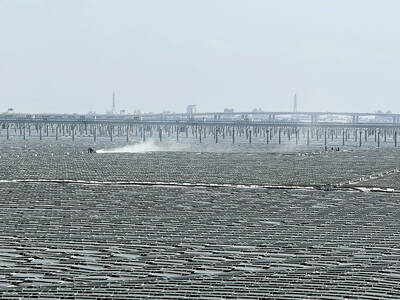
The arithmetic is straightforward and uncomfortable. By the end of 2025, Taiwan had committed itself to a 50-30-20 electricity mix — half natural gas, 30 per cent coal, 20 per cent renewables. The Ministry of Economic Affairs’s (MOEA) own monthly energy reports tell a different story. Natural gas reached 47.8 per cent of generation last year. Coal stood at 35.4 per cent, comfortably above its target ceiling. Renewables came in at 13.1 per cent, well short of the 20 per cent Taipei had pledged a decade earlier. Installed renewable capacity reached roughly half of the 12 gigawatts (GW) the government
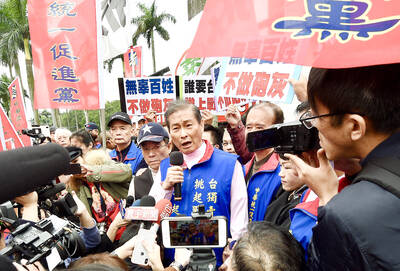
There are shadowy cabals plotting to sell out Taiwan to be annexed by China, by invasion if necessary. Fortunately, they are buffoons. In 2019, former Bamboo Union gangster and founder of the China Unification Promotion Party (CUPP), Chang An-le (張安樂, colorfully known as “White Wolf”), led a protest at the Legislative Yuan against comments made by then-premier Su Tseng-chang (蘇貞昌) that in the event of an attack by China, he would never surrender, but would protect the nation by fighting to the end, even if he only had a broom. Chang had party members bring a wooden casket that they
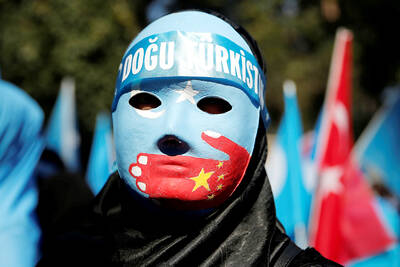
It seems every few days one bumps into one of those “real man” comments in which Taiwan is urged to “face reality” or similar, and “make a deal,” with the speaker implying that soon it will be too late. “Deal” advocates always present themselves as having a superior grip on reality, and the manly ability to make the “hard choice.” Their testosterone-laden language often echoes that of Taiwan sellout advocates. Note that such commentary always specifies a process (“make a deal, work with, make progress”), never the end state of what occupation by a violent authoritarian colonialist state will entail. In
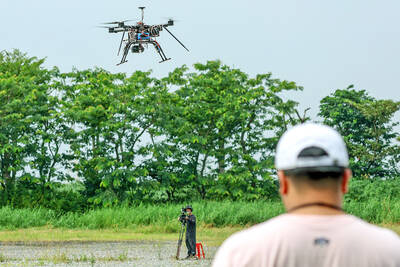
Taiwan’s drone exports are taking off, fuelled by the war in Ukraine, as Taiwanese companies seek a stake in the fast-growing global market for unmanned aerial vehicles (UAV). Low-cost drones used for reconnaissance and strikes are in high demand as governments around the world boost defense spending in the face of intensifying conflicts. A relative new player in the increasingly competitive industry, Taiwan’s pitch is to be an “Asian hub” for the production of UAVs and components free of Chinese materials, or “non-red.” That means its UAVs can be up to three times more expensive than their Chinese competitors, like the world’s biggest


 RSS
RSS