


There are few sports that are more essentially Chinese than dragon boat racing, and with the Tuanwu Festival (
The eye-dotting ceremony for the boats taking part in this race will be held this afternoon between 1pm and 3 pm, at the Tachia section of the Keelung River beneath the Tachih Bridge.
Chang Chin-jen (
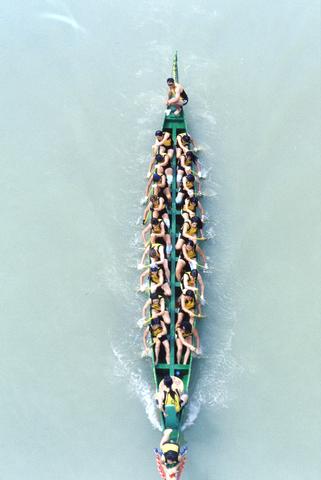
PHOTO: LYNN LEE
The Hsintien team has an advantage over other local teams, for as the managing body for a dragon boat racing area at Bitan (
Bitan is the venue of the Taipei County Congressional Cup Dragon Boat Races (台北縣議長盃龍舟錦標賽), which are held a week before the Taipei City event. The boats used in the Taipei County races are much more modern, being made of fiberglass. The Taipei City race uses traditional wooden boats that are heavier and wider.
Joining the lineup
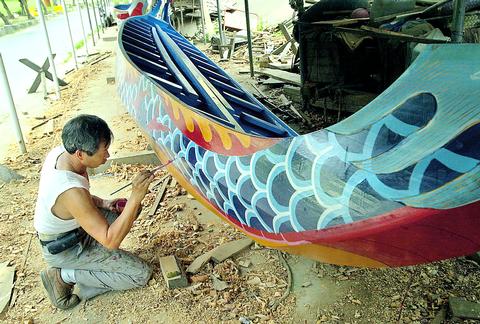
PHOTO: AP
The Taipei International Dragon Boat Race Championships have only been held on the Keelung River -- specifically, the Tachia section (大佳段) beneath the Tachih Bridge (大直橋) -- since 1995, when the Taipei City Government began co-sponsoring the races with the Taipei Municipal Sports Federation. That year, the city government completed a major reconstruction project to straighten out the Keelung River and establish a park on its banks.
So far, the international division in the 2001 competition has nine registered men's teams and three women's teams, including teams from Hawaii, the Philippines, Canada, Thailand, and Japan. A few teams, however, are guaranteed participants in the event.
One such team is the Aqua Fortis Dragon Boat Rowing Team from the Philippines. "We have been participating in the Taipei dragon boat races since 1993," states Earnest S. Versoza, the drummer and over-all leader of the Philippine delegation. "We were overwhelmed by the warm acceptance of the Taiwanese when we came the first time, and we have participated ever since."
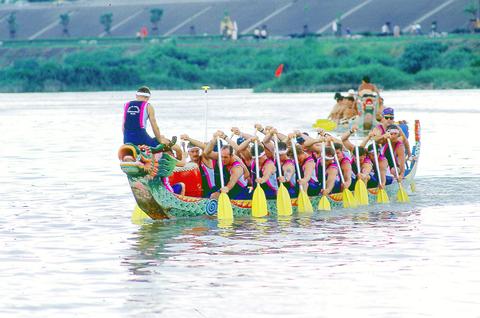
PHOTO COURTESY OF HUANG CHUNG-HSIN
Two other teams with assured positions in the lineup are locally-based teams consisting of foreign students studying at Chinese language schools: the Taipei Language Institute (TLI) and the Center for Chinese Language and Culture (CCLC), formerly the Mandarin Training Center. Both schools have fielded teams in the Taipei City races for at least twenty years.
Janie Moor from England, who is serving as captain of the TLI team for her second year and participating for her third, attributes her continued participation to the wonderful feeling that she gets when building up the team.
"It's a great feeling when you have a group of people who do not really know each other that well, but who must work together to get the boat moving; and once everyone begins to fall in sync with one another, it's especially exciting, because the boat surges forward almost like a rollercoaster ride. It's very exhilarating!"
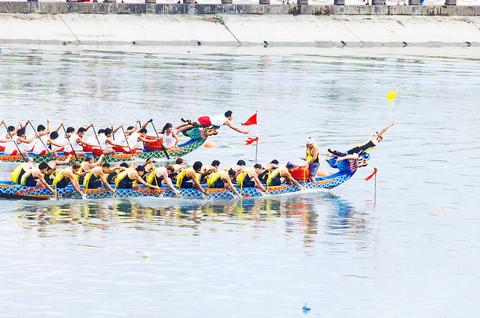
PHOTO COURTESY OF YEH MING-YUAN
Tsuyoshi Kano from Japan, a member of the CCLC team who has been participating for three years now, gives three reasons for rejoining: "First, it's a great place to meet a lot of new friends. Second, the cultural aspects and traditions behind the races are so deep and meaningful, and it's great to be a small part of that. Finally, the overall experience and the feeling of accomplishment when it's done -- it's a great memory to take back to Japan of my stay here in Taiwan."
Ancient traditions
The Dragon Boat Festival occurs on the fifth day of the fifth lunar month -- which falls on June 25 this year -- and is filled with many ancient customs and rituals.
Dragon boats are a very important feature of the festival and were originally used as part of an elaborate ceremony for supplicating the water gods to prevent floods and other natural disasters. Later, they also became associated with the death of the poet Chu Yuan (屈原) in 290BC, who drowned himself in the Milo River of Hunan Province (湖南省). The beating of drums and splashing of oars which are so much part of dragon boat racing were originally intended to scare away fish who might desecrate the poet's body.
Tradition dictates that before a dragon boat can be used in a race, the eyes on the dragon's head adorning the prow of every boat must first be opened. This is done several weeks before the race itself in a special ceremony.
The ceremony to open the eyes of the dragon is presided over by a Taoist priest. Ringing a bell and burning incense, he first blesses the boats, and then race officials daub a bit of red paint onto each dragon's eyes to "open" them. This is followed by lion dances and other performances as the dragon boats are carried to the river by the various teams. The boats are paddled up and down the racecourse as fire crackers, sticky rice cakes and ghost money are thrown into the water, in part as offerings to the River God, in part to commemorate the spirit of Chu Yuan.
The eye-dotting ceremony for the Taipei International Dragon Boat Race Championships will be held today between 1pm and 3 pm, at the Tachia section of the Keelung River beneath the Tachih Bridge. Traditionally, the mayor of Taipei presides over the ceremony, and everyone is invited to come down and join the fun.
The Taipei International Dragon Boat Race Championships will be held on the three-day weekend of the festival itself, June 23-25. During the festival, aside from the races, which will take place between 8am and 5pm every day, the Taipei City Government will be organizing numerous other activities for spectators, such as kungfu and taichi performances, lion dances and folk art and handicraft exhibitions.
Dragon boat races in major cities and counties
For more information about the Taipei City races, check the offical bilingual Chinese-English Web site for this year's competition at http://dragon2001.nihs.tp.edu.tw
Chiayi County
Date: June 25
Contact: (05) 362-0123
Changhua County Date: June 23-25 Contact: (04) 722-2151 ext. 1051 or (04) 777-2668 Hsinchu City Date: June 25 Contact: (03) 521-6121 Ilan County Date (local): June 24-25 Date (national*): June 30, July Contact: (03) 936-4567 ext. 1440/1 *Note: Ilan County will be hosting the island-wide provincial dragon boat races this year. Kaohsiung City Date: June 23-25 Contact: (07) 723-2751 ext. 83 Kaohsiung County Date: June 23-25 Contact: (07) 747-7611 Keelung City Date: June 24-25 Contact: (02) 2420-1122 ext. 360 Miaoli County Date:June 24-25 Contact: (037) 322-150 Pingtung County Date: June 24-25 Contact: (08) 732-0415 Taoyuan County Date: June 24-25 Contact: (03) 479-3070 Tainan City Date: June 24-25 Contact: (06) 299-1111 ext. 1705 Tainan County Date: June 16-17 Contact: (06) 632-2231 Taipei City Date: June 23-25 Contact: (02) 2570-2330 ext. 120 Taipei County Date: June 16-17 Contact: (02) 2960-3456 Taitung County Date: June 22-23 Contact: (089) 326-141

It seems every few days one bumps into one of those “real man” comments in which Taiwan is urged to “face reality” or similar, and “make a deal,” with the speaker implying that soon it will be too late. “Deal” advocates always present themselves as having a superior grip on reality, and the manly ability to make the “hard choice.” Their testosterone-laden language often echoes that of Taiwan sellout advocates. Note that such commentary always specifies a process (“make a deal, work with, make progress”), never the end state of what occupation by a violent authoritarian colonialist state will entail. In

There are shadowy cabals plotting to sell out Taiwan to be annexed by China, by invasion if necessary. Fortunately, they are buffoons. In 2019, former Bamboo Union gangster and founder of the China Unification Promotion Party (CUPP), Chang An-le (張安樂, colorfully known as “White Wolf”), led a protest at the Legislative Yuan against comments made by then-premier Su Tseng-chang (蘇貞昌) that in the event of an attack by China, he would never surrender, but would protect the nation by fighting to the end, even if he only had a broom. Chang had party members bring a wooden casket that they
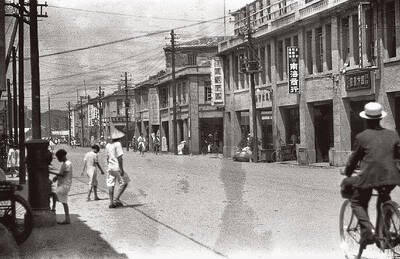
June 1 to June 7 "If all Taiwanese were as afraid of dying as you, then what would happen?” Physician Shih Chiang-nan (施江南) reportedly said this to his wife Chen Chiao-tung (陳焦桐) after she urged him to stop intervening on behalf of Taiwanese soldiers stranded overseas after serving in the Japanese Army during World War II. Shih had clashed with high-ranking officials over the issue, engaged in several heated arguments with Taiwan governor-general Chen Yi (陳儀) and allegedly shouted at general Ko Yuan-fen (柯遠芬), chief of staff of the Taiwan Garrison Command, over
Food prices have often played a major role in Taiwan’s history. The first major wave of migration from China occurred in 1628. A moderate drought, the Ming Dynasty maritime ban that prohibited fishing and trading (intended to reduce piracy) and a temporary tax, conspired to exhaust local resources, leading to famine in Fujian Province. The famed pirate and trader Zheng Zhilong (鄭芝龍), scooped up starving people from Fujian and transported them across the Taiwan Strait, where they settled under the Dutch. Two factors enabled Zheng. First, by 1624 he had settlements around today’s Beigang (北港) in Yunlin County with a small


 RSS
RSS