


Watching Ann Hu's (
But, Shadow Magic is also a story about a young man's dual dilemma, torn by the opposing forces of Western novelty and Chinese tradition and facing a choice between his passion for love and his father's urge that he marry a rich widow to improve the family's fortunes. It's a film with a heavy East-meets-West emphasis -- set as it is in the waning days of the Qing empire -- and benefits hugely from Hu's background as a Chinese-American.
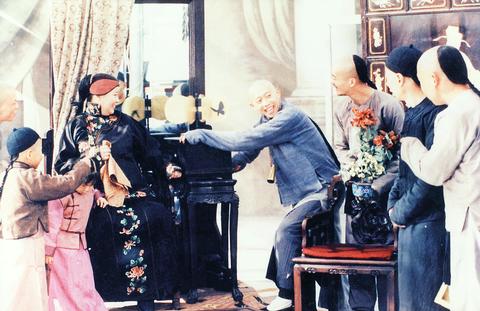
PHOTO COURTESY OF CMPC
The plot of Shadow Magic is based loosely on the life of Chinese filmmaking pioneer Liu Jinglun (劉京倫) and his production of the first silent film in China in 1902. Jared Harris (Happiness, I Shot Andy Warhol, Smoke) plays a threadbare entrepreneur, Raymond Wallace, who is in China hoping to sell the West's latest invention -- moving pictures. Wallace's show, called "Shadow Magic," enjoys little success until he meets Liu, a young photographer played by Xia Yu (夏雨).
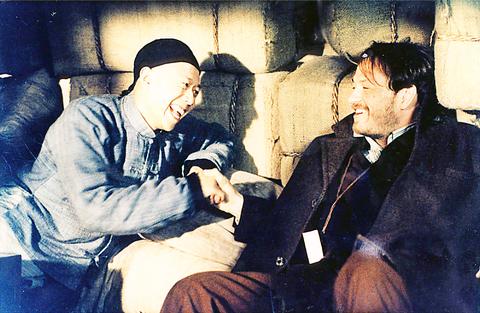
PHOTO COURTESY OF CMPC
Liu, a photographer at a Beijing photography shop, is fascinated by the much-maligned and "useless" foreign "gadgetry" of photos and film. His interests eventually connect him with Wallace, and he begins to help with the "Shadow Magic" show.
But Chinese society at the time felt intense animosity toward foreigners and was deeply suspicious of all elements of Western culture. Liu is then forced to hide his friendship with Raymond from his employer and his father. His desire to learn the "foreigner's tricks" also jeopardizes his relationship with Ling, the woman he loves, who is the daughter of a man named Lord Tan. Tan happens to be China's most celebrated Chinese opera star at that time, and he unsurprisingly was contemptuous of movies in comparison with thousand-year-old Chinese performance art.
The most intriguing parts of the film deal with the collision of these two cultures and the ultimate compromises reached between the two. With humor and detail, Hu brings out people's apprehensive contact with film by showing audiences' astonished faces when they see images projected on a screen, the openly voiced suspicion and afterward the excited chatter and visible enjoyment. Even the Empress Dowager Cixi (慈禧太后), featured in a climactic scene, is won over: "The foreigners indeed excel at this. They know how to have fun."
Using magic as a metaphor, Hu hints at the value of film as a possible bridge between cultures. Liu has to convince his neighbors not to worry. "The black box can make you into a film, and you'll look the same in the film even 100 years later." At the end of the movie, one of Liu's neighbors who has become an avid movie fan, says: "even if the machine blows up again, I'll still go to the movies."
And don't forget Shadow Magic also features a love story, as Liu takes the bold step to pursue Ling in a "Western way" as taught by Wallace. Liu and Ling -- played by rising starlet Xing Yufei (邢宇飛) -- indulge in slight flirtation when Ling asks Liu to take her photo.
The love story provides a refreshingly light-hearted backdrop for the documentary nature of the story of film's arrival in China, and as the Chinese audiences begin to appreciate movies and shake off their initial fears of the medium, we see film acting as a force for mutual understanding. This is Ann Hu's own magic.
Film Notes:
Shadow Magic
Written by: Ann Hu
Taiwan release: Feb. 24
Running time: 115 minutes
Rated: Not rated
Starring: Xia Yu, Jared Harris, Xing Yufei
For many people, Bilingual Nation 2030 begins and ends in the classroom. Since the policy was launched in 2018, the debate has centered on students, teachers and the pressure placed on schools. Yet the policy was never solely about English education. The government’s official plan also calls for bilingualization in Taiwan’s government services, laws and regulations, and living environment. The goal is to make Taiwan more inclusive and accessible to international enterprises and talent and better prepared for global economic and trade conditions. After eight years, that grand vision is due for a pulse check. RULES THAT CAN BE READ For Harper Chen (陳虹宇), an adviser

Traditionally, indigenous people in Taiwan’s mountains practice swidden cultivation, or “slash and burn” agriculture, a practice common in human history. According to a 2016 research article in the International Journal of Environmental Sustainability, among the Atayal people, this began with a search for suitable forested slopeland. The trees are burnt for fertilizer and the land cleared of stones. The stones and wood are then piled up to make fences, while both dead and standing trees are retained on the plot. The fences are used to grow climbing crops like squash and beans. The plot itself supports farming for three years.
President William Lai (賴清德) on Nov. 25 last year announced in a Washington Post op-ed that “my government will introduce a historic US$40 billion supplementary defense budget, an investment that underscores our commitment to defending Taiwan’s democracy.” Lai promised “significant new arms acquisitions from the United States” and to “invest in cutting-edge technologies and expand Taiwan’s defense industrial base,” to “bolster deterrence by inserting greater costs and uncertainties into Beijing’s decision-making on the use of force.” Announcing it in the Washington Post was a strategic gamble, both geopolitically and domestically, with Taiwan’s international credibility at stake. But Lai’s message was exactly

May 4 to May 10 It was once said that if you hadn’t performed at the Sapphire Grand Cabaret (藍寶石大歌廳), you couldn’t truly be considered a star. Taking the stage at the legendary Kaohsiung club was more than just a concert. Performers were expected to entertain in every sense, wearing outlandish or revealing costumes and staying quick on their feet as sharp-tongued, over-the-top hosts asked questions and delivered jokes that would be seen as vulgar, even offensive, by today’s standards. Opening in May 1967 during a period of strict political and social control, Sapphire offered a rare outlet for audiences in


 RSS
RSS