


The Taiwan Decoration Bulb and Light-Set Exporters' Association is located in a drab little office on the second floor of a typical Taipei apartment building. Though the office used to be the central headquarters for the world's largest Christmas light export industry, its halls are hardly decked; all that flickers here now is a TV screen.
"They've all gone to China," says Chang Chung-hsiung (張忠雄), the association's chief executive, who sits in front of shelves of dusty binders pushing some papers around. A retired public servant, Chang takes care of the odds and ends that still come through one of Santa's abandoned workshops.
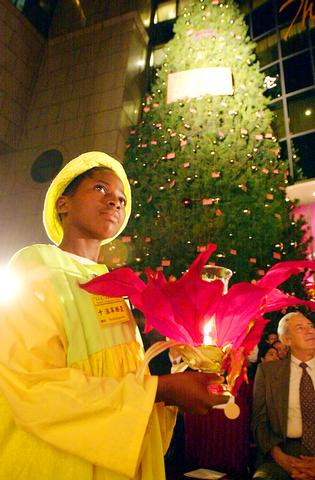
PHOTO: CHIANG YING-YING, TAIPEI TIMES
Yet if the twinkle is gone from TDB & LSEA, it has nothing to do with Taiwanese companies not making Christmas lights anymore. It's just that they don't make them in Taiwan. Around 90 percent of the strings, nets and ropes of ornamental lights currently sold in the US are still supplied by Taiwanese companies, most of which operate factories in China. Last year, China exported more than US$358 million in Christmas lights to the US alone. Most of that production was once located in Taiwan, which exported US$247 million in blinking strands in 1988. Last year, however, the island's export total came to only US$5.5 million.
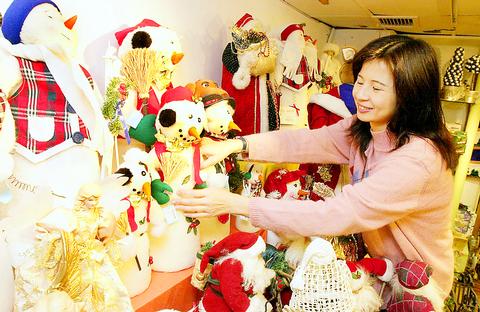
PHOTO: CHIANG YING-YING, TAIPEI TIMES
"There are still 65 companies [manufacturing Christmas decorations] in Taiwan," says Chang, "but most of them only keep their R&D, administration and sales here. If you're talking about companies with factories here, there are only four."
The ebb tide began in the late 1980s, on the heels of the industry's biggest boom. It was during that era that Taiwan made its name with mini-lights, those now ubiquitous strings of 50 clear 2.5 volt bulbs that are twined onto forest green wires.
Tiffany Feng (馮永璇), a 27-year-old Taipei office worker, remembers making mini-lights during her elementary school days more than 15 years ago. "My neighbor would bring home the materials from the factory and distribute them around," she said. "Lots of my classmates did it too. I was only about 10 years old, and it was kind of like a game. We had to thread the two leads from the bulbs into their bases and then twist the wires together. It was all by hand, and it would take me all day to do one giant bag. For that I'd only get paid NT$10."
At her present office job, Feng now easily makes over a hundred times her former wage as one of Santa's little helpers. "Not many people do that anymore, but there are still a few, like my neighbors -- mostly older people who could use some extra money," she said.
Since Taiwan's economy has largely risen above such low-pay menial work, local Christmas companies focus almost exclusively on product development, often borrowing from the island's electronics industry. "The ICs [integrated circuits] have gotten really cheap. They're in everything now," said Michael Chang (
The "everything" Chang speaks of includes dancing Santa Claus manikins, which are getting more advanced all the time. "Last year he could just sing a song and swivel a little bit. This year he can shake his butt," said Chung, proprietress of Jin May, a Christmas decorations store on Taipei's Chunghshiao East Road.
Santas aside, the ICs are also widely used in the light sets, where they allow either eight or 16 different flashing sequences depending on the type of chip used. According to the description on one box, the chips will enable the lights on this year's Christmas trees to twinkle "in waves," "chasing flashing," or else just "slo-glo." Another development has come in the bulbs, which are often plastic and shaped like Frosty the Snowman rather than conventional glass globes. "They can use plastic bulbs because the light comes from LEDs, which have a low temperature," said Chang.
LEDs (light-emitting diodes) don't get very hot because they produce light by running electricity through a semiconductor chip, not by heating up a wire filament as in conventional incandescent bulbs. Pointing at a strip of red and yellow LED lights, Chang notes, "These won't set your tree on fire." Not that Taiwan or China made PVC Christmas trees would be likely to burn; they'd probably melt first. Last year, Taiwan exported around US$1.5 million in plastic pines, a paltry sum compared to the industry's finest years. Like lights and other ornaments, the tree companies have survived by migrating to China, so little manufacturing is left in Taiwan. "The factory price of a 1.7m PVC tree is only US$7," said Alan Chang (張聰達) of the Monita Decoration Industry Company, another exporter of plastic Christmas cheer. "You need to ship hundreds or thousands of [shipping] containers to get that kind of price, and it's more efficient to do that in China." Since profit margins are tight on NT$7 trees, designers have been looking for new gimmicks. One of the more recent is fiber optic trees, which make use of fiber optic strands that look like swaying pine needles. When the trees are turned on, the needles shoot multi-colored light from their tips. The final effect creates a series of in-tree starbursts that are constantly changing colors. But like everything else, the fiber optic trees are largely produced in the China -- which, like all the other Christmas product migrations, hardly bothers anyone on this side of the Taiwan Strait.
"Almost all of Taiwan's manufacturers have gone over to China, but the companies just basically buy the manufacturing services they can find there. The main profit always comes back to Taiwan," said Richard Lin, CEO of the POP Three Dimensional Picture Co, which makes puffy polystyrene Santa Claus wall plaques for Walmart, K-mart and other retailers.
Strangely, however, Lin hasn't taken his own advice. Instead, he finds himself as the odd reindeer in the herd. After manufacturing for 20 years in Taiwan, he's still here. Moreover, he says he doesn't have any plans to leave. "Our business is steady here," he said. "I wouldn't exactly say we're high end, but we have the advantage of having a licensed design from the US. To Westerners it looks a lot more Christmasy than, say, a Santa Claus designed in. China."
Note: Most of the products mentioned above and many others can be found at the following retail outlets in Taipei : Shine Meei (鑫美外銷進口藝品), 53 Tunhwa S. Rd., Sec. 1, Lane 190 (敦化南路一段190巷53號) and Jin May (津美外銷藝品公司), 41 Tunhwa S. Rd., Sec. 1, Lane 190 (敦化南路一段190巷41號). Both are near Sogo.
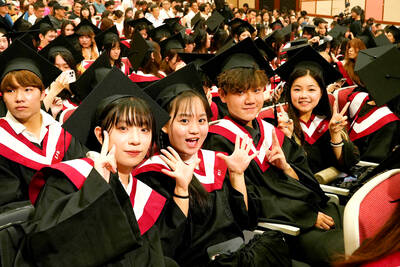
Taiwan’s English education system is being pulled apart by three opposing forces. Bilingual Nation 2030 pulls students toward English and global communication. Artificial Intelligence (AI) readiness pulls them toward digital judgment, verification and AI-mediated work. But Taiwan’s old exam culture pulls them back toward memorization, grammar drills, timed reading and correct answers. If the education system keeps using old exams to define success, it risks producing graduates who are neither genuinely bilingual nor genuinely AI-ready, but trained for tasks machines can already perform. The first force is Bilingual Nation 2030. Launched in 2018, the policy aimed to “help Taiwan’s workforce connect
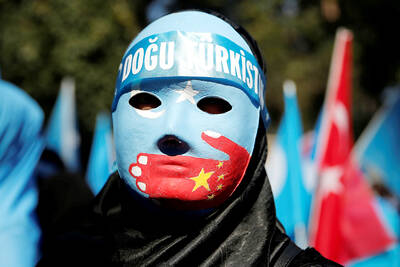
It seems every few days one bumps into one of those “real man” comments in which Taiwan is urged to “face reality” or similar, and “make a deal,” with the speaker implying that soon it will be too late. “Deal” advocates always present themselves as having a superior grip on reality, and the manly ability to make the “hard choice.” Their testosterone-laden language often echoes that of Taiwan sellout advocates. Note that such commentary always specifies a process (“make a deal, work with, make progress”), never the end state of what occupation by a violent authoritarian colonialist state will entail. In
June 1 to June 7 "If all Taiwanese were as afraid of dying as you, then what would happen?” Physician Shih Chiang-nan (施江南) reportedly said this to his wife Chen Chiao-tung (陳焦桐) after she urged him to stop intervening on behalf of Taiwanese soldiers stranded overseas after serving in the Japanese Army during World War II. Shih had clashed with high-ranking officials over the issue, engaged in several heated arguments with Taiwan governor-general Chen Yi (陳儀) and allegedly shouted at general Ko Yuan-fen (柯遠芬), chief of staff of the Taiwan Garrison Command, over

“Taiwan’s Opposition Leader Comes to US With a Message Straight Out of Beijing” read a May 31 headline in the Wall Street Journal. Top US administration officials and members of Congress almost certainly read the WSJ, and if there was a bullet point takeaway that people in Washington should absorb ahead of Chinese Nationalist Party (KMT) Chair Cheng Li-wun’s (鄭麗文) arrival in DC on June 9, that headline is it. The last few columns have discussed this very topic, and the timing is not coincidental. While those top officials likely do not read the Taipei Times, judging by the number


 RSS
RSS