

In a summer of intense political maneuvering, Taiwanese, whose democratic vibrancy is a constant rebuke to Beijing’s authoritarianism, delivered a powerful verdict not on China, but on their own political leaders. Two high-profile recall campaigns, driven by the ruling party against its opposition,
Taiwan’s summer of recalls has ended. Thirty-one Chinese Nationalist Party (KMT) legislators targeted across two waves of voting all remain in their seats. On paper, it was a decisive defeat for recall campaigners. In reality, the real recall Taiwan faces is not about removing individual lawmakers f
A passage in ancient Chinese text Guanzi (管子) says: “Laws are the yardsticks of all realms and the guidelines of all things.”The 4,258 forgeries in the recall petitions initiated by the Chinese Nationalist Party (KMT) were more than unauthorized signatures; each of them commandeered the voice of a c
EDITORIAL CARTOON
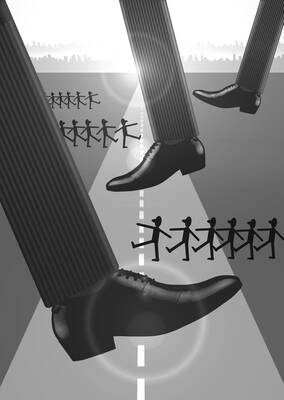
Hardly a day goes by without a new insult being hurled in the faces of asylum seekers and refugees. We are scroungers, rapists, fighting-age men who should not have left our home countries. Sometimes we are simply “illegals,” the most dehumanizing term of all. When did it become a crime to run for y
You might not be familiar with the word “clanker.” Its roots come from the Star Wars franchise — in which a “clanker” is a derogatory term used to refer to droids, or robots — but it has entered the Gen Z lexicon as a blanket derogatory term for artificial intelligence (AI) and robots.In viral TikTo
India has stunned its online gaming industry by moving legislation to ban real-money stakes. At first blush, the reasons for hitting the kill switch appear valid. Rising addiction, money laundering and financial frauds through such apps are all serious problems.However, have policymakers thought thr
Much like the first round on July 26, Saturday’s second wave of recall elections — this time targeting seven Chinese Nationalist Party (KMT) lawmakers — also failed. With all 31 KMT legislators who faced recall this summer secure in their posts, the mass recall campaign has come to an end.The outcom
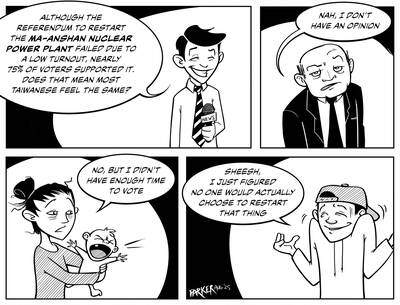
For many, the hardest part of Saturday’s recall elections and the referendum on restarting the Ma-anshan Nuclear Power Plant in Pingtung was not the outcome itself, but the perception gap and sense of helplessness when the majority seemed to endorse views different from their own.Supporters of exten
The urgency of the climate crisis is sharpening global debates about how to secure the resources needed for a clean energy transition. Lithium, cobalt, nickel and rare earth elements are the backbone of decarbonization. Without them, batteries cannot store renewable energy, electric vehicles cannot
Voters returned to the polls on Saturday for the second time in less than a month to cast ballots in seven legislative districts on recall motions targeting Chinese Nationalist Party (KMT) lawmakers. None succeeded. At the same time, a KMT-backed national referendum on nuclear power also failed to c
Civic movement a milestoneThe recall votes on July 26 and yesterday have concluded. The chief reason none succeeded was the Chinese Nationalist Party’s (KMT) ability to mobilize its members, including party workers under investigation for forging documents, many of whom have already admitted guilt.
EDITORIAL CARTOON

Sat beside his Ukrainian counterpart in the White House this week, US President Donald Trump explained why he had dropped the idea of trying to pressure Russia into a ceasefire: They are nice to have, but not necessary, he said — just look at the six wars he had already ended, none of which involved
The idea of the “revolving door” at the Kantei, or the offices of Japan’s prime minister, is a long-standing trope of English-language coverage of politics. It became part of the parlance in the 1990s, amid US impatience at how frequently things changed at the top while the country went through succ
Yesterday’s recall and referendum votes garnered mixed results for the Chinese Nationalist Party (KMT). All seven of the KMT lawmakers up for a recall survived the vote, and by a convincing margin of, on average, 35 percent agreeing versus 65 percent disagreeing. However, the referendum sponsored by
A recent critique of former British prime minister Boris Johnson’s speech in Taiwan (“Invite ‘will-bes,’ not has-beens,” by Sasha B. Chhabra, Aug. 12, page 8) seriously misinterpreted his remarks, twisting them to fit a preconceived narrative. As a Taiwanese who witnessed his political rise and fall
The administration of US President Donald Trump dropped a bombshell in its recent proposal to take equity stakes in companies getting funds from the 2022 CHIPS and Science Act, as it has triggered a perfect storm surrounding Taiwan Semiconductor Manufacturing Co’s (TSMC) management autonomy and core
Earlier this month, I went on a Mediterranean cruise organized by a Taiwanese travel agency. The cruise departed from Barcelona, Spain, and made stops in Gibraltar, Marseille and Genoa, before ending in Rome. Each of the southern European countries I visited had their own unique charm. Barcelona is


 RSS
RSS