


The man and woman are wearing blue hospital gowns and clear face shields. Doctors James Sones and Indu Srinivasan are in a room in the Division of Digestive Diseases at the University of Mississippi Medical Center in Jackson. They are about to create something that has spread through medicine like, well, a shitstorm.
Sones takes a brown gloopy material and spoons it into what looks like a regular kitchen blender. The camera zooms in to a label on it: fecal blender. The brown gloopy stuff is, depending on your profession and level of politeness, fecal matter, stool, excrement or poo. It has been donated by a generous volunteer and it is almost certainly going to transform the life of the person who is going to receive it.
Once blended and mixed with saline, the brown stuff is poured into large syringes and infused into a willing patient by colonoscopy (nasogastric tubes and enemas are other delivery methods).
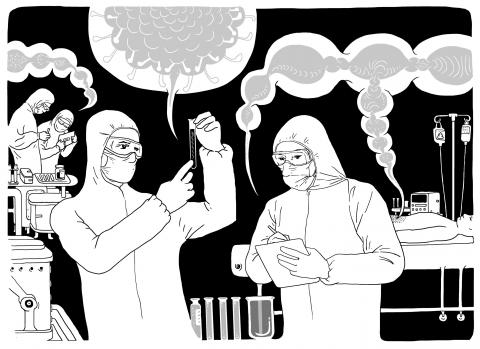
Illustration: Mountain People
In the UK, this treatment is available for patients suffering from repeated infections of Clostridium difficile or C diff.
These bacteria can live harmlessly inside us, but in patients who are given strong antibiotics, C diff can survive, overwhelm a gut wiped of its microbiome, then secrete a toxin that causes severe pain, awful diarrhea and vomiting. In the worst cases, it can be fatal.
Even when vanquished by antibiotics, it can return except if the patient receives an infusion of poo, a procedure known as a fecal microbiota transplant (FMT).
Human waste is a misnomer. What we excrete contains nutrients and bacteria, and it can be a useful fertilizer or fuel. That the bacteria it contains can also cure ailing guts was known by ancient Chinese writers, who wrote of “yellow soup” (assumed to have been liquidized excrement), which was used to treat food poisoning and bad diarrhea.
A US surgeon, Ben Eiseman, resurrected the procedure in 1958, but then the antibiotic vancomycin was discovered and became the standard treatment for C diff.
Yet when antibiotics began failing, enterprising doctors began to try FMT to restore a damaged microbiome. The success rates were astounding: About 90 percent of patients with recurrent C diff were cured.
In 2013, Dutch researchers halted a randomized control trial — the gold standard of medical trials — because FMT was so much more effective than vancomycin.
By 2014, the procedure was accepted enough that the UK National Institute for Health and Care Excellence issued guidelines allowing fecal transplants to be used in clinical practice, but only for C diff.
Even so, says Tariq Iqbal of the Microbiome Treatment Centre (MTC) at the University of Birmingham, “it was very poorly taken up. Only about 30 hospitals [in the UK] had ever done a fecal transplant. Only four had done 10 or more.”
Partly, there was a supply problem: Where was the poo to come from? In the early years of FMT, patients were often infused with fecal material donated by a close relative or friend.
Slowly, though, the concept of a stool donor emerged. Now, MTC is one of only two licensed stool banks in the UK, and in its first year of operation sent out 150 samples, at a cost of £650 (US$845) for each 50ml.
Donors are recruited by poster and word of mouth.
Iqbal says they need to drop off their stools for 10 days in a row before 11am — so they have to be regular in more ways than one. Although MTC is next to Queen Elizabeth Hospital, healthcare workers are excluded because they are exposed to too many bugs.
Screening is rigorous: It has to be, when each sample can be different.
More than 90 percent of volunteers are turned away. For safety reasons, each sample is kept for three months before being used, in case a donor is incubating something. A sample will be kept indefinitely, too. The screening tests are as severe as the donor questionnaires: All samples are tested for a wide range of pathogens.
What does a finished FMT sample look like? Does it smell?
Iqbal looks at my coffee cup.
“It’s the color of latte,” he says.
And yes, of course it smells, “it’s shit,” he says.
Patients have no problem accepting the procedure, he says. They would not smell it, for a start, in a nasogastric tube or colonoscopy. And you can not afford an ick factor when you are desperately ill.
James Elliot, 50, a company director from Dudley, developed ulcerative colitis in his 30s. He would take antibiotics and be well, then relapse. His diarrhea was so bad that he had to go to the toilet 50 times a day.
Then Iqbal told him about FMT. Although he didn’t have C diff, he could get the procedure as part of a planned clinical trial into colitis and FMT.
He had an enema of FMT once a week for eight weeks.
“After six weeks, there was a drastic improvement. After the course I was 90 percent to 95 percent well,” Elliot says.
He remembers clearly that it was during the FIFA World Cup two years ago, because when he went in for a final assessment by an internal camera, “the room went up in applause. I remember comparing it to watching England playing the night before and these people were cheering at my colon.”
Because it is so simple, widely available and seems so miraculous, the use of FMT has long since departed from sterile medical establishments into home bathrooms and YouTube.
If it transforms the microbiome so well for C diff , why should it not do it for other conditions? If the microbiome plays a part in all sorts of body functions from mood to metabolism, as research seems to show, why shouldn’t a dose of healthy poo sort out other problems, too?
There are more than 300 clinical trials listed on https://clinicaltrials.gov that are using FMT to treat a range of conditions including autism, dementia, anorexia and obesity. The most recent wants to explore FMT as a treatment for fecal incontinence (the inability to control bowel movements) in women.
However, Mark Wilcox, professor of medical microbiology at the University of Leeds, is circumspect.
“The thing that’s common about FMT is that, wherever you are, there are particular enthusiasts, and in the US in particular. It’s a major fee-earning opportunity in the US, but it is, like it or not, an experimental procedure,” Wilcox says.
Animal trials have shown that conditions and pre-conditions can be transmitted with the fecal material.
“There are data that gut bacteria play a role in gut cancers, blood pressure, diabetes, obesity. You can turn fat mice thin and thin mice fat by transplanting their gut bacteria,” he says. “Because we don’t know the full roles of the gut microbiome, you are potentially transferring someone’s bacteria that have something to do with cancer, diabetes, obesity and so on.”
Last year, two people participating in trials in the US contracted Escherichia coli from fecal transplants — one died — because samples had not been tested for that pathogen.
However, even this news does not stop people who can not get FMT on the UK’s National Health Service or cannot afford it in the US, where it can cost US$1,000, from doing their own thing.
Adrienne Grierson, an Australian filmmaker based in London, describes herself as “an antibiotic child.” Since then she has suffered “terrible stomach troubles” including “cramps, doubling over, vomiting, diarrhea, boiling hot flush, sweating, agony.”
In 2015, stuck in bed, she turned to Google and discovered fecal transplants and the microbiome.
“I thought: My God, I’ve been playing here with half a deck of cards. There’s only so much I can do with what I’ve destroyed,’” she says.
She paid for 10 FMTs from a private clinic and “by the third day, it was like somebody had switched my brain on, like the antibiotics used to do. And that was a shock. I hadn’t thought that far ahead. I just wanted my guts to not fall out,” she says.
Since then, Grierson has had fecal transplants every three months or so, although now she does it DIY, at home.
When we spoke, she had had a fecal infusion two days earlier, thanks to a friend.
“She poops in a bag and I plop it on a sieve, a couple of scoops. Then I pour saline and I mash it through so I don’t get all the big particles. Then I suck it up through a syringe and pretend I’m at a clinic,” she says.
Grierson paid for her friend to be comprehensively screened when she first started donating. Now, she trusts her to be healthy.
“If you do pick up other people’s characters and personalities, I really hope I get hers, because she’s really lovely. I have zero history of cancer in my family. I don’t come from sickly people. The concerns are, what if I can get all of that from somebody? You have to decide: Do you want to take a risk and live really well or do you want to keep on living like that?” Grierson says.
Iqbal has a clinician’s reaction to DIY fecal transplants.
“I think doing it yourself really needs to be a thing of the past, because we don’t know what we’re doing, really,” he says.
Although metagenomic tests to analyze bacteria are now far more affordable, there are countless unknowns about FMT and the microbiome.
“When you do metagenomics on stool samples, you still find a whole bunch of stuff that is not in the databases. It’s very early days,” Iqbal says.
FMT has even made its way into popular culture with a mention in an episode of South Park.
It is exciting enough for serious money to be invested in improving upon it.
Vedanta Biosciences, a large pharmaceutical company, is one of several working on developing a “rationally defined consortia of human microbiome-derived bacteria.”
In other words, distilling the useful stuff from poo into a safe, commercial product that probably will not be the color of latte or mixed in a blender.
Iqbal is convinced this will happen sooner rather than later.
“FMT is too empirical,” he says. “We need to understand the mechanisms. I hope in five years’ time we won’t be doing FMT any more.”
The Comedy Club on Fuxing N Road in Taipei was vandalized with paint bombs mixed with feces on May 29, allegedly because one of its performers had satirized Chinese President Xi Jinping (習近平). The incident has triggered concerns about the growing threat from China’s cross-border repression within Taiwan. On the day of the attack, a comedian surnamed Huang (黃), who is known for mocking Xi, was the headline performer. The Comedy Club founder said the assault was obviously politically motivated. China, which Freedom House said “conducts the most sophisticated, extensive and far-reaching campaign of transnational repression in the world,” has
China’s Taiwan Affairs Office spokesperson Zhu Fenglian (朱鳳蓮) at a press conference last week repeated the same, tired line, claiming that Taiwan’s future should be “decided jointly by the more than 1.4 billion Chinese people, including Taiwan compatriots.” The statement is absurd. Virtually every word is incorrect, with some parts mistaken to an astonishing degree. First, the People’s Republic of China (PRC) has never included Taiwan. When the Republic of China’s (ROC) original five-colored flag was established in 1912, Taiwan was still under Japanese rule. When the PRC was founded in 1949, Taiwan was under the control of president Chiang
Following the outbreak of conflict in Iran, TikTok was flooded with videos targeting Taiwanese users. Many featured artificial intelligence (AI)-generated anchors posing as Taiwanese broadcasters with localized traditional Chinese subtitles. The videos warned of imminent social collapse due to liquefied natural gas shortages, blamed the Democratic Progressive Party and its alleged failed energy policies for a fabricated crisis, and used recycled footage from unrelated events to create the impression Taiwan stood on the edge of systemic breakdown. By saturating the information environment with falsehoods or selectively edited material designed to trigger emotional responses, malign actors can exploit cognitive vulnerabilities and
Taiwan’s leading position in the global semiconductor industry is not, as some claim, based on misconceptions, a result of “stealing.” It was built upon formal, transparent and costly technology transfer agreements between the Taiwanese government and US enterprises half a century ago. According to the oral history of Hu Ding-hua (胡定華), a pioneer in Taiwan’s semiconductor industry, the origin of Taiwan’s integrated circuit (IC) technology dates back to the “IC pilot factory” in the 1970s. The implementation of this project fully complied with international commercial standards and legal procedures. First, the project completed formal contract signing and payment. In 1975,


 RSS
RSS