


The BBC Reith Lectures in 1967 were given by Edmund Leach, a Cambridge social anthropologist.
“Men have become like gods,” Leach began. “Isn’t it about time that we understood our divinity? Science offers us total mastery over our environment and over our destiny, yet instead of rejoicing, we feel deeply afraid.”
That was about half a century ago and yet Leach’s opening lines could easily apply to today.
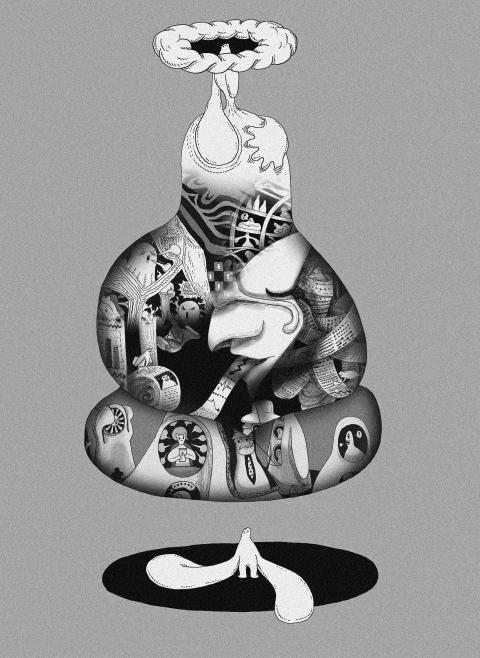
Illustration: Mountain People
He was speaking before the Internet had been built and long before the human genome had been decoded and so his claim about men becoming “like gods” seems relatively modest compared with the capabilities that molecular biology and computing have subsequently bestowed upon us.
Our science-based culture is the most powerful in history and it is ceaselessly researching, exploring, developing and growing.
However, in recent times it seems to have also become plagued with existential angst as the implications of human ingenuity begin to be dimly glimpsed.
The title that Leach chose for his Reith Lecture — “A Runaway World” — captures our zeitgeist too. At any rate, we are also increasingly fretful about a world that seems to be running out of control, largely, but not solely, because of information technology and what the life sciences are making possible.
We seek consolation in the thought that “it was always thus”: People felt alarmed about steam in George Eliot’s time and got worked up about electricity, the telegraph and the telephone as they arrived on the scene. The reassuring implication is that we weathered those technological storms, and so we will weather this one too. Humankind will muddle through.
However, in the past five years or so even that cautious, pragmatic optimism has begun to erode. There are several reasons for this loss of confidence. One is the sheer vertiginous pace of technological change. Another is that the new forces at loose in our society — particularly information technology and the life sciences — are potentially more far-reaching in their implications than steam or electricity ever were. And, third, we have begun to see startling advances in these fields that have forced us to recalibrate our expectations.
A classic example is the field of artificial intelligence (AI), defined as the quest to enable machines to do things that would require intelligence if performed by a human.
For as long as most of us can remember, AI in that sense was always 20 years away from the date of prediction. Maybe it still is, but in the past few years we have seen that the combination of “machine learning,” powerful algorithms, vast processing power and so-called “Big Data” can enable machines to do very impressive things — real-time language translation, for example, or driving cars safely through complex urban environments — that seemed implausible even a decade ago.
And this, in turn, has led to a renewal of excited speculation about the possibility — and the existential risks — of the “intelligence explosion” that would be caused by inventing a machine that was capable of recursive self-improvement.
This possibility was first raised in 1965 by the British cryptographer I.J. Good, who famously wrote: “The first ultraintelligent machine is the last invention that man need ever make, provided that the machine is docile enough to tell us how to keep it under control.”
Fifty years later, we find contemporary thinkers like Nick Bostrom and Murray Shanahan taking the idea seriously.
There is a sense that we are approaching another “end of history” moment, but with a difference. In his famous 1989 article, political scientist Francis Fukuyama argued that the collapse of the Soviet empire meant the end of the great ideological battle between East and West and the “universalization of Western liberal democracy as the final form of human government.” This was a bold, but not implausible, claim at the time.
What Fukuyama could not have known is that a new challenge to liberal democracy would eventually materialize and that its primary roots would lie not in ideology, but in bioscience and information technology.
For that, in a nutshell, is the central argument of Yuval Noah Harari’s new book, Homo Deus: A Brief History of Tomorrow. In a way, it is a logical extension of his previous book, Sapiens: A Brief History of Humankind, which chronicled the entire span of human history, from the evolution of Homo sapiens in the stone age up to the political and technological revolutions of the 21st century, and deservedly became a world bestseller.
Most writers on the implications of new technology focus too much on the technology and too little on society’s role in shaping it. That is partly because those who are interested in these things are — like the engineers who create the stuff — determinists: They believe that technology drives history. And, at heart, Harari is a determinist too.
“In the early 21st century the train of progress is again pulling out of the station and this will probably be the last train ever to leave the station called Homo sapiens,” he writes in a striking passage. “Those who miss this train will never get a second chance. In order to get a seat on it, you need to understand 21st century technology and in particular the powers of biotechnology and computer algorithms.”
“These powers are far more potent than steam and the telegraph and they will not be used mainly for the production of food, textiles, vehicles and weapons. The main products of the 21st century will be bodies, brains and minds, and the gap between those who know how to engineer bodies and brains and those who do not will be wider than the gap between Dickens’ Britain and the Madhi’s Sudan. Indeed, it will be bigger than the gap between sapiens and Neanderthals. In the 21st century, those who ride the train of progress will acquire divine abilities of creation and destruction, while those left behind will face extinction,” he says.
This looks like determinism on steroids. What saves it from ridicule is that Harari sets the scientific and technological story within a historically informed analysis of how liberal democracy evolved. And he provides a plausible account of how the defining features of the liberal democratic order might indeed be upended by the astonishing knowledge and tools that we have produced in the past half-century. So while one might, in the end, disagree with his conclusions, one can at least see how he reached them.
In a way, it is a story about the evolution and nature of modernity. For most of human history, Harari argues, humans believed in a cosmic order. Their world was ruled by inscrutable, omnipotent gods who exercised their power in capricious and incomprehensible ways. The best one could do was to try to placate these terrifying powers and obey — and pay taxes to — the priesthoods who claimed to be the anointed intermediaries between mere humans and the gods. It might have been a dog’s life, but at least you knew where you stood, and in that sense belief in a transcendental order gave meaning to human lives.
Then came science. Harari argues that the history of modernity is best told as a struggle between science and religion. In theory, both were interested in truth, but in different kinds of truth. Religion was primarily interested in order, whereas science, as it evolved, was primarily interested in power — the power that comes from understanding why and how things happen and enables us to cure diseases, fight wars and produce food, among other things.
In the end, in some parts of the world at least, science triumphed: belief in a transcendental order was relegated to the sidelines, or even to the dustbin of history. As science progressed, we did indeed start to acquire powers that in pre-modern times were supposed to be possessed only by gods, which was Edmund Leach’s point.
However, if “God was dead,” as Nietzsche famously said, where would humans find meaning?
“The modern world promised us unprecedented power and the promise has been kept,” Harari writes. “Now what about the price? In exchange for power, the modern deal expects us to give up on meaning. How did humans handle this chilling demand... How did morality, beauty and even compassion survive in a world of gods, of heaven or hell?”
The answer, he writes, was in a new kind of religion: humanism — a belief system that “sanctifies the life, happiness and power of Homo sapiens.”
So the deal that defined modern society was a covenant between humanism and science in which the latter provided the means for achieving the ends specified by the former.
And our looming existential crisis, as Harari sees it, comes from the fact that this covenant is destined to fall apart in this century. For one of the inescapable implications of bioscience and information technology is that they will undermine and ultimately destroy the foundations on which humanism is built.
And since liberal democracy is constructed on the worship of humanist goals — “life, liberty and the pursuit of happiness” by citizens who are “created equal,” as the founders of the US put it — then our new powers are going to tear liberal democracy apart.
How come? Well, modern society is organized around a combination of individualism, human rights, democracy and the free market. And each of these foundations is being eaten away by 21st-century science and technology. The life sciences are undermining the individualism so celebrated by the humanist tradition with research suggesting that “the free individual is just a fictional tale concocted by an assembly of biochemical algorithms.”
Similarly with the idea that we have wills. People may have freedom to choose between alternatives, but the range of possibilities is determined elsewhere. And that range is increasingly determined by external algorithms as the “surveillance capitalism” practised by Google, Amazon and co becomes ubiquitous — to the point where Internet companies will eventually know what your desires are before you do. And so on.
Where is this heading? Here Harari ventures into the kind of dystopian territory that Aldous Huxley would recognize. He sees three broad directions:
First, humans will lose their economic and military usefulness and the economic system will stop attaching much value to them.
Second, the system will still find value in humans collectively, but not in unique individuals.
Third, the system will, however, find value in some unique individuals, “but these will be a new race of upgraded superhumans rather than the mass of the population.”
By “system,” he means the new kind of society that will evolve as bioscience and information technology progress at their current breakneck pace. As before, this society will be based on a deal between religion and science, but this time humanism will be displaced by what Harari calls “dataism” — a belief that the universe consists of data flows and the value of any entity or phenomenon is determined by its contribution to data processing.
Personally, I am not convinced by his dataism idea: The technocratic ideology underpinning our current obsession with “Big Data” will eventually collapse under the weight of its own absurdity. However, in two other areas, Harari is exceedingly perceptive.
The first is that our confident belief that we cannot be superseded by machines because we have consciousness and they cannot have it might be naive. Not because machine consciousness would be possible, but because for Harari’s dystopia to arrive, consciousness is not required. We require machines that are super-intelligent: intelligence is necessary; consciousness is an optional extra that in most cases would simply be a nuisance. Therefore it is not a showstopper for AI development.
The second is that I am sure that his reading of the potential of bioscience is accurate. Even the Economist magazine recently ran a cover story entitled: “Cheating death: the science that can extend your lifespan.”
However, the exciting new possibilities offered by genetic technology would be expensive and available only to elites. So the long century in which medicine had a “leveling up” effect on human populations, bringing good healthcare within the reach of most people, has come to an end.
Even today, rich people live longer and healthier lives. In a couple of decades, that gap will widen into a chasm.
Homo Deus is a remarkable book, full of insights and thoughtful reinterpretations of what we thought we knew about ourselves and our history. In some cases it seems to me to be naive about the potential of information technology. What is really valuable about it is the way it grounds speculation about sci-tech in the context of how liberal democracy evolved.
One measure of Harari’s achievement is that one has to look a long way back — to 1934, in fact, the year when Lewis Mumford’s Technics and Civilization was published — for a book with comparable ambition and scope. Not bad going for a young historian.
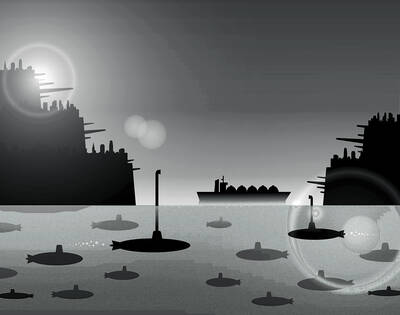
In the event of a war with China, Taiwan has some surprisingly tough defenses that could make it as difficult to tackle as a porcupine: A shoreline dotted with swamps, rocks and concrete barriers; conscription for all adult men; highways and airports that are built to double as hardened combat facilities. This porcupine has a soft underbelly, though, and the war in Iran is exposing it: energy. About 39,000 ships dock at Taiwan’s ports each year, more than the 30,000 that transit the Strait of Hormuz. About one-fifth of their inbound tonnage is coal, oil, refined fuels and liquefied natural gas (LNG),
On Monday, the day before Chinese Nationalist Party (KMT) Chairwoman Cheng Li-wun (鄭麗文) departed on her visit to China, the party released a promotional video titled “Only with peace can we ‘lie flat’” to highlight its desire to have peace across the Taiwan Strait. However, its use of the expression “lie flat” (tang ping, 躺平) drew sarcastic comments, with critics saying it sounded as if the party was “bowing down” to the Chinese Communist Party (CCP). Amid the controversy over the opposition parties blocking proposed defense budgets, Cheng departed for China after receiving an invitation from the CCP, with a meeting with
Chinese Nationalist Party (KMT) Chairwoman Cheng Li-wun (鄭麗文) is leading a delegation to China through Sunday. She is expected to meet with Chinese President Xi Jinping (習近平) in Beijing tomorrow. That date coincides with the anniversary of the signing of the Taiwan Relations Act (TRA), which marked a cornerstone of Taiwan-US relations. Staging their meeting on this date makes it clear that the Chinese Communist Party (CCP) intends to challenge the US and demonstrate its “authority” over Taiwan. Since the US severed official diplomatic relations with Taiwan in 1979, it has relied on the TRA as a legal basis for all
Taiwan ranks second globally in terms of share of population with a higher-education degree, with about 60 percent of Taiwanese holding a post-secondary or graduate degree, a survey by the Organisation for Economic Co-operation and Development showed. The findings are consistent with Ministry of the Interior data, which showed that as of the end of last year, 10.602 million Taiwanese had completed post-secondary education or higher. Among them, the number of women with graduate degrees was 786,000, an increase of 48.1 percent over the past decade and a faster rate of growth than among men. A highly educated population brings clear advantages.


 RSS
RSS