


There is much evidence that the Chinese Communist Party (CCP) is sending soldiers from the People’s Liberation Army (PLA) to support Russia’s invasion of Ukraine — and is learning lessons for a future war against Taiwan.
Until now, the CCP has claimed that they have not sent PLA personnel to support Russian aggression. On 18 April, Ukrainian President Volodymyr Zelinskiy announced that the CCP is supplying war supplies such as gunpowder, artillery, and weapons subcomponents to Russia. When Zelinskiy announced on 9 April that the Ukrainian Army had captured two Chinese nationals fighting with Russians on the front line with details of 168 Chinese, the PRC Ministry of Foreign Affairs claimed that Zelinskiy’s statement was “irresponsible.” Zelinskiy retorted that the CCP already knew about aggressive Russian recruitment of Chinese citizens and had done nothing to stop it.
In comparison, when Indian Prime Minister Narendra Modi heard that Russia recruited dozens of Indian nationals, he flew to Moscow and convinced Putin to return them to India. Chinese President Xi Jinping (習近平) has not interfered with Russian recruitment of Chinese “volunteers.”

But are all these Chinese males “volunteers,” and why would Xi not interfere in their recruitment?
What we know: The 168 Chinese males vary in age from 19 to 56. The Financial Times described them as having the following military occupations: drone operators, riflemen, snipers, gunners, and reconnaissance soldiers. They also have a variety of military ranks: private, junior sergeant and commander. These military occupations and ranks mean that many of these men had PLA military experience.
Article 26 of the PRC’s Military Service Law of the People’s Republic of China (2021) states all eighteen-year-olds are eligible for two-year conscription based on the needs of the PLA. After serving two years, some volunteer to remain in the PLA until age 55. Those soldiers who stayed beyond two years can become non-commissioned officers. Therefore, at a minimum, the Chinese males identified by Zelinskiy who have ranks above private were in the PLA beyond two years. The individuals who are older than fifty-five are likely senior PLA enlisted or officers. Given that there are more than 57 million PLA veterans, and the CCP is having difficulty finding jobs for them, we can assume that many of these 168 Chinese males are PLA veterans.
Why does the PLA want to get combat experience so badly?
Xi demanded the PLA prepare for war and be ready no later than 2027 for a Taiwan “contingency” — in other words, “war.”
On 11 April 2023, Xi presented a speech at the Southern Theater Command where he challenged those present “to strengthen training under actual combat conditions, deepen the study of war and operational issues, innovate the concepts of combat and the methods of combat and training.”
Consistent with Xi’s challenge, in August 2021, Russia and China conducted the Zapad 2021 exercise, which was a milestone in China-Russia joint military exercises. For the first time, the PLA established three-tiered joint bilingual (Russian-Chinese) command centers to ensure coordination between 10,000 PLA personnel and their 13,000 Russian counterparts. These troops were integrated into mixed units.
Russian and Chinese personnel that participated in Zapad/Interaction 2021 are continuing their collaboration in Russia/Ukraine. For example, Ukrainian Special Services Units discovered that the Chinese serve in the Russian Army’s 70th, 71st and 225th motorized rifle regiments, some of which also participated in Zapad/Interaction 2021.
The Zapad exercise occurred about six months before the February 2022 Russian invasion of Ukraine. Could this Zapad exercise have been preparation for the PLA deployment to Russia in support of Russia’s Ukraine invasion?
In April, Reuters reported that PLA officers are touring various locations close to Russia’s front line to derive lessons and improve tactics. The design of these “tours” address Xi’s directive to deepen their study of war and to improve the PLA’s combat training.
In addition to war zone tours, PLA soldiers are reportedly fighting Ukrainians using drones, long-range fires (artillery, rockets, missiles). Some PLA soldiers are on the front lines refining weapon systems tactics, such as anti-tank guided missile (ATGMs) fires. This is where the 168 Chinese males are relevant.
My sources reveal that Chinese mercenaries and active-duty PLA forces are deployed to the Russian front line. The PLA instructed these soldiers, if captured, to not reveal their PLA affiliation on the threat of death. If they reveal nothing about their deployment to Ukraine, they will return as war heroes to their units. All captured Chinese males are telling the same story: they are volunteers and have nothing to do with the PLA. But we know that many of these males are PLA veterans who are in the PLA reserves.
Without these Chinese “volunteers” fighting against the Ukrainians, the CCP would not have a “cover story” for active-duty PLA soldiers.
The CCP lies, especially about military issues, to deceive Western adversaries about their intent and capabilities. During the Korean War, Mao Zedong (毛澤東) changed the name of the PLA soldiers fighting against the UN to “People’s Volunteer Army” to disguise their true PLA affiliation.
The last time that the PLA fought a war was in 1979 against Vietnam, which lasted for a month. Some 7,000 PLA soldiers were killed and 15,000 wounded according to PRC sources, but Western sources claim about 28,000 dead and 43,000 injured.
In 2016, during the Battle of Juba, the UN tasked PLA troops (UN peacekeepers) to protect civilians from marauding bandits. PLA soldiers abandoned their posts and left civilians, for which they were responsible, to their own devices. The CCP falsely claimed that PLA forces did not betray these South Sudanese civilians even though several other investigations claimed otherwise.
In the June 2020 Galwan Valley attack, India reported that the PLA killed 20 Indian soldiers. China did not report casualties. Nine months later, a PLA spokesman stated four PLA soldiers had died “heroically.” Exhaustive investigative research later revealed that 38 PLA soldiers were killed in the fighting, twice as many as the Indian troops killed by the PLA.
These cases demonstrate that the CCP lies, which should alert us to Chinese lies about their combat activities in Ukraine.
My research indicates the PLA rotates troops from its Theater Commands into Russia/Ukraine. Since February 2022, up to 18,000 PLA military personnel may have rotated into Russian units to gain combat experience/knowledge. Currently, there are about 6,000 PLA troops forward deployed in Russia/Ukraine. Most of these PLA troops are in command centers observing operations, rather than fighting.
Some analysts have identified specific PLA units deployed to Russia/Ukraine. For example, personnel from the 127th Medium Combined Arms Brigade (CAB) (about 6,000 personnel), the best unit in PLA history, rotate into Ukraine. The 127th CAB is part of the 82nd Group Army (GA), which is the best equipped and trained GA in China. The 82nd GA is tasked to guard Beijing and evaluate the latest equipment and update doctrine.
PLA combined arms brigades specialize in UAVs, ATGM, and long-range fires (artillery, rockets, missiles, long guns), which are the weapon systems used extensively against Ukraine. These CABs would be the PLA’s main maneuver units if the PLA invades Taiwan.
Other PLA units rotating into Ukraine include the elite Tiger Regiment (based in Beijing), the 11th Motorized Infantry Division (East Turkestan) (about 13,000 personnel), and the 80th Group Army (Shandong Province) (50,000-60,000 personnel).
Why does the CCP want the PLA to gain combat experience and combat preparedness?
Some analysts believe the conditions favoring a successful PLA invasion are disappearing. For example, US forces training ROC forces in Taiwan and in the US — in accordance with the National Defense Authorization Acts (for fiscal years 2023 and 2024) — is a bad trend for the PLA. ROC military lethality increases as more units receive advanced American training. This relationship between training and lethality was observed in Ukraine. US President Trump authorized lethal force training for Ukrainian military forces during his first term. My Ukrainian sources assert that the US’s and NATO’s lethal training to Ukraine enabled Ukrainian military forces to resist and stall the Russian invasion.
A second condition concerns the quantity of munitions available to the ROC military. The US is energizing its industrial base to produce weapons and munitions. Within a few years the US will be able to produce in quantity weapons needed to effectively repel a PLA invasion force. The sooner the CCP acts, the less prepared the US will be.
Third, Xi said that he would not pass the Taiwan issue to the next generation. This assertion means he intends to annex Taiwan. At 71, Xi has certain ailments, and his opportunities are declining.
PLA combat experience and learning from the Russian invasion of Ukraine is dangerous for Taiwan and other Indo-Pacific countries.
First, assuming effective PLA organizational processes to identify and correct doctrinal and operational errors and implement effective corrections, the PLA learns from its combat experience in Ukraine. Taiwan’s military is not being exposed to equivalent stimuli and applying that experience to refine its military doctrine and plans.
Second, Xi believes the PLA is learning from combat in Ukraine, and the Ukraine combat experience increases the PLA’s ability to defeat Taiwan. PLA military leaders share Xi’s confidence that Russia’s Ukraine adventure is a useful laboratory from which to improve the PLA’s operational capability and lethality.
Third, the PLA’s Ukraine experience also corrects tactics regarding the use of drones, anti-tank-guided-missiles, and long-range fires. The PLA will adapt these weapon systems for land, sea, and air operations.
Fourth, the PLA will apply ideas developed with Russia against the Ukrainians and their supporters for psychological operations against Taiwan and its allies. The CCP also has refined ideas to counter and avoid US economic sanctions imposed on Russia, and how to prepare to defeat a sanctions regime applied against them.
PRC officials say they are not party to the Russia-Ukraine war. Yet, the details noted above indicate that China is a co-belligerent, and Ukraine’s allies should treat China as they do Russia.
Guermantes Lailari is a retired US Air Force Foreign Area officer specializing in counterterrorism, irregular warfare, missile defense, and strategy. He holds advanced degrees in international relations and strategic intelligence. He was a Ministry of Foreign Affairs Taiwan Fellow in 2022, a visiting scholar at National Chengchi University and National Defense University in 2023, and is a visiting researcher at the Institute for National Defense and Security Research in 2024.
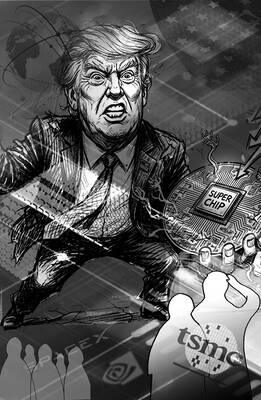
The White House’s decision to take a 9.9 percent stake in Intel Corp is looking like very shrewd business indeed. Since the government bought in at US$20.47 a share last August, the US chipmaker’s surging stock price has delivered the US a US$43 billion return. One of the reasons the investment has so far proved so sound is that the White House has made sure of it. According to The Wall Street Journal, Howard personally pushed deals on Intel’s behalf with some of the most lucrative clients imaginable. They include Nvidia Corp, the company at the heart of the AI
In a Taiwanese university classroom, a lecturer asks in English: “Can anyone give me an example from Taiwan?” Students look down. No one answers. After class, one student writes on the course platform in Mandarin: “I understood the concept, but I didn’t know how to answer in English.” That moment highlights a key issue in Taiwan’s English-medium instruction (EMI) reform: It is not just about more English-taught courses, but whether students can learn, participate and belong. EMI expansion is part of the Bilingual 2030 policy and the Ministry of Education’s BEST Program, aiming to improve English ability, support EMI teaching
The Ministry of the Interior, working with the navy and coast guard, is organizing Taiwan’s first joint exercise simulating escort tankers carrying liquefied natural gas (LNG) and oil through a Chinese blockade. The drills simulate fuel transport along three maritime corridors leading toward Japan, the Philippines and the US. Deputy Minister of the Interior Sawyer Mars (馬士元) said that a blockade of the Taiwan Strait would amount to “almost a 100 percent blockade of the regional energy supply.” Minister of National Defense Wellington Koo said planning to counter a blockade is standard practice in Taipei. While the exercise is limited in
A single photograph can cut through a lot of noise, but it can also be used to misrepresent the truth. At the very least, it can concentrate the mind on something that requires further investigation. On Monday last week, Ma Ying-jeou Foundation CEO Tai Hsia-ling (戴遐齡) and former National Security Council secretary-general King Pu-tsung (金溥聰) held a news conference in which they showed a photograph of former foundation CEO Hsiao Hsu-tsen (蕭旭岑), now Chinese Nationalist Party (KMT) deputy chairman. In the image Hsiao is seated next to Xiamen Taiwan Businessmen Association chairman Han Ying-huan (韓螢煥). The two men were holding


 RSS
RSS