


Taiwan elected its first female president — Tsai Ing-wen (蔡英文) — in a landmark election on Jan. 16, with her Democratic Progressive Party also securing a majority in the legislature for the first time. The new legislature takes office on Monday, which offers the new Cabinet opportunities to reconsider the long-awaited Free Economic Pilot Zone project and many other significant domestic bills.
The draft special act for Free Economic Pilot Zones mainly focuses on economic liberalization and regulatory loosening, which has faced hurdles as political parties and the public hold different perspectives. The draft also claims its mid-term goal is to create favorable conditions for Taiwan’s entry to the Trans-Pacific Partnership and the Regional Comprehensive Economic Partnership, so the act’s period of effectiveness has been set at only 10 years.
Special economic zones have been a powerful instrument for attracting foreign investments and boosting economic growth, as evidence in the growth of such the zones in East Asia, Africa and Latin America since the 1970s. However, there are also many examples of failures, where firms have taken advantage of tax breaks and natural resources. Some zones have even been criticized as “pollution havens” for failing to meet international environmental standards.
A World Bank study said that zones that are the most successful in contributing to long-term development go beyond the traditional models of attracting investment and generating employment. This means that successful projects will ultimately deliver structural transformation of the economy. Critical to this process is the degree of integration of economic efficiency with other social and environmental considerations in the domestic economy.
Established in 2012, Enterprise Zones are at the center of the UK government’s long-term economic plan, which adopts a “local enterprise partnerships” approach to create entrepreneurial cultures in local communities and deliver sustainable growth.
As climate change becomes a development challenge, exploring a new paradigm that decouples economic growth from further increases in greenhouse gas emissions is a main task.
The role of special economic zones in promoting climate-friendly development has become critical in policy discussions. The zones can provide an ideal platform for both social and environmental policy innovations, not only because of their enclave nature, but also because they own built-in compliance and implementation mechanisms.
The concept of developing low-carbon “green” economic zones is already being adopted worldwide. Northern European nations have successfully developed eco-industrial parks since the 1960s, such as the Kalundborg Symbiosis in Denmark.
It is expected that greenhouse gas emissions from developing nations will surpass those from developed countries. China, India and South Korea have realized that special economic zones will play a catalytic role in pursuing “green” growth. For instance, South Korea’s Incheon Free Economic Zone sets a clear low-carbon master plan and harnesses foreign investment to fund climate mitigation strategies.
Taiwan published its Intended Nationally Determined Contributions report before the Paris climate negotiations last year. Now it is necessary to consider incorporating this reduction commitment into the next wave of development. Synergising low-carbon and investment policies, the new generation of “green” Free Economic Pilot Zones would provide an ambitious path for long-term sustainable economic development.
Yang Chung-han is a doctoral candidate researching international environmental law at the University of Cambridge and a member of the Taipei Bar Association.
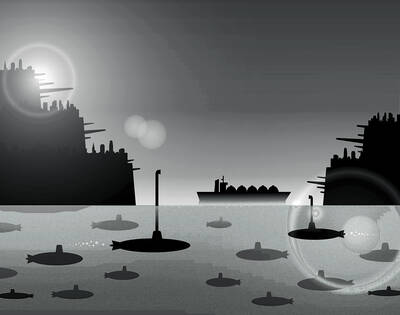
In the event of a war with China, Taiwan has some surprisingly tough defenses that could make it as difficult to tackle as a porcupine: A shoreline dotted with swamps, rocks and concrete barriers; conscription for all adult men; highways and airports that are built to double as hardened combat facilities. This porcupine has a soft underbelly, though, and the war in Iran is exposing it: energy. About 39,000 ships dock at Taiwan’s ports each year, more than the 30,000 that transit the Strait of Hormuz. About one-fifth of their inbound tonnage is coal, oil, refined fuels and liquefied natural gas (LNG),
On Monday, the day before Chinese Nationalist Party (KMT) Chairwoman Cheng Li-wun (鄭麗文) departed on her visit to China, the party released a promotional video titled “Only with peace can we ‘lie flat’” to highlight its desire to have peace across the Taiwan Strait. However, its use of the expression “lie flat” (tang ping, 躺平) drew sarcastic comments, with critics saying it sounded as if the party was “bowing down” to the Chinese Communist Party (CCP). Amid the controversy over the opposition parties blocking proposed defense budgets, Cheng departed for China after receiving an invitation from the CCP, with a meeting with
Chinese Nationalist Party (KMT) Chairwoman Cheng Li-wun (鄭麗文) is leading a delegation to China through Sunday. She is expected to meet with Chinese President Xi Jinping (習近平) in Beijing tomorrow. That date coincides with the anniversary of the signing of the Taiwan Relations Act (TRA), which marked a cornerstone of Taiwan-US relations. Staging their meeting on this date makes it clear that the Chinese Communist Party (CCP) intends to challenge the US and demonstrate its “authority” over Taiwan. Since the US severed official diplomatic relations with Taiwan in 1979, it has relied on the TRA as a legal basis for all
The two major opposition parties, the Chinese Nationalist Party (KMT) and the Taiwan People’s Party (TPP), jointly announced on Tuesday last week that former TPP lawmaker Chang Chi-kai (張啟楷) would be their joint candidate for Chiayi mayor, following polling conducted earlier this month. It is the first case of blue-white (KMT-TPP) cooperation in selecting a joint candidate under an agreement signed by their chairpersons last month. KMT and TPP supporters have blamed their 2024 presidential election loss on failing to decide on a joint candidate, which ended in a dramatic breakdown with participants pointing fingers, calling polls unfair, sobbing and walking


 RSS
RSS