


Following the indictment of former president Lee Teng-hui (李登輝) by the Supreme Prosecutors’ Office Special Investigation Panel, Prosecutor-General Huang Shyh-ming (黃世銘) said that of course Lee should be indicted, because the nation cannot have a situation where only ordinary people are taken to court.
Make no mistake, it would be wrong to just charge ordinary people and let the rich and powerful off the hook, so even former presidents should be indicted if they are suspected of breaking the law, but it is equally important that this standard not just apply to former presidents.
It was correct to indict former president Chen Shui-bian (陳水扁) for instances of blatant corruption. It is true that the president’s state affairs fund is much larger than a mayor’s special allowance fund and that Chen and his family employed all sorts of means to misappropriate government money.
However, in both Chen’s case and the case of President Ma Ying-jeou’s (馬英九) special allowance fund when he was mayor of Taipei, money was put to similar use, namely gift-giving and wining and dining guests. Considering that these two cases are almost identical in this respect, it is inconsistent that the charges in Ma’s special allowance case were dropped, but Chen was indicted and convicted in his state affairs fund case.
Indicting Lee for the diplomatic relations consolidation fund is even more vindictive. Chen and Ma both put money in their own pockets, but Lee did not do that with the consolidation fund. Since he did not pocket the money, why should he be charged with embezzlement?
All the evidence presented in Lee’s indictment is identical to that set out in the charges against former National Security Bureau (NSB) chief accountant Hsu Ping-chiang (徐炳強). Hsu was found not guilty, so there is no good reason to indict Lee on the same grounds.
Based on the principle of double jeopardy, the Code of Criminal Procedure (刑事訴訟法) states that a case in which a final judgement has been reached can only be retried if it meets certain conditions, such as the original evidence or testimony was false, new evidence has been discovered or the prosecutors, investigators or judges in the original case acted unlawfully or negligently. If these conditions are not met, the case cannot be brought to trial again.
This regulation exists to prevent malicious prosecutors from heaping endless litigation on a person. The principle of double jeopardy also preserves the order and stability of the legal system by ensuring that the courts do not get bogged down with frivolous cases.
The case against Lee is based on the same grounds as Hsu’s indictment. The evidence is the same and the conduct of the original prosecution and trial has not been found to have been in any way unlawful, so the case does not meet any of the conditions required for a retrial.
Nevertheless, this old case is being tried again, only this time with Lee as the defendant. Prosecutors have wilfully applied their own subjective views to the case, tailored it as they see fit and even swapped things and people around to intentionally confuse cause and effect.
Why was Hsu found not guilty?
The National Security Council (NSC) decided to set up an autonomous think tank along the lines of the Rand Corp in the US, and the council’s secretary-general, Ting Mao-shih (丁懋時), asked Lee to sign his approval. That is how Research Division IV of the Taiwan Research Institute was established. Evidently there was no embezzlement involved, hence the not-guilty verdict.
However, the prosecutors’ office in Lee’s indictment starts off by saying that it was former Chinese Nationalist Party (KMT) financier Liu Tai-ying (劉泰英) who reported to Lee and asked for his approval, following the example of Japan’s Nomura Research Institute. It alleges that the NSC only decided to set up an autonomous think tank after the consolidation fund case came to light, allowing Lee, who “knew that he had broken the law,” to “absolve himself.”
Although Lee started working in an office in the Taiwan Research Institute after he stepped down as president, he paid rent. The indictment omits this fact, while working on the assumption that the institute was set up so that Lee could use it after he stepped down.
From the point of view of criminal law, the consolidation fund case concluded with a not-guilty verdict, but the court did identify serious administrative irregularities in the way the fund was handled, such as the fact that no invoices were filled out for expenditure as applications for reimbursement were submitted orally.
Unfortunately, this kind of irregularity is commonplace in intelligence work, which often involves doing things for the sake of national security that are illegal under the Criminal Code. That is why the US used to have a rule that heads of intelligence agencies could act beyond the bounds of existing laws when directing intelligence duties. The National Intelligence Services Act (國家情報工作法) also offers immunity from prosecution for certain intelligence activities, and many of its articles are ambiguous.
The National Intelligence Services Act became law relatively recently, in 2003, prior to which the government’s intelligence activities were often conducted as leaders saw fit, without legal regulation.
During the presidencies of Chiang Kai-shek (蔣介石) and Chiang Ching-kuo (蔣經國), intelligence activities were not subject to normal budget regulations, so considerable sums of money earmarked for intelligence purposes did not have to be paid into the national treasury.
This money was in effect a private slush fund and that is where the diplomatic relations consolidation fund originated. Lee did not approve of the way his predecessors handled this money, so when he became president he made it an official fund. When Chen took over from Lee, he thought that the way Lee had handled the money was still incorrect, and this issue caused strife between the two.
After the case of irregularities involving Liu Kuan-chun (劉冠軍), who was chief of the bursary section in the NSB’s General Service Office, came to light, then-bureau director-general Yin Tsung-wen (殷宗文) and Hsu asked Lee to sign invoices to fend off media accusations of unlawful spending, but Lee refused.
During Hsu’s trial, the judges discovered that applications for expenditure reimbursements for intelligence purposes were also made orally. The consolidation fund was not an isolated case in this respect as the practice was widespread in relation to covert operations. This was another reason why Hsu was acquitted. Conversely, the prosecutors’ office now has a different interpretation of Yin’s handling of the affair, taking the view that Lee knew he had broken the law and was trying to cover his tracks.
So what is the crime that Lee is supposed to have known he committed? Since the establishment of the Taiwan Research Institute was a matter of policy, the institute should not have to pay back the funds, despite the irregularities that have come to light (the money embezzled by Liu is another matter).
However, the result of the strife between Lee and Chen was that Chen canceled the appointment of the Taiwan Research Institute and that is why the institute finally had to return the money. The indictment really is full of absurdities.
It would not be acceptable if prosecutors only brought charges against ordinary people and let the rich and powerful go, but now that alarm bells are ringing over Ma’s prospects for re-election as president, and with Lee calling on voters to dump Ma it is apparently alright for prosecutors to ignore the letter and spirit of the Code of Criminal Procedure by transplanting the Hsu case to Lee.
If even a former president can be treated in such a malicious manner, what legal protections are there for the rest of us?
Lin Cho-shui is a former Democratic Progressive Party legislator.
TRANSLATED BY JULIAN CLEGG
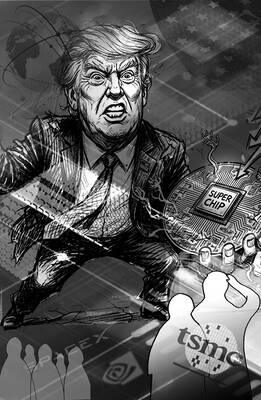
The White House’s decision to take a 9.9 percent stake in Intel Corp is looking like very shrewd business indeed. Since the government bought in at US$20.47 a share last August, the US chipmaker’s surging stock price has delivered the US a US$43 billion return. One of the reasons the investment has so far proved so sound is that the White House has made sure of it. According to The Wall Street Journal, Howard personally pushed deals on Intel’s behalf with some of the most lucrative clients imaginable. They include Nvidia Corp, the company at the heart of the AI
In a Taiwanese university classroom, a lecturer asks in English: “Can anyone give me an example from Taiwan?” Students look down. No one answers. After class, one student writes on the course platform in Mandarin: “I understood the concept, but I didn’t know how to answer in English.” That moment highlights a key issue in Taiwan’s English-medium instruction (EMI) reform: It is not just about more English-taught courses, but whether students can learn, participate and belong. EMI expansion is part of the Bilingual 2030 policy and the Ministry of Education’s BEST Program, aiming to improve English ability, support EMI teaching
The Ministry of the Interior, working with the navy and coast guard, is organizing Taiwan’s first joint exercise simulating escort tankers carrying liquefied natural gas (LNG) and oil through a Chinese blockade. The drills simulate fuel transport along three maritime corridors leading toward Japan, the Philippines and the US. Deputy Minister of the Interior Sawyer Mars (馬士元) said that a blockade of the Taiwan Strait would amount to “almost a 100 percent blockade of the regional energy supply.” Minister of National Defense Wellington Koo said planning to counter a blockade is standard practice in Taipei. While the exercise is limited in
A single photograph can cut through a lot of noise, but it can also be used to misrepresent the truth. At the very least, it can concentrate the mind on something that requires further investigation. On Monday last week, Ma Ying-jeou Foundation CEO Tai Hsia-ling (戴遐齡) and former National Security Council secretary-general King Pu-tsung (金溥聰) held a news conference in which they showed a photograph of former foundation CEO Hsiao Hsu-tsen (蕭旭岑), now Chinese Nationalist Party (KMT) deputy chairman. In the image Hsiao is seated next to Xiamen Taiwan Businessmen Association chairman Han Ying-huan (韓螢煥). The two men were holding


 RSS
RSS