


To many in the West, China seems to have gone from a country that “keeps a cool head and maintains a low profile” in Deng Xiaoping’s (鄧小平) formulation, to one that loves a good international bust-up. Putting an Australian mining executive behind bars for 10 years, squeezing out Google, keeping the EU at bay for an important dialogue and letting a mid-level official wag his finger at US President Barack Obama at the Copenhagen Climate summit is not, after all, the best way to convince partners of your constructive intentions.
Nor is it reassuring to recall that China has been stubbornly watering down sanctions on Iran, investing in major offensive military systems and pillorying Western leaders for irresponsible financial policies and protectionism.
However, the point in reciting this litany is not so much to highlight China’s behavior as it is to demonstrate the dilemma in which it finds itself: If it behaves like a “normal” power, the world will forget the many hundreds of millions of people that it still needs to pull out of poverty.
The Chinese leadership is aware of this and is not eager to fiercely compete with the West or its neighbors. During the recent National People’s Congress, Chinese Premier Wen Jiabao (溫家寶) said that China should not punch above its weight and that the country still needs stability if it is to be a society that offers a decent life to all of its citizens.
Recognizing this, China has stepped up its efforts to mend fences. Chinese President Hu Jintao’s (胡錦濤) visit to Washington was a clear attempt to de-escalate tensions with the US over its arms sales to Taiwan, the yuan’s exchange rate and Obama’s meeting with the Dalai Lama. China will likely go to great lengths to foster a more positive attitude among the dozens of EU leaders visiting this year’s World Expo in Shanghai.
At a lower level, China has also unleashed an impressive charm offensive. State broadcaster CCTV will launch a worldwide program to explain the Chinese position on global affairs. In the EU and US, one gets the impression that the mission of China’s diplomats nowadays is to meet and charm everyone. Hardly a week passes without its ambassadors giving eloquent speeches for different audiences. Indeed, in Brussels, events are organized for members of the EU Parliament, the business community and even high school students. Chinese diplomats now maintain closer relations with think tanks than their European counterparts and are praised for their constructive contribution to the public debate.
However, charm will not make up for lack of progress at the official level. It is unlikely that cajoling Western elites will mitigate the deep-seated uncertainty in the West about China’s rise. And economic stagnation in the West will inevitably exacerbate distrust vis-a-vis the rising power as the relative gains from trade diminish and defensive and even protectionist policies follow.
China needs a mature strategic dialogue, particularly with the EU. This will not rescue the partnership, but at least it could help define common interests, identify policy options and create the conditions to achieve results. One can have the most visible business summits possible, but if Western companies feel threatened by Chinese state-owned enterprises, relations will continue to sour. Roundtables can be staged to discuss the importance of relations between China and the West, but if issues like Iran, Africa, or other trouble spots are not managed better, China will inevitably be seen as a security threat.
Cultivating high expectations without progress could even be dangerous. In the short term, it would reduce the sense of urgency among decisionmakers to get serious about translating ambitions into deeds; long term, the growing expectation gap would aggravate the inevitable setbacks and leaders who championed closer relations could even be replaced by hardliners.
“The crash will come if things go on like this,” German chancellor Otto von Bismarck wrote in the 19th century. “We ought to do all we can to weaken the bad feeling, which has been called out through our growth to the position of a real great power. In order to produce this confidence, it is above all necessary that we are honorable, open, and easily reconciled in case of frictions.”
However, even Bismarck had to watch as distrust, economic nationalism and populism pulled the European powers into a downward spiral of trade wars and diplomatic rivalry.
History offers too many examples of partnerships collapsing for China and the West to take their relations for granted. For China, it will be hard to build confidence if the EU and US doubt their own future and Beijing will remain prickly as long as it fears protectionism or a new containment strategy. Neither side can talk its way out of this predicament. If Beijing is serious about building strategic partnerships with the West, it should back up its charm offensive with deeds and take the initiative in fostering more effective cooperation.
Jonathan Holslag is research fellow at the Brussels Institute of Contemporary China Studies.
COPYRIGHT: PROJECT SYNDICATE
Minister of Labor Hung Sun-han (洪申翰) on April 9 said that the first group of Indian workers could arrive as early as this year as part of a memorandum of understanding (MOU) between the Taipei Economic and Cultural Center in India and the India Taipei Association. Signed in February 2024, the MOU stipulates that Taipei would decide the number of migrant workers and which industries would employ them, while New Delhi would manage recruitment and training. Employment would be governed by the laws of both countries. Months after its signing, the two sides agreed that 1,000 migrant workers from India would
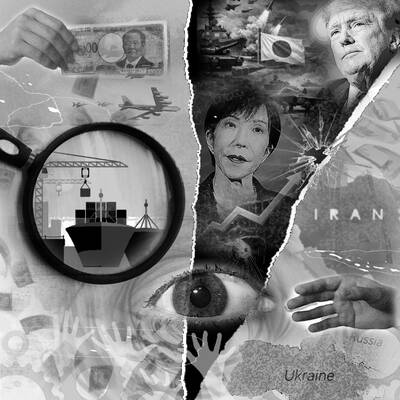
Japan’s imminent easing of arms export rules has sparked strong interest from Warsaw to Manila, Reuters reporting found, as US President Donald Trump wavers on security commitments to allies, and the wars in Iran and Ukraine strain US weapons supplies. Japanese Prime Minister Sanae Takaichi’s ruling party approved the changes this week as she tries to invigorate the pacifist country’s military industrial base. Her government would formally adopt the new rules as soon as this month, three Japanese government officials told Reuters. Despite largely isolating itself from global arms markets since World War II, Japan spends enough on its own
On March 31, the South Korean Ministry of Foreign Affairs released declassified diplomatic records from 1995 that drew wide domestic media attention. One revelation stood out: North Korea had once raised the possibility of diplomatic relations with Taiwan. In a meeting with visiting Chinese officials in May 1995, as then-Chinese president Jiang Zemin (江澤民) prepared for a visit to South Korea, North Korean officials objected to Beijing’s growing ties with Seoul and raised Taiwan directly. According to the newly released records, North Korean officials asked why Pyongyang should refrain from developing relations with Taiwan while China and South Korea were expanding high-level
When 17,000 troops from the US, the Philippines, Australia, Japan, Canada, France and New Zealand spread across the Philippine archipelago for the Balikatan military exercise, running from tomorrow through May 8, the official language would be about interoperability, readiness and regional peace. However, the strategic subtext is becoming harder to ignore: The exercises are increasingly about the military geography around Taiwan. Balikatan has always carried political weight. This year, however, the exercise looks different in ways that matter not only to Manila and Washington, but also to Taipei. What began in 2023 as a shift toward a more serious deterrence posture


 RSS
RSS