


Nina Chamorro runs her finger across the montage of photos of neighborhood children tacked to the wall of her community soup kitchen in Villa Itati, a sprawling urban slum on the outskirts of Buenos Aires.
“He is dead now. And him. And him,” says the 75-year-old grandmother, her eyes drifting sadly over grinning faces. She points to another photograph. “He was shot by the police last month. That girl disappeared. We have lost so many of our beautiful children. We knew them since they were born. They had their whole lives to live.”
Villa Itati is only a few minutes’ drive from the more upmarket parts of Buenos Aires. Ask most people here to explain the cause of the grisly gallery in Chamorro’s kitchen and the answer will be a single word: paco. A toxic and highly addictive mixture of raw cocaine base cut with chemicals, glue, crushed glass and rat poison, paco is the curse of Argentina’s urban poor. And consumption of this bastardized, low-grade drug is eating away at the vitality and hope of the most deprived neighborhoods of the capital.
Essentially a chemical waste product, paco is what remains from the narco-kitchens producing cocaine bound for US and European markets. Since its appearance on the streets of Buenos Aires in the late 1990s, the drug has taken a deadly grip in slums such as Itati. Levels of addiction rose by more than 200 percent in the first part of the decade and more than 400,000 doses are now being consumed daily.
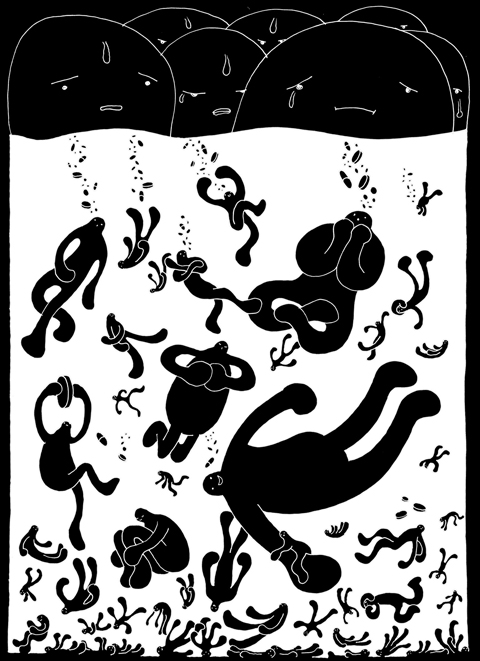
Users are witheringly referred to as the muertos vivientes — the living dead — of Buenos Aires. Addictive after one or two hits, the drug systematically destroys the nervous system. Users quickly become skeletal and ravaged, resorting to crime, violence and prostitution to feed their habits. Enormous numbers die in short order.
Villa Itati runs on paco: an economy that is an endless, grim cycle of illicit profit, addiction-fueled crime and wasted lives, all witnessed by a despairing generation of parents.
According to urban myth, the first paco in Argentina was sold here. Residents say narco-traffickers started flooding the neighborhood with paco in 2005, selling hits for as little as US$0.15 each. According to provincial government reports, 50 percent of Villa Itati’s 60,000 residents have used or are currently addicted to the drug. Across the country, 2008 government figures show that 64.9 percent of under-18s in addiction and treatment services are there because of paco.
Virtually no one owns a car in Villa Itati. But in a place where there is only one source of wealth, there are stark signs of big money being made by some. Shiny black four-wheel-drives with darkened windows are parked in the unpaved street near Chamorro’s kitchen.
“Paco,” says one woman, pointing to the trucks. “Those cars are what they buy with our children’s blood.”
“The dealers came here and first they targeted kids,” says one resident running a community project who didn’t want to be named. “They sold these kids hits of paco for 1 peso [US$0.26] and got them hooked and now they work for them selling it in the streets. If they lose one dose, they shoot them in the legs or kill them. Families are cooking paco in their houses because it is the only way they can make money.”
“This place used to be a real neighborhood, people had work. We were poor but we were a community; now it is all crime and drugs and sewage,” Chamorro says. “There is no work, the factories all closed. Some of the women go into the city to clean rich people’s houses and a few of the men collect cardboard. But there is nothing for the young people.”
Sonia Andrade, Chamorro’s daughter who helps her run the soup kitchen, describes how she lies awake at night hearing the children of her friends scrambling across the roof “like rats” looking for things to steal.
“They are so desperate they rob everything from their families to get another hit, and when there is nothing left to take they steal from their neighbors,” Andrade says. “They didn’t have much of a chance before paco, and now they don’t have any at all.”
The scourge of paco may be the final act in the tragedy of decline in what is one of the city’s oldest and largest slums. When Chamorro started her soup kitchen more than 20 years ago she used to feed 20 or 30 people a day; now it is closer to 200. Her simple two-room soup kitchen is at the heart of the urban shanty town. It is only midday, but already the smell from “La Cava,” the huge open pit filled with household rubbish and sewage at the heart of the slum is overpowering.
Andrade points to the high embankments of the highway. When it rains, she explains, water pours down the slopes and floods into the pit. The slum’s poorest families living closest to the pit find themselves knee-deep in putrid water in under an hour.
“All the children here have scabs all over their bodies, they don’t eat outside of what we give them here, they all have breathing problems,” she says. “The kindergarten used to give them milk and breakfast, but now the money from the government has stopped and the teachers don’t come any more.”
But however appalling the poverty, it is the growth in drug abuse that has turned the place into an urban hell.
Carlos Vizzotti, director of national assistance and prevention programs at SEDRONAR, the government’s agency for drug treatment, prevention and enforcement, admits the government is struggling to contain the problem of serious drug addiction in the city’s poorest neighborhoods.
“We can’t compete with the dealers who are paying kids and families 200 pesos a day to sell and traffic paco and cocaine. We try to get them off drugs, but then we just send them back to the same problems which brought them to paco in the first place,” Vizzotti said.
The accounts of those working on the front line are unremittingly grim. Father Pepe, a missionary priest, runs addiction and poverty alleviation projects from his small, whitewashed church in another slum, Villa 21-24, close to the heart of Buenos Aires.
Paco is a manifestation of everything that is rotten in Argentina,” he says. “It exposes the systematic and growing failure of the whole system, health, education, basic services — they are all falling to ruin. It isn’t that paco is a drug of the poor; it is that it feeds off the poverty and exclusion that was always here. Paco just shows us what lies at the heart of our country today.”
Outside the heat is searing, but inside the church is dark and cool, the walls covered in murals depicting the harsh reality of life in Argentina’s slums. The largest shows a child paco user protected from the grave by angels.
“Paco is a tsunami that has hit the most vulnerable. If we weren’t working here, then there would be nobody to help families fight against this. The state and wider society have washed their hands of us,” Pepe says.
Rising crime has made Villa 21-24 a byword for violence in Buenos Aires with many areas of this vast urban settlement being controlled entirely by narco-gangs. Last year Pepe was forced to ask for official protection and faced death threats after he spoke out against the traffickers and rising crime in the neighborhood.
“In the last few years we have seen many more problems with crime, with violence and guns linked to a more coordinated narcotics operation here in the slums. It’s an increasingly big business,” he says. “Yet the capacity of the people to prevail, to want something better, lives on, and this is what we should be supporting.”
But as Argentina gains a new unwanted status as a premier narco-trafficking route, the outlook for campaigners such as Pepe is bleak. Traditionally used mainly as a transit route to get cocaine out of Latin America to Europe, Argentina is increasingly used as a producer and consumer of cocaine and cocaine byproducts in Latin America.
Drug Enforcement Argentina, an anti-drugs pressure group, claims cocaine kitchens like those first discovered in the slums in 2006 are booming and that there are more than 1,500 clandestine airstrips bringing cocaine base into the north of the country.
SEDRONAR admits that porous borders, limited resources and expertise and a lack of effective coordination between regional and national agencies means that Argentina is losing the battle to contain the rise of narco-trafficking into the country.
In Villa Itati, Chamorro and thousands of others like her are desperate that paco should disappear and their children be given the chance of a way out of the spiral of poverty and drug addiction that is destroying their future.
“We have been abandoned by the government, by everybody. They are all terrified of our children coming to their houses and taking their things, but [our children] need hope for something better. There has to be more for them that this,” Chamorro says as she heads inside the soup kitchen.
Her words are an almost certainly futile expression of despair.
In the grip of ‘paco’
• Paco is cocaine base paste, a byproduct of the refining process, cut with chemicals such as sulphuric acid and kerosene as well as glue, rat poison and crushed glass.
• Readily available, paco is sold for as little as US$0.15 a hit. The average paco user smokes more than seven doses a day.
• Madres en Lucha, a group of campaigning mothers, estimates paco kills two people a week in Buenos Aires.
• Drug Enforcement Argentina, an anti-drug lobbying group, says paco trafficking exceeds US$927.3 million a year. Cocaine seizures in Argentina doubled between 1999 and 2006.
• Paco was smoked in other cocaine-producing countries before it reached Argentina: It is known as kete in Peru, bazuco in Colombia and pitillo in Bolivia.
There is much evidence that the Chinese Communist Party (CCP) is sending soldiers from the People’s Liberation Army (PLA) to support Russia’s invasion of Ukraine — and is learning lessons for a future war against Taiwan. Until now, the CCP has claimed that they have not sent PLA personnel to support Russian aggression. On 18 April, Ukrainian President Volodymyr Zelinskiy announced that the CCP is supplying war supplies such as gunpowder, artillery, and weapons subcomponents to Russia. When Zelinskiy announced on 9 April that the Ukrainian Army had captured two Chinese nationals fighting with Russians on the front line with details
On a quiet lane in Taipei’s central Daan District (大安), an otherwise unremarkable high-rise is marked by a police guard and a tawdry A4 printout from the Ministry of Foreign Affairs indicating an “embassy area.” Keen observers would see the emblem of the Holy See, one of Taiwan’s 12 so-called “diplomatic allies.” Unlike Taipei’s other embassies and quasi-consulates, no national flag flies there, nor is there a plaque indicating what country’s embassy this is. Visitors hoping to sign a condolence book for the late Pope Francis would instead have to visit the Italian Trade Office, adjacent to Taipei 101. The death of
The Chinese Nationalist Party (KMT), joined by the Taiwan People’s Party (TPP), held a protest on Saturday on Ketagalan Boulevard in Taipei. They were essentially standing for the Chinese Communist Party (CCP), which is anxious about the mass recall campaign against KMT legislators. President William Lai (賴清德) said that if the opposition parties truly wanted to fight dictatorship, they should do so in Tiananmen Square — and at the very least, refrain from groveling to Chinese officials during their visits to China, alluding to meetings between KMT members and Chinese authorities. Now that China has been defined as a foreign hostile force,
On April 19, former president Chen Shui-bian (陳水扁) gave a public speech, his first in about 17 years. During the address at the Ketagalan Institute in Taipei, Chen’s words were vague and his tone was sour. He said that democracy should not be used as an echo chamber for a single politician, that people must be tolerant of other views, that the president should not act as a dictator and that the judiciary should not get involved in politics. He then went on to say that others with different opinions should not be criticized as “XX fellow travelers,” in reference to


 RSS
RSS