


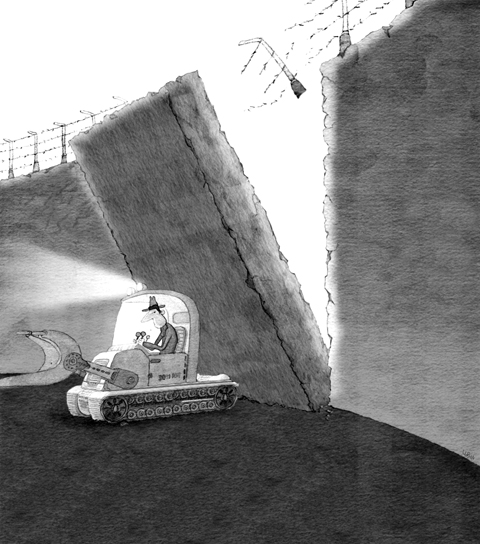
Those who witnessed that night 20 years ago in Berlin, or elsewhere in Germany, will never forget what happened — the night the Wall came down.
History in the making is all too often tragic. Only rarely is it capable of irony. Nov. 9, 1989, was one of those rare moments when irony reigned, because East Germany’s bureaucratic socialism died as it had lived — with a bureaucratic snafu.
The Speaker of the Politburo, Gunter Schabowski, had simply misunderstood that body’s decision and, by releasing to the public incorrect information about the lifting of travel restrictions, triggered the fall of the Wall. Groucho Marx could not have bettered Schabowski that night. It was Germany’s happiest hour.
Twenty years later, many revolutionary consequences of that night lie behind us. The Soviet Union and its empire quietly disappeared, and with them the Cold War international order. Germany was reunited; Eastern Europe and the states on the Soviet periphery won their independence; South Africa’s apartheid regime fell apart, numerous civil wars in Asia, Africa, and Latin America ended; Israelis and Palestinians came closer to peace than at any time since; and a disintegrating Yugoslavia degenerated into war and ethnic cleansing. In Afghanistan, war continued under different circumstances, with serious ramifications for the region and, indeed, the world.
As the victorious heir to the collapsed Cold War order, the US stood alone, undisputed, at the peak of its global power. But, within two decades — following the war in Iraq and financial and economic crisis — the US had squandered that special status.
Arrogance of power and blindness about reality were the two main causes for the decline of the sole remaining superpower. While most of the blame lies with former US president George W. Bush, numerous negative trends had preceded him. He merely took them to the extreme.
After Sept. 11, 2001, the US had a second big chance to use its unique power to reorganize the world. After this terrible crime, countries — including in the Arab world — were ready to embrace far-reaching steps. At that moment, peace between Palestinians and Israelis could have been achieved, and thus a new beginning made in the Middle East.
Even a radical about-face in US energy policy, with the introduction of energy taxes, would have been possible under the banner of national security. The challenge posed by global climate change could have been addressed more effectively that way. But that opportunity, too, was thrown away.
Europe — and, within it, Germany — were among the big winners of Nov. 9, 1989. The Continent reunited in liberty: Germany on Oct. 3, 1990; Europe with the great EU enlargement of May 1, 2004. The introduction of a common European currency was successful; political integration by means of a constitutional treaty a failure. Since then, the EU has been stagnating, both internally and externally. Europe has made only insufficient use of its opportunities since 1989 — and could dramatically lose influence in the emerging power structure of the twenty-first century.
In Germany, which largely owes its reunification to its firm roots in the EU and NATO, Europe-weariness is palpable. The generation ruling in Berlin today increasingly thinks in national rather than European terms. This was never more obvious than in the deciding days and weeks of the global financial crisis.
Russia, the big loser of 1989, remains two decades later mired in a mix of social and economic depression and political regression and illusion. Life expectancy continues to decline; investment in infrastructure, research, and education are stunted; the economy is barely able to compete internationally; and the social divide between poor and rich is deepening.
Economically, Russia has turned into a commodity exporter, dependent on the imponderables of the global energy market, while simultaneously dreaming that it can use energy as a tool to revise the post-Soviet order in its neighborhood.
Russia’s elites still largely think in the power categories of the 19th and 20th centuries. This constitutes the illusionary and historically regressive element of current Russian policy. Russia’s desire to reclaim its role as a powerful global player is understandable and legitimate. If it turns toward the past in looking for its future, however, and if it believes it can dispense with investments in the future in favor of shameless personal self-enrichment, it will continue to lose ground.
Nov. 9, 1989, marked not only the end of the Cold War era, but also the beginning of a new wave of globalization. The real winners of this new world order are the large emerging countries, first and foremost China and India, which increasingly set the pace of global economic and political development.
The G8 has been dismissed by history as a club of Western industrial nations; its place has been taken by the G20, which conceals the underlying formula of power distribution within the new world order: the G2 (China and the US). All these changes reflect a dramatic transfer of power from West to East, from Europe and the US to Asia, which within the next two decades is likely to bring to an end 400 years of Eurocentrism.
The past two decades also have seen the world begin to reach its ecological limits. The majority of humanity has sought since Nov. 9, 1989, to achieve Western living standards at all costs, over-stretching our planet’s climate and ecosystems.
The years since the Berlin Wall came down have been rich in dramatic change, but the real era of upheaval lies ahead. Global warming is only the tip of the iceberg toward which we are moving, knowingly, with eyes wide open. What matters now is that states act globally and in unison. Twenty years after Berlin, Copenhagen is calling.
Joschka Fischer, a leading member of Germany’s Green Party for almost 20 years, was German foreign minister and vice chancellor from 1998 until 2005.
COPYRIGHT: PROJECT SYNDICATE/INSTITUTE OF HUMAN SCIENCES
Recently, China launched another diplomatic offensive against Taiwan, improperly linking its “one China principle” with UN General Assembly Resolution 2758 to constrain Taiwan’s diplomatic space. After Taiwan’s presidential election on Jan. 13, China persuaded Nauru to sever diplomatic ties with Taiwan. Nauru cited Resolution 2758 in its declaration of the diplomatic break. Subsequently, during the WHO Executive Board meeting that month, Beijing rallied countries including Venezuela, Zimbabwe, Belarus, Egypt, Nicaragua, Sri Lanka, Laos, Russia, Syria and Pakistan to reiterate the “one China principle” in their statements, and assert that “Resolution 2758 has settled the status of Taiwan” to hinder Taiwan’s
Singaporean Prime Minister Lee Hsien Loong’s (李顯龍) decision to step down after 19 years and hand power to his deputy, Lawrence Wong (黃循財), on May 15 was expected — though, perhaps, not so soon. Most political analysts had been eyeing an end-of-year handover, to ensure more time for Wong to study and shadow the role, ahead of general elections that must be called by November next year. Wong — who is currently both deputy prime minister and minister of finance — would need a combination of fresh ideas, wisdom and experience as he writes the nation’s next chapter. The world that
Can US dialogue and cooperation with the communist dictatorship in Beijing help avert a Taiwan Strait crisis? Or is US President Joe Biden playing into Chinese President Xi Jinping’s (習近平) hands? With America preoccupied with the wars in Europe and the Middle East, Biden is seeking better relations with Xi’s regime. The goal is to responsibly manage US-China competition and prevent unintended conflict, thereby hoping to create greater space for the two countries to work together in areas where their interests align. The existing wars have already stretched US military resources thin, and the last thing Biden wants is yet another war.
Since the Russian invasion of Ukraine in February 2022, people have been asking if Taiwan is the next Ukraine. At a G7 meeting of national leaders in January, Japanese Prime Minister Fumio Kishida warned that Taiwan “could be the next Ukraine” if Chinese aggression is not checked. NATO Secretary-General Jens Stoltenberg has said that if Russia is not defeated, then “today, it’s Ukraine, tomorrow it can be Taiwan.” China does not like this rhetoric. Its diplomats ask people to stop saying “Ukraine today, Taiwan tomorrow.” However, the rhetoric and stated ambition of Chinese President Xi Jinping (習近平) on Taiwan shows strong parallels with


 RSS
RSS