


Airbus knew since at least 2002 about problems with the type of speed sensor that malfunctioned on an Air France passenger plane that went down in June, The Associated Press (AP) has learned. But air safety authorities did not order their replacement until after the crash, which killed all 228 people aboard.
The tubes, about the size of an adult hand and fitted to the underbelly of a plane, are vulnerable to blockage from water and icing. Experts have suggested that Flight 447’s sensors, made by French company Thales SA, may have iced over and sent false speed information to the computers as the plane ran into a thunderstorm at about 10,600m.
The exact role the sensors — known as Pitots — played in the crash may never be known without the flight recorders, which have not been recovered and which have stopped emitting signals.
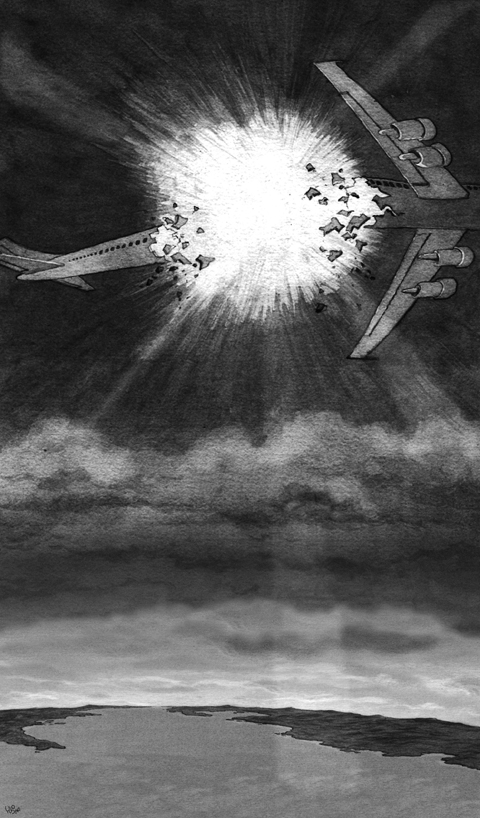
Investigators insist sensor malfunction was not the cause of the crash, but many pilots think false speed readings may have triggered a chain of events that doomed the plane.
Fernando Alonso, head of Flight Operations at Airbus, maintains the doomed Airbus A330 plane was “totally airworthy.”
“There is no question for me the safety, the reliability of the airplane nor of the maintenance and operation procedures used by our operators,” he said.
The plane was flying from Rio de Janeiro back to the French capital when it went down in a remote area of the Atlantic, 1,500km off Brazil’s mainland and far from radar coverage. Automatic messages transmitted by the plane show its computer systems no longer knew its speed, and the automatic pilot and thrust functions were turned off.
Several European airline pilots, including former Air France captain Gerard Feldzer, believe a reading of the messages suggests Air France pilots were suddenly forced to take manual control in near impossible conditions: a cockpit ringing with warning bells and flashing lights, some of them contradictory, with few clues to speed, altitude and nighttime weather conditions.
“It’s very difficult when you are already experiencing turbulence in the middle of the night to know what to do,” said Feldzer, adding that the plane’s automated warning system could have been issuing incorrect instructions. “It’s very difficult to resist what you are being ordered to do because they are false orders.”
Air France is now starting a training program for pilots on how to manage a Pitot malfunction at high altitudes of the type experienced on Flight 447. Previously, Air France had only offered simulator training for Pitot malfunction on take-off and landing.
ANGRY
Pilots are angry about what they see as an attempt to pin the crash on pilot error. Eric Tahon, an Air France pilot, defended the role of the Flight 447 crew.
“We are trained to deal with multiple failures of the plane,” he said. “We are convinced that without the breakdown of the Pitots, Air France 447 that day would have set down at Roissy [airport in Paris].”
Feldzer, however, said that while the dangers now appear to have been underestimated, he believes Airbus and Air France would not have risked their reputations had they thought Pitot faults were critical.
A series of industry documents verified by investigators show that regular warnings on Airbus Pitots popped up as far back as 1994, although for a different model that was later banned in 2001 by French aviation officials.
An Airbus memo from July 2002 warns of blocked drainage holes on the Thales AA Pitot — the type fitted onto the doomed Air France jet — and says “this issue can affect all Airbus aircraft fitted with Thales Pitot probes.”
Airbus recommended replacing Thales Pitots with a newer model in 2007 but did not make the change mandatory. Air France decided to replace Pitots on its longer range Airbus fleet only when they broke down.
Air France says it started having problems with speed-measuring equipment on long-range Air France A330 and A340 jets in May last year, which Airbus blamed on ice crystals blocking Pitot tubes. But functioning sensors were not replaced at that stage.
Paul-Louis Arslanian, head of BEA, the French agency investigating the crash, said the body knew of around seven Pitot incidents on long-range planes of the A330-A340 family before the crash, and that Airbus knew of around 20.
Europe’s air safety authorities say they had been monitoring Thales Pitots on A330-340 long-range planes since last year, when it was aware of nine malfunction incidents.
Michael Barr, who teaches aviation safety at the University of Southern California, said it appears Airbus recognized the Pitot problem needed to be fixed but did not make it an urgent priority.
“What they hoped for was that the perfect storm wouldn’t come up before they got it fixed,” Barr said. “They were in the process of doing that when this one hit that perfect storm over the ocean.”
COST
The cost of replacing all Pitots on a worldwide fleet of planes is hardly major: For Air France, a full speed-sensor overhaul on its A330-A340 fleet would cost around 153,000 euros (US$222,000), according to AP calculations based on pilot estimates.
Both Thales and Goodrich declined to disclose the cost of their sensors.
But if prosecutors rule that the crash could have been avoided, the financial penalties and loss of reputation for Air France and especially Airbus, whose aircraft fill the skies every day, would be devastating.
There is no hard evidence that faulty Pitots caused the Air France crash, and in past reported incidents of Pitot malfunction, pilots have been able to regain control of the plane. Furthermore, what looks to be a likely cause in the beginning of a crash investigation sometimes shifts after investigators get more information from the flight recorders.
However, more than two months after the crash, the European Aviation Safety Agency has reassessed the dangers of faulty Pitots, ordering a continent-wide ban on the types of Thales sensors that were fitted onto Flight 447 on all long-range planes.
Barr said serious efforts to correct safety problems in the airline industry tend to increase in direct proportion to the number of people killed, while too little action is often taken in response to incidents in which no one is killed.
It even has a name: blood priority.
“The more blood that is spilled, the more corrective action is taken. The less blood that is spilled, the less corrective action that’s taken,” Barr said.

KMT Chairwoman Cheng Li-wun’s (鄭麗文) recent visit to Beijing and her upcoming visit to Washington will serve as a high-level test of her diplomatic mettle. In Beijing, Cheng was received with symbolic gestures, a warm reception, and high-level access. In Washington, she will receive far less pomp and far sharper questions about the KMT’s vision for the future of Taiwan. Her challenge will be to persuade Washington that the KMT’s engagement with China can coexist with strong deterrence. Cheng’s April 7-12 visit to mainland China coincided with an intense period of conflict in Iran. Despite the strategic significance of Cheng’s trip,

The closure of the Strait of Hormuz has sent the vast Asian chemicals industry into a tailspin. Deprived of the likes of Qatari natural gas and Saudi Arabian oil, the region’s fertilizer and plastics plants are slowing production or even shutting down. Everywhere except China, that is. In petrochemicals, China is unique. As well as a traditional industry that uses oil and gas as feedstock, it has parallel output that relies on its abundant domestic coal. Unsurprisingly, India and other regional powers want to copy and paste the Chinese method. This would not be easy — or climate friendly. The
Indonesian President Prabowo Subianto says he knows how to fix the problems facing Indonesia. Yet his economic mismanagement and authoritarian tendencies are steering the nation toward a familiar mix of currency instability and political chaos. The world’s fourth-most populous nation risks reversing the hard-won democratic and business reforms that came after the Asian Financial Crisis in 1997. At that time, the rupiah collapsed and the political upheaval that followed forced former president Haji Mohamed Suharto from power. Prabowo’s administration is ignoring similar warning signs. That disconnect was apparent in a national address on Wednesday, when Prabowo projected the swagger that has
“Of course you can choose not to be Taiwanese, just do not stay here,” chairwoman of Taipei 101 operator Taipei Financial Center Corp Janet Chia (賈永婕) said in an online interview with local entertainer Tai Chih-yuan (邰智源), triggering intense discussion on social media, with politicians across party lines weighing in. In the interview, which was aired on May 14, Chia and Tai’s discussion over a meal in Taipei 101 covered Chia’s career change from entertainer to chairwoman and US climber Alex Honnold’s free solo climb up the Taipei 101 building. During the interview, Chia said, “Being on this land, we


 RSS
RSS