


Even at the time, we understood that our world had changed and that we could pinpoint this change to almost the second. We didn’t have to wait for Neil Armstrong to get out of the lunar module and fumble a portentous remark about a small step for a man. When we heard the words “Houston, Tranquillity Base here, the Eagle has landed,” it didn’t quite sink in, but then after a short, eerie pause the man at Houston, known only as Capcom, choked a bit and stumbled and then said: “We copy you on the ground. You’ve got a bunch of guys about to turn blue. We’re breathing again.”
That was the moment a 100 million people around the world also started breathing again.
Apollo was momentous in a way that Yuri Gagarin’s first, heroic orbit could never have been. Gagarin had circled the Earth in 92 minutes in 1961. He had travelled 38,600km in an hour--and-a-half; he had made history; he had confirmed Soviet space supremacy; he had done a thing that many thought could never be done. But two things separated him from the Apollo team eight years later.
One was that Gagarin had done all these things before anyone in the world knew about them, or could have known about them. We cheered his triumph, but missed the drama. The other was that he never really left the Earth; he flew higher than anybody had ever done, but he was still a prisoner of the planet’s tug. He was never much further from Earth than Manchester is from London.
Everything about the Apollo landing, though, was high adventure. It was the climax of a space race that had been so tightly contested that, right up to that moment on the Sea of Tranquillity, it had seemed possible that the Russians might get there first. This race had developed, although we could not know the details at the time, from a duel of wits between two men.
One was Wernher von Braun, the former German Waffen-SS officer who had devised, built, tested and deployed what, in 1944, had been the ultimate weapon: the Vergeltungswaffe-2, the vengeance weapon, the V2 . He pioneered the US technocracy. His Soviet opponent was a figure so shadowy that even in the USSR he was known only as “the Chief Designer.” In fact, Sergei Kolorev was an even more remarkable man who had lost his teeth, his health and very nearly his life in Stalin’s prison camps, but most of us knew nothing about him, not even his name, until 1990.
RIPOSTE
The decision to finance a moon race was a dramatic maneuver in Cold War politics, the ultimate in one-upmanship, a seizure of the commanding heights of space, begun by former US president John F. Kennedy as a riposte to the Soviet Union’s boastful Nikita Khrushchev.
But the sprint for the moon also united an implacably divided world. It gave us our first sense of the loneliness and the beauty of our planet, seen from a distance of 400,000km. And it was the first direct step in the search for extraterrestrial life. We forget this now, but in 1969, the fear of global infection by alien lunar organisms seemed real enough to ensure that the three astronauts went straight into biological isolation when they came home.
Above all, it was a moment of human drama, played out with fragile, gleaming technology against a backcloth of infinity. Like a billion other people, I listened, on an old junkshop radio with an improvised antenna, in the small parlour of a two-up, two-down railwayman’s cottage in Kent, southeast of London, while my wife, son and daughter slept overhead. I wasn’t, at the time, a science reporter, but I had joined a newspaper at 16 in 1957, just in time for Sputnik 1 and, like millions of others, I had followed every step of the drama that, on the night of 20 July 1969, reached its highest point.
IMPLAUSIBLE
Neil Armstrong, Buzz Aldrin and Mike Collins had left the Earth altogether. They had traveled 38,600km, and then two of them had climbed into a little module that looked then, and still looks now, implausible, and descended to leave their footprints in the dust of an alien world, and they did these things while almost the whole of the human race watched and listened and, yes, held its breath. Eagle’s touchdown on the moon was the unforgettable moment: one in which we might eavesdrop on triumph or tragedy. We knew that astronauts could get out of a spacecraft and walk in space; it would be no problem to get out and walk on the moon. That much was a formality, a performance for the cameras they carried with them. What was not certain was that the Eagle could land at all.
Consider the problem: Eagle had to detach itself from the mothership Apollo at the right moment, and begin a precise descent that had to be completed while still on the side of the moon always facing Earth: radio transmission was impossible from the far side. Although Aldrin and Armstrong were astronauts, test pilots and history-makers, they were also the agents of the most ambitious peacetime co-operative enterprise ever: They were emissaries from Earth, touching down on another world. They were part of a corporate journey into the unknown that could go terribly wrong at any point, and they had to do it while mission control at Houston could monitor the technology, and while the world watched.
“Apollo 11 was a half-a-million-mile [800,000] daisy chain draped around the moon, a chain that was as fragile as it was long,” Collins wrote afterwards. “I figured our chances for a successful landing and return were not much better than 50-50.”
NASA’s safety chief during the Apollo 8 mission, the one that flew round the moon in 1968, had calculated that the spaceship had 5,600,000 moving parts and “even if all functioned with 99.9 percent reliability, we could expect 5,600 defects.”
But how much more potentially calamitous was the flight of the Eagle, the module that landed on the moon. There were no circumstances in which anyone could really complete a test flight of the ungainly little vehicle with its ridiculous legs. You could not simulate lunar gravity on Earth; you could not simulate a 100km journey in a vacuum anywhere here; and you could not mock-up the fine detail of a lunar surface — the dust, stones, boulders, crags, crevices, chasms and craters — because until the touchdown, nobody had ever seen the fine detail.
Could Eagle find a level surface? Or might it land on a slope, on unstable ground, on a protruding rock, and topple over, so much expensive wreckage on a hostile shore? And even if it could land safely upright, might it not sink into the dust, to be trapped in lunar quicksand, never to escape? There was no precedent, no information and almost no room for error at any point in the landing, that night of 20 July, and everybody in the world knew it.
We knew that the entire endeavor was hazardous then; but its magnitude, variety and unpredictability became even more starkly clear years later, as astronauts began to tell, and sell, their stories. The mission lasted eight days, and everything had to go right.
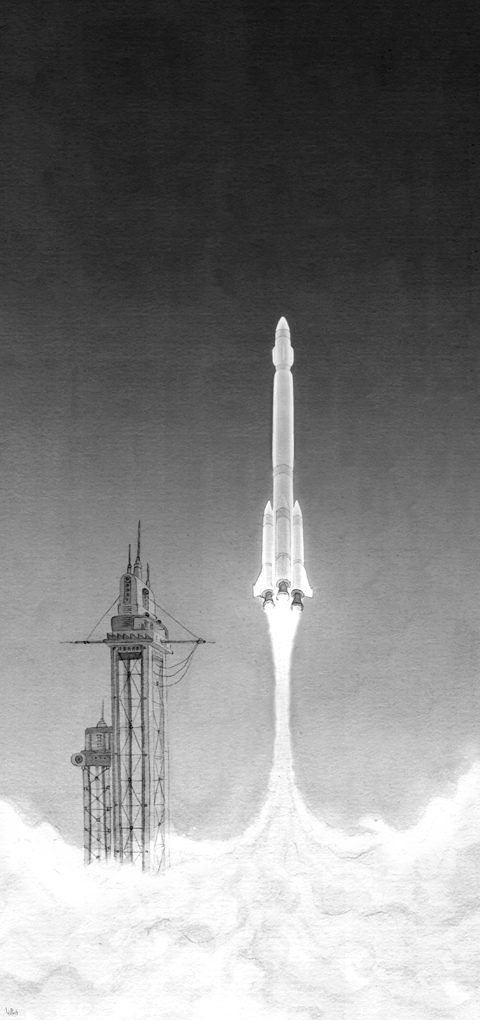
First, they had to get there. It meant taking off at the pinnacle of a Saturn rocket: a controlled incendiary device that would accelerate the trio to a speed of 40,000kph and allow them to scramble above the well of terrestrial gravity and then begin the long fall towards the alien embrace of the moon.
They had to be on exactly the right course. In the 1960s, the world marvelled at NASA’s state-of-the-art computers, but one forgets how new this art was. Any household washing machine now has greater memory, more sophisticated programming and faster processing power than the entire sum of NASA’s computing resources at the time. Like Captain Cook and other 18th century mariners before them, the astronauts had to back up their computer-guided navigation system by making star sightings with a sextant. Essentially, the whole US$24 billion operation rested on Newtonian mechanics, slide-rule mathematics, the watchfulness of 60,000 NASA chiefs, scientists and engineers, and the labor of 400,000 men and women employed by 20,000 private contractors.
This enormous army of achievers had to work as one and yet at the same time think of everything, including the temperature of space through which Apollo and Eagle, locked together, made the journey. Space is very cold, but sunlight is very hot: the difference between light and shade in high orbit is more than 200˚C. If one side of the spacecraft got too hot, while the other got too cold, the electrical wiring that maintained the guidance system and the oxygen supply might collapse. So Apollo had to rotate at intervals all the way to the moon and back. The astronauts had to worry about how they moved: sudden lunges might send the fluid in their inner ears sloshing about, inducing giddiness and nausea. Nausea meant vomiting — it has happened often enough in space — but floating vomit inside a space helmet would be catastrophic.
RENDEZVOUS
When it reached the moon, the mother ship had to go into a precise circular orbit around the new world, because Armstrong and Aldrin had to take their little lifeboat down there and then back again. It was one thing to touch down on the Moon — they could hardly miss. But it would be quite another thing to take off in what was little more than a tent wrapped in foil and perched on stilts, and make a rendezvous with something the size of a small caravan moving at thousands of kilometers an hour. So everything had to go right.
And of course, things went wrong. The alarm systems on board Eagle started complaining as it began its descent: engineers and mission controllers and the astronauts themselves had to make a terrible calculation. Was it just the warning technology playing up, or was there something really wrong? Should they abort? And could they successfully abort? Collins, the man who stayed behind aboard Apollo, whirling round and round the moon, had a checklist of 18 different rescue scenarios clipped to his pressure suit, in case things went wrong. Some of these had to be executed immediately, and flawlessly, to avert tragedy.
Collins, too, while waiting for the touchdown, the moon walk, the show for an estimated billion television viewers, and the take-off, had more time than the others to think about things that might go wrong. If the ascent engine wouldn’t fire, then Armstrong and Aldrin would be marooned with just a day’s supply of oxygen. “How would NASA handle that? Would NASA pull the plug or keep broadcasting their final words to the world? What would I say or do?” he wrote years later in his memoir Liftoff.
The duo made it safely, in a cliff-hanger landing. They also began their two-and a-half-hour extra-vehicular activity (EVA) and stepped from Eagle to the dust of the moon seven hours earlier than planned, because, as Aldrin put it in his book Men from Earth, “Whoever signed off on that plan didn’t know much psychology ... Telling us to try to sleep before the EVA was like telling kids on Christmas morning they had to stay in bed till noon.”
They stepped down, Armstrong said the bit that everybody in the world can quote, and then he said what he really felt: He turned to Aldrin and said: “Isn’t that something?”
HISTORIC
What followed happened according to a script already arranged, with an awkward few minutes of improvisation when former US president Richard Nixon telephoned from the White House: “Neil and Buzz ... this certainly has to be the most historic telephone call ever made.”
The pair planted a flag and left a plaque (“We came in peace ...”) and a medal for the late Yuri Gagarin. They walked no more than 60m from the lander, gathered 20kg of moon rocks, and set up two experiments, one of which failed in the harsh lunar climate and one of which worked for 40 years. After that they prepared for the return journey.
It was then that they discovered something that very few others knew about at the time: One of them, in turning inside the lunar module while wearing the oxygen pack and helmet, had snapped off a little plastic circuit breaker. It was the circuit that would send electrical power to the engine to fire the rockets that would get them off the moon. Both men were by this time suffering from severe fatigue — they had barely slept at all in 36 hours — but, as Aldrin put it afterwards, “this got our attention.” They shoved a felt-tip pen into the slot, and luckily, it fitted. They consulted mission control, began the countdown and took off. This time everything went right: four hours later, they had docked with Apollo.
The return journey had its dangers. They had to hit the Earth’s atmosphere at a very precise angle at 40,000kph. The capsule had to survive friction that would generate several thousand degrees of heat. The parachutes had to open. And the splashdown had to be sufficiently near to the waiting naval craft and its frogmen.
But by 1969, US astronauts and Soviet cosmonauts had survived many such landings. They could do it. The real heart-in-mouth moments had been when Eagle skimmed low over the surface of the moon, looking for somewhere it could safely land, and when it did, we all understood that an epoch had begun. A new era was to begin: there would one day be huge satellite cities in space, colonies on the moon, an outpost on Mars, and all before 2001.
A few days later Senator Teddy Kennedy, brother of the late John Kennedy, was trying to explain the mysterious death of a girl off a bridge at Chappaquiddick, Nixon was talking again about the war in Vietnam and Britain abolished the halfpenny. Somehow, we were back to business as usual.
Recently, China launched another diplomatic offensive against Taiwan, improperly linking its “one China principle” with UN General Assembly Resolution 2758 to constrain Taiwan’s diplomatic space. After Taiwan’s presidential election on Jan. 13, China persuaded Nauru to sever diplomatic ties with Taiwan. Nauru cited Resolution 2758 in its declaration of the diplomatic break. Subsequently, during the WHO Executive Board meeting that month, Beijing rallied countries including Venezuela, Zimbabwe, Belarus, Egypt, Nicaragua, Sri Lanka, Laos, Russia, Syria and Pakistan to reiterate the “one China principle” in their statements, and assert that “Resolution 2758 has settled the status of Taiwan” to hinder Taiwan’s
Singaporean Prime Minister Lee Hsien Loong’s (李顯龍) decision to step down after 19 years and hand power to his deputy, Lawrence Wong (黃循財), on May 15 was expected — though, perhaps, not so soon. Most political analysts had been eyeing an end-of-year handover, to ensure more time for Wong to study and shadow the role, ahead of general elections that must be called by November next year. Wong — who is currently both deputy prime minister and minister of finance — would need a combination of fresh ideas, wisdom and experience as he writes the nation’s next chapter. The world that

Can US dialogue and cooperation with the communist dictatorship in Beijing help avert a Taiwan Strait crisis? Or is US President Joe Biden playing into Chinese President Xi Jinping’s (習近平) hands? With America preoccupied with the wars in Europe and the Middle East, Biden is seeking better relations with Xi’s regime. The goal is to responsibly manage US-China competition and prevent unintended conflict, thereby hoping to create greater space for the two countries to work together in areas where their interests align. The existing wars have already stretched US military resources thin, and the last thing Biden wants is yet another war.
Since the Russian invasion of Ukraine in February 2022, people have been asking if Taiwan is the next Ukraine. At a G7 meeting of national leaders in January, Japanese Prime Minister Fumio Kishida warned that Taiwan “could be the next Ukraine” if Chinese aggression is not checked. NATO Secretary-General Jens Stoltenberg has said that if Russia is not defeated, then “today, it’s Ukraine, tomorrow it can be Taiwan.” China does not like this rhetoric. Its diplomats ask people to stop saying “Ukraine today, Taiwan tomorrow.” However, the rhetoric and stated ambition of Chinese President Xi Jinping (習近平) on Taiwan shows strong parallels with


 RSS
RSS