


Russian Prime Minister Vladimir Putin once characterized liberals and leaders of human rights groups as jackals who scavenged for handouts at foreign embassies. His protege and successor as president, Dmitri Medvedev, recently met with some of those very people, praising their work and saying that they had been treated unfairly.
But Medvedev left it at that. No new policies or aid.
About a year after becoming Russia’s third president, Medvedev remains something of a puzzle, and the financial crisis has only deepened the questions about his intentions. Is he the affable front man for the business-as-usual hardliners in the Kremlin, a puppet president who offers soothing remarks but little else? Or is he a genuine reformer who is edging Russia away from the more heavy-handed practices of Putin, but needs time to make his mark?
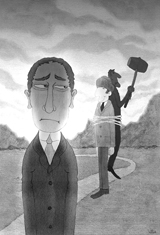
Medvedev lately seems to have gone out of his way to showcase his supposed liberal leanings and to distinguish himself from Putin. Medvedev first gave an interview to a fiercely anti-Kremlin newspaper, Novaya Gazeta, whose reporters have been killed and harassed in recent years.
He then convened the meeting with human rights and related advocacy groups on April 15. They have long complained of government harassment and are now operating in such a climate of intimidation that some of their leaders have hired bodyguards.
“It is no secret that there is a seriously distorted perception of human rights activities in our country,” Medvedev said at the meeting, issuing the kind of apology rarely, if ever, heard from Putin.
“Many officials are now under the impression that all non-governmental organizations are enemies of the state and should be fought, so that they do not transmit some sort of disease that may undermine the foundations of our society,” Medvedev said. “I think such an interpretation is simply dangerous.”
If his statements were heartening to the groups, they were, as often is the case, not accompanied by action. And in general, it is difficult to discern even a minor shift in how the Kremlin wields power under Medvedev.
The recent mayoral race in Sochi, host of the 2014 Winter Olympics, appeared to have been orchestrated using the same techniques honed in the Putin era. Opposition candidates were kicked off the ballot or subjected to intensely hostile TV coverage. The Kremlin’s favorite won 77 percent of the vote after barely campaigning.
“For now, Medvedev is just pronouncing nice words,” said Alexei Simonov, who is president of the Glasnost Defense Foundation in Moscow, which promotes media freedom, and who was at the meeting. “And he has done a lot of that. But there has been a complete lack of deeds.”
Medvedev’s comments are regularly parsed for signs of discord with Putin, who is considered Russia’s paramount leader, and it is perhaps possible to glean from them a rebuke to Putin’s style.
But it seems far more likely that Putin has chosen to let Medvedev adopt his own tone as long as he does not alter the government’s course.
Medvedev is a former law professor who appears to have sympathy for the difficulties of human rights groups. Even so, the groups’ leaders could point to only one move by the government recently that indicated a thaw: a court-ordered release from prison of a lawyer, Svetlana Bakhmina, who was a minor figure in the crackdown by Putin on the Yukos Oil company and its head, former oligarch Mikhail Khodorkovsky.
At the same time, though, prosecutors are pursuing new charges against Khodorkovsky, who was once Russia’s richest man and was imprisoned in 2003 after angering Putin by getting involved in politics. The new charges, which could keep Khodorkovsky behind bars for two more decades, have been widely seen as a sign that the Kremlin has no intention of loosening the reins.
“We so want to believe that things are getting better that we sometimes confuse our expectations with what is really happening,” said Irina Yasina, an analyst at the Institute for the Economy in Transition in Moscow, who was also at the meeting with Medvedev. “We so want to believe that there is a big difference between Putin and Medvedev. And sometimes our hopes prevent us from seeing the reality.”
Beyond the debate about whether Medvedev is sincere, there is another issue. Does he have the power to carry out significant changes in civil liberties, political pluralism and related matters, especially during the financial crisis?
Putin, of course, is still in office. As in Soviet times, there are competing groups of senior officials in the Kremlin — some liberal, some decidedly not. Some have signaled that it would be a mistake to consider ceding control now that Russia is facing widespread unemployment and fears of disorder in regional centers.
In March, Vladislav Surkov, often described as the Kremlin’s chief political strategist, publicly mocked calls for reform.
“The system is working,” he said. “It will cope with the crisis and get through it.”
In truth, it is not at all clear that most Russians care about Medvedev’s gestures. A majority of the population is primarily concerned with what the government is doing to preserve stability and the strong economic gains of the last decade.
What is more, the government in the Putin era has mounted such a sustained campaign against liberals and advocacy groups that they have become widely discredited.
“Most people don’t trust these organizations, which have been brought in from abroad,” said Yevgeny Fedorov, a prominent member of parliament from Putin’s party. “They carry out lobbying, involving the political, economic or other interests, of those who have sent them here and financed their activities.”
For now, the liberals say they have not given up on Medvedev, though they have grown very discouraged.
Simonov, the leader of the media advocacy group, said that when he left the meeting with Medvedev, he ran into a group of executives arriving for consultations with the government.
They were the heads of the national TV networks, which have come under stiff official control. Simonov said he realized that while he was not a frequent visitor to the Kremlin, those executives most definitely were.
Recently, China launched another diplomatic offensive against Taiwan, improperly linking its “one China principle” with UN General Assembly Resolution 2758 to constrain Taiwan’s diplomatic space. After Taiwan’s presidential election on Jan. 13, China persuaded Nauru to sever diplomatic ties with Taiwan. Nauru cited Resolution 2758 in its declaration of the diplomatic break. Subsequently, during the WHO Executive Board meeting that month, Beijing rallied countries including Venezuela, Zimbabwe, Belarus, Egypt, Nicaragua, Sri Lanka, Laos, Russia, Syria and Pakistan to reiterate the “one China principle” in their statements, and assert that “Resolution 2758 has settled the status of Taiwan” to hinder Taiwan’s
Singaporean Prime Minister Lee Hsien Loong’s (李顯龍) decision to step down after 19 years and hand power to his deputy, Lawrence Wong (黃循財), on May 15 was expected — though, perhaps, not so soon. Most political analysts had been eyeing an end-of-year handover, to ensure more time for Wong to study and shadow the role, ahead of general elections that must be called by November next year. Wong — who is currently both deputy prime minister and minister of finance — would need a combination of fresh ideas, wisdom and experience as he writes the nation’s next chapter. The world that
Can US dialogue and cooperation with the communist dictatorship in Beijing help avert a Taiwan Strait crisis? Or is US President Joe Biden playing into Chinese President Xi Jinping’s (習近平) hands? With America preoccupied with the wars in Europe and the Middle East, Biden is seeking better relations with Xi’s regime. The goal is to responsibly manage US-China competition and prevent unintended conflict, thereby hoping to create greater space for the two countries to work together in areas where their interests align. The existing wars have already stretched US military resources thin, and the last thing Biden wants is yet another war.
Since the Russian invasion of Ukraine in February 2022, people have been asking if Taiwan is the next Ukraine. At a G7 meeting of national leaders in January, Japanese Prime Minister Fumio Kishida warned that Taiwan “could be the next Ukraine” if Chinese aggression is not checked. NATO Secretary-General Jens Stoltenberg has said that if Russia is not defeated, then “today, it’s Ukraine, tomorrow it can be Taiwan.” China does not like this rhetoric. Its diplomats ask people to stop saying “Ukraine today, Taiwan tomorrow.” However, the rhetoric and stated ambition of Chinese President Xi Jinping (習近平) on Taiwan shows strong parallels with


 RSS
RSS