


The School of Life, which just opened in London, is the sort of place that would welcome the news out of Bari, Italy, the other day. A certain Marina de Tommaso, leading a team of Italian colleagues, recently asked a dozen young men and women to choose 20 attractive pictures and 20 ugly ones from several hundred works of art. The volunteers stared at said images while being zapped with a laser beam that caused them mild pain.
The intensity of their suffering, it turned out, diminished while they gazed at a Leonardo or a Botticelli or at van Gogh’s Starry Night. It persisted before Picasso and Fernando Botero.
Beauty makes you feel better, de Tommaso concluded, notwithstanding that Edvard Munch’s Scream muddied the results: Some volunteers found it beautiful, others not so much, proving the different scientific point that everyone’s an art critic.
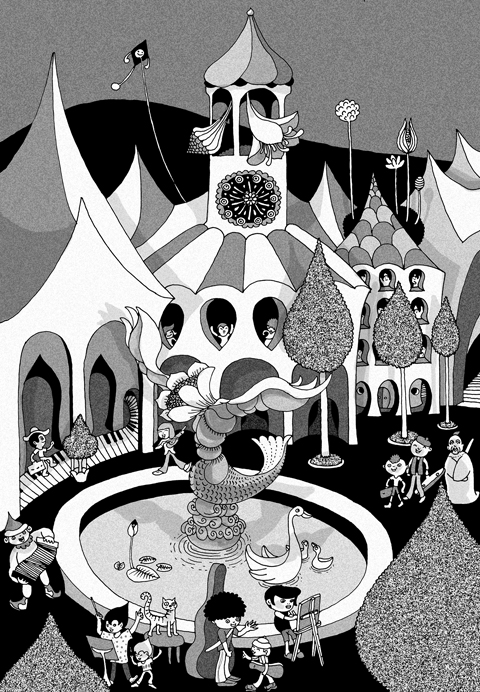
ILLUSTRATION: MOUNTAIN PEOPLE
Sophie Howarth is director of the School of Life. She likes to call this storefront school in Bloomsbury “an apothecary of the mind.” Adults enroll in courses on love, politics, family and play. They may take an instructional tour of the M1 motorway or spend an overnight snooping around Heathrow Airport (staying in a Japanese capsule hotel) with the best-selling author Alain de Botton as guide, lecturing about the art of travel.
There are also bibliotherapists on call, dispensing literary advice; consultants to recommend the most agreeable route for a nighttime walk through the London neighborhood of Brixton; and group meals to enhance conversational skills.
One recent afternoon a line formed on the sidewalk outside the school. Dozens of people were waiting for impromptu private therapy sessions, on a leopard-spotted chaise lounge, with David Gale, an actor who described himself as a “nonpsychotherapist.” Strangers revealed their secrets to him anyway.
It may all sound like a big metaprank, but the school is perfectly sincere. The ambition is to offer a road map to a fuller life — secular and interior, not religious — toward which end a sense of humor helps. For reticent Britons, disinclined to emote in public, it’s a kind of lubricant.
Whimsy being in short supply these days, every little bit helps, especially here. The US$200 million Damien Hirst auction at Sotheby’s last month, when the world financial markets imploded, summed up the local climate. London has become a greedy city.
The school, too, is looking to turn a profit (courses cost about US$350 each). But it’s the earnest brainchild of various London writers, artists and friends — Geoff Dyer, the writer, among them. Like de Botton, he belongs to the faculty, and is scheduled to deliver a lecture (“sermon” in school speak) this fall on punctuality.
The other day, apropos of the Esalen Institute in California and the Jack Kerouac School of Disembodied Poetics in Colorado, he said the School of Life, by contrast, existed “in a postideological vacuum, in the wake of the thing that Margaret Thatcher said didn’t exist: society.”
“It’s maybe part of the attempt to rebuild a notion of society,” Dyer said.
Howarth, the school’s 33-year-old director, frowned when a visitor wondered aloud if it were instead a kind of twee Learning Annex for those who wouldn’t be caught dead at the Learning Annex. McSweeney’s, the American literary enterprise with an educational component, was the comparison she preferred.
“The alchemy of learning involves making ideas theatrical,” she said, before a large round table in the school’s basement classroom (“our Wonderworld,” Howarth called it).
The walls were decorated with Lewis Carroll-like scenes by Charlotte Mann, an artist.
“Design is not a trivial part of the enjoyment of how you learn,” Howarth said. “There’s a snootiness in the culture sphere around teaching ‘relevance.’ We have spent a lot of time talking to psychotherapists about the questions people really care about, so that we can provide a broader mental apparatus to decide when you wake up in the morning whether to park on the yellow line or to make up with your dad.”
De Botton sees such instruction as responding to a specifically English problem. On the one hand, he said, there is the exclusionary elitism of ancient higher education.
On the other, for English people, he said “sitting down and talking with strangers about emotional things is taboo, and so we use wit at the school because wit is what the English use when they want to talk about something serious, like the soul.”
Along which lines the school occupies not a formal campus but a modest shop on busy Marchmont Street in Bloomsbury among neighborhood hairdressers, closet-size newsstands and cheap restaurants. The Pasha spa and clinic is nearby, as is a store called Gay’s the Word. The aforementioned chaise beckons from just inside the school’s front window, inviting passers-by to recline with a book purchased from the select few shelves that Howarth daily organizes by shifting categories. The other morning the categories included “Things to Learn About Sex” and “For Those Who Worry About Death.”
The design scheme involves tasteful variations of beige and taupe, along with a few artfully arranged birch trunks. With its bookshelves and a glass cabinet stocked with knickknacks, it looks much more like a curiosity shop than a school.
Leaning on that old wonder-cabinet idea, the school sells US$1.50 postcards of airplanes (an AvAtlantic Boeing 727 on the tarmac at Fort Lauderdale, dated 1992), US$10 bottles of “I Love You” Marmite and posters with aphorisms by, among others, Voltaire and Mae West. (“Between two evils, I always pick the one I never tried before.”) The frugal can take Tunnock’s Milk-Chocolate Coated Caramel bars, in gold and red wrappers, free from a glass jar.
“The school is sort of pointless, like art, culture, sport and many of the other good things in life,” is how Dyer put it. “We English don’t have your excellent American assumption that the purpose of life is to be happy, that the waiters in restaurants should bring us exactly the food we want, promptly and gladly. We have a much more stoic or Soviet attitude. So the school is a way either of making us happier, ie, more American, or helping us make an accommodation with the shortcoming of our lot.”
London already offers adult evening classes in women’s self-defense, Indian cooking and Hegel. They’re often a good excuse to unwind at the pub afterward. In a way, Dyer suggested, the school brings the pub’s charm into the classroom.
Charm is a matter of opinion, of course. So far the charm of the school seems to be working. More than 1,000 Londoners turned up on opening day, Sept. 6. Spots in de Botton’s Heathrow holiday and a two-day jaunt to the Isle of Wight with the photographer Martin Parr quickly disappeared.
A gap appears to be emerging between Washington’s foreign policy elites and the broader American public on how the United States should respond to China’s rise. From my vantage working at a think tank in Washington, DC, and through regular travel around the United States, I increasingly experience two distinct discussions. This divergence — between America’s elite hawkishness and public caution — may become one of the least appreciated and most consequential external factors influencing Taiwan’s security environment in the years ahead. Within the American policy community, the dominant view of China has grown unmistakably tough. Many members of Congress, as
The Hong Kong government on Monday gazetted sweeping amendments to the implementation rules of Article 43 of its National Security Law. There was no legislative debate, no public consultation and no transition period. By the time the ink dried on the gazette, the new powers were already in force. This move effectively bypassed Hong Kong’s Legislative Council. The rules were enacted by the Hong Kong chief executive, in conjunction with the Committee for Safeguarding National Security — a body shielded from judicial review and accountable only to Beijing. What is presented as “procedural refinement” is, in substance, a shift away from
The shifting geopolitical tectonic plates of this year have placed Beijing in a profound strategic dilemma. As Chinese President Xi Jinping (習近平) prepares for a high-stakes summit with US President Donald Trump, the traditional power dynamics of the China-Japan-US triangle have been destabilized by the diplomatic success of Japanese Prime Minister Sanae Takaichi in Washington. For the Chinese leadership, the anxiety is two-fold: There is a visceral fear of being encircled by a hardened security alliance, and a secondary risk of being left in a vulnerable position by a transactional deal between Washington and Tokyo that might inadvertently empower Japan

After declaring Iran’s military “gone,” US President Donald Trump appealed to the UK, France, Japan and South Korea — as well as China, Iran’s strategic partner — to send minesweepers and naval forces to reopen the Strait of Hormuz. When allies balked, the request turned into a warning: NATO would face “a very bad” future if it refused. The prevailing wisdom is that Trump faces a credibility problem: having spent years insulting allies, he finds they would not rally when he needs them. That is true, but superficial, as though a structural collapse could be caused by wounded feelings. Something


 RSS
RSS