


After racing through spectacular desert, sleeping under the stars and enjoying boundless hospitality, three Westerners on a motorbike odyssey say they are convinced that Sudan is Africa’s next tourist paradise just waiting to be discovered.
President Omar al-Beshir may be the first sitting head of state in history to face a possible international arrest warrant for alleged genocide and war crimes, but two Canadians and an Englishman are spellbound by the country.
“I’m convinced that in a few years’ time Sudan will be right up there with the other big African countries in terms of tourist spots,” said Tom Smith, on three months’ leave from the Bank of England to bike from London to Cape Town.
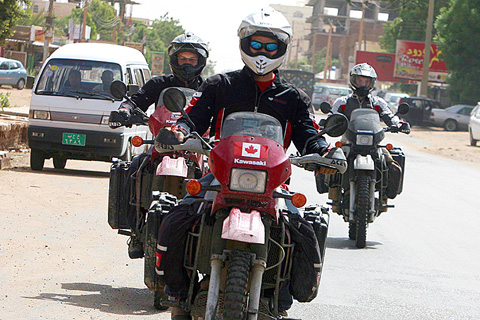
PHOTO: AFP
“If it stays like this, you know, has the same appeal, then yeah — I think they’ll be flocking,” added the 25-year-old, on a pit stop in Khartoum with the desert behind them and a two-day run to the Ethiopian border ahead.
More than two years in the planning, their 24,000km ride through Europe, the Middle East, Sudan and down through Africa to the Cape is costing Smith and his Canadian mates a self-financed total of US$60,000.
Inspired by film actor Ewan McGregor and his close friend Charley Boorman who rode BMW bikes from Scotland to South Africa for a television series, the intrepid three are also raising thousands of dollars to help HIV sufferers.
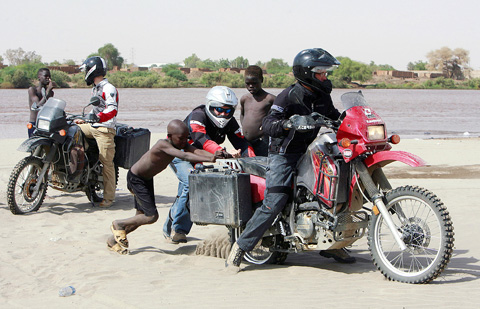
PHOTO: AFP
They were apprehensive about the security situation in Sudan, bogged down in war in Darfur to the west and also trying to recover from a 21-year north-south civil war.
But such fears quickly dissipated after their arrival in Sudan by ferry from Egypt across Lake Nasser.
“The perception of this war-torn country has been the focus of the media, but the experience that we’ve had — nothing could be further from the truth,” said Tyson Brust, a 30-year-old medical student from Toronto.
“It’s probably one of the safer areas in the world, and we found that when we went through. The people were incredibly friendly — everyone was waving us in, wanting us to have breakfast with them and giving us drinks,” he added.
Such comments are music to the ears of a country slapped with US sanctions, blacklisted by Washington as a sponsor of terror and on a diplomatic offensive to save Beshir from the dock of the International Criminal Court.
After driving dirt bikes through Europe, Syria and Jordan and enduring a horrifying crash that left 32-year-old Yarema Bezchlibnyk in pain and weary of “being completely shafted” in Egypt, they say their adventure really began.
Yarema, also a medical student, described the journey from Lake Nasser to Dongola, site of a mediaeval city, as a “spectacular ride, the landscape almost lunar” with rock formations jutting from the desert and blasted by the scorching heat.
“We got into the desert. The sun started to go down and I was thinking ‘wow, I’m in Sudan riding through the desert.’ Just spectacular scenery. This is what it’s all about, this is the adventure,” added Tyson.
They expect to be in Sudan for another week. They have slept under the stars, been invited to stay overnight in village huts and rested at a guest house recommended by a friend of a friend near the UN headquarters in Khartoum.
But it has not all been plain sailing. Stomach upsets from the local cuisine have plagued their advance since Turkey. None is a trained mechanic, so just a flat tire can take half a day to repair. And the heat can be intense.
They are a week behind schedule and need to get to Cape Town in time to fly back for medical school and work. They’ve been away for a month and a half, but at 10,100km have completed only two-fifths of the route.
Smith likened one hotel they stayed in — apparently the best in town — to a POW camp with cell-like rooms where they awoke “absolutely sweltering” because the air conditioning had conked out in a power cut.
Despite having just one guidebook, they are finding their way without GPS and stumbling across tourist gems quite by chance — such as lazing under palm trees next to an ancient Egyptian temple after lunch.
Sudan’s attraction was being able to realize the dream of getting off the beaten track — the trio’s blog is at www.ditchthecomfortzone.com. But from Wadi Halfa to Dongola they also witnessed Sudan’s march to development on the back of oil profits.
“You can see that in a couple of years that (new road) is going to be finished. You won’t need any of the dirt bikes that we’ve kitted out — you can do it on anything,” said Smith.

And so, in the wake of US President Donald Trump’s trip to the People’s Republic of China (PRC), all the experts on the Strait of Hormuz suddenly became experts on US-China-Taiwan relations. The Internet has certainly expanded human knowledge. Lots of these sudden experts made noise this week about Trump’s words after the meeting with PRC dictator Xi Jin-ping (習近平). Trump is going to sell out Taiwan! Longtime Taiwan commentator J. Michael Cole summed the situation up neatly in the Guardian: “We need to keep in mind that he has a tendency to say many things — sometimes contradicting himself within

There is considerable frustration and confusion among many, both in Taiwan and abroad — including in Washington — as to why the Chinese Nationalist Party (KMT) seems so dead set on using their legislative leverage to slash defense spending and disrupt the ability of the ruling Democratic Progressive Party (DPP) administration to function. Are they pawns of the Chinese Communist Party (CCP)? Are they traitors? In reality, there are multiple reasons. In the first column in this series on this subject, “Donovan’s Deep Dives: How and why the TPP and KMT help Beijing” (Sat May 16, page 12), we examined three
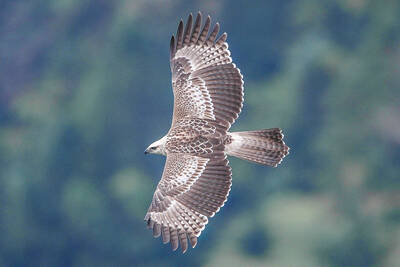
It took 12 years and months of standing in the same mountain location for director Liang Chieh-te (梁皆得) to capture a few seconds of footage: Taiwan’s largest resident raptor locking talons with its mate and spinning through the air in a courtship ritual. With only about 1,000 left in the wild and very short flight windows, the mountain hawk-eagle remains among Taiwan’s most elusive birds. The species generally produces only one offspring per year. Using forest cameras, the film crew and research teams document the arduous process the monogamous pairs go through for the chick to hatch and grow up, weathering
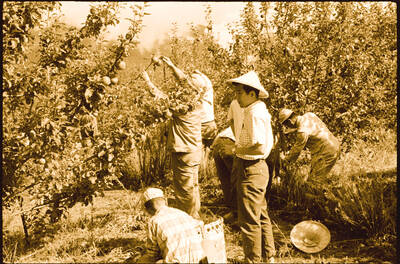
May 25 to May 31 Few believed that apples could be cultivated on a commercial scale in Taiwan’s high mountains. When horticulturalist Cheng Chao-hsiung (程兆熊) first proposed the idea in 1955, both American and Taiwanese colleagues dismissed it as implausible, arguing that temperate fruit could not be reliably grown on a subtropical island, especially on rugged terrain. However, it was this terrain in the Central Mountain Range where many Chinese Civil War veterans were resettled in the late 1950s. With limited job prospects and no family in Taiwan, they were placed on cooperative farms aimed toward self-sufficiency. Some say the conditions


 RSS
RSS