


It could be described as a poke, but not a friendly one. For those who have not yet succumbed to Facebook, the latest craze on the Internet, a "poke" is an electronic greeting sent, for example, to an old friend from university. In the case of Facebook CEO Mark Zuckerberg, who stands to make a fortune from the Web site if and when he sells it, the contact made by three of his former student colleagues represented an aggressive jab to the ribs.
Facebook has been described as the most sophisticated and powerful socializing device on the Internet, growing so rapidly -- with 150,000 new members every day -- that media mogul Rupert Murdoch, owner of rival MySpace, is said to be worried.
MySpace was bought by News Corp in 2005 for US$580 million, now regarded as a bargain. Facebook is expected to sell for more than double that, turning Zuckerberg, its 23-year-old creator, into the latest dotcom millionaire and darling of Silicon Valley.
glitch
But there is a glitch. Yesterday, at a federal court in Boston, Zuckerberg was accused of snatching the idea for Facebook from under the noses of three fellow students, who believe its wealth and influence should be theirs.
Cameron Winklevoss, his twin brother Tyler and their colleague, Divya Narendra, recruited Zuckerberg to their social networking site when they were all students at Harvard University. They now claim that he deliberately stalled its progress, stole the source code, design and business plan, then set up his own rival. Facebook sped away while their site, now called ConnectU, was still in Zuckerberg's traps.
"It's sort of a land grab," Tyler Winklevoss has said. "You feel robbed. The kids down the hall are using it, and you're thinking, `That's supposed to be us.' We're not there because one greedy kid cut us out."
At the first court hearing yesterday they were expected to ask a judge to shut down Facebook and transfer its assets to them, plus damages. At stake is a large slice of pride, one of the most coveted prizes of the Web 2.0 goldrush and potentially millions, or even billions, of dollars. Last week, Facebook signaled its ambitions by making its first acquisition, reportedly beating even Google to buy a Web-based operating system called Parakey and fueling bloggers' suspicions that Facebook could threaten Web diversity by sucking the best of it into one place.
Web 2.0 is the ambiguously defined revolution that has changed the way millions use the Internet, as fast broadband connections enable them to upload their own content and share it with friends and millions of strangers.
Facebook, a word barely known in most countries a year ago, refers to printed facebooks: the class directory at a US university containing photographs of each student along with their name, hometown and other personal details. It was one such facebook at Harvard that inspired the Web site that for millions seems to have become more addictive than YouTube or their own e-mail inbox.
Users enter their name and details about their career, education and interests. They are provided with a home page, or "profile," where they can store photographs and a "wall" -- an online message board. They can seek out friends and share content and are constantly updated with their friends' comments. Common interest groups can form around everything from people who share the same name to people who want to "throw a [virtual] sheep" at someone they like. Such is Internet humor.
background
The Facebook story began when Zuckerberg, the son of a dentist from New York state, enrolled at Harvard in 2002 to study psychology and quickly gained a reputation as an Internet prodigy. One of his first projects was Facemash, onto which he uploaded pictures of students from their ID cards, two per Web page, and invited fellow students to vote on which was the more attractive. More than 22,000 votes were recorded, but then Harvard blocked Zuckerberg's Internet access after receiving complaints that the site was offensive.
Harvard's administrative board summoned Zuckerberg to a disciplinary hearing but he escaped without punishment, later celebrating with a bottle of champagne.
According to a profile in the New Yorker magazine, three older students at Harvard learned of Zuckerberg's prowess and invited him to write computer code for a new site they were planning. The Winklevoss brothers and Narendra based their idea on existing social networking Web sites that allowed members to post personal details and link to other members. By late 2003 they had designed a prototype, known as HarvardConnection, and approached Zuckerberg to help them to complete it.
Tyler Winklevoss told the New Yorker: "We met Mark, and we talked to him and we thought, `This guy seems like a winner.'"
Zuckerberg began working on HarvardConnection in November 2003. But it was not his only assignment. Harvard had been planning to put its facebook online so students could learn more about each other. Zuckerberg decided to take on that task as well.
With immaculate self-assurance, he said at the time: "I think it's kind of silly that it would take the university a couple of years to get around to it. I can do it better than they can, and I can do it in a week."
Thefacebook.com went live on Feb. 4, 2004, and within 24 hours more than 1,200 students had registered. By the end of February, about three-quarters of undergraduates had created a profile, consisting of a picture and details such as the user's major, club memberships, favorite films and choice quotations. There was a search box to look up others' profiles and a "poking" button to make contact -- now one of the most famous features on Facebook.
By the end of the month it had launched at Columbia, Yale and Stanford universities, again taking each campus by storm, but maintaining an intimacy that many still regard as the secret of its success.
With two colleagues, Zuckerberg worked over the summer to build up a quarter of a million users. He decided to drop out of Harvard and moved to Palo Alto in Silicon Valley, met local venture capitalists and attracted millions of dollars of investment.
Then a cloud appeared on the horizon. In September 2004 the Winklevoss brothers and Narendra filed allegations with a federal court that Zuckerberg stole their idea and worked to drag out their site's launch so that he could complete Facebook first.
He was not paid to do the work, they said, but he was a full member of their team and would have reaped any future rewards. In total they made nine claims, including copyright infringement, misappropriation of trade secrets and breach of contract.
countersuit
That November, Facebook filed a countersuit, charging ConnectU with defamation. Zuckerberg has said ConnectU asked him to do about six hours of work, which he did, and any delays were due to him getting bogged down by his studies. He points out that he was not paid and did not sign a contract. But ConnectU's founders claim he agreed to an "oral contract," deliberately played for time and that an e-mail trail supports their case.
The messages, filed with the court, were reproduced in the New Yorker. In a message to Cameron Winklevoss, Zuckerberg allegedly wrote: "Sorry I was unreachable tonight. I just got about three of your missed calls. I was working on a problem set."
Thirteen days later, he allegedly wrote again: "Sorry I have not been reachable for the past few days. I've basically been in the lab the whole time working on a ... problem set which I'm still not finished with."
Then, about a month later, he allegedly wrote: "I'm completely swamped with work this week. I have three programming projects and a final paper due by Monday, as well as a couple of problem sets due Friday."
The magazine reported that the Winklevoss brothers and Narendra then met with Zuckerberg to discuss his apparent procrastination. According to Tyler Winklevoss, Zuckerberg mentioned that he had been occupied with other projects, but did not identify them, even though he had registered the domain name Thefacebook.com three days earlier.
"He didn't mention it at all," Tyler Winklevoss said. "He didn't say he was working on anything similar to our site. It just seems like the way he acted was very duplicitous."
ConnectU eventually launched in May 2004 and shares many of Facebook's features, such as profiles, messaging and groups. The sites are so similar that ConnectU began a service called Social Butterfly that allows Facebook users to upload their profiles straight to ConnectU in just one minute. But today ConnectU is only a fraction of the size of its rival.
The site carries a message from its founders that reads: "Over the course of development, we've had our ups and downs. We've cycled through several programmers, even one who stole our ideas to create a competing site, without informing us of his intentions. But we've been troupers. At first we were devastated and climbed into a bottle of Jack Daniel's for a bit, but eventually emerged with a bad headache and renewed optimism. We weren't going to lie down and get walked over like this. So we regrouped, reassessed, and the end result is ConnectU, albeit a couple of months late."
offers
Zuckerberg has received half a dozen offers to buy out Facebook, including one from Yahoo for nearly US$1 billion, all of which he has turned down. Earlier this year Business Week reported that Zuckerberg was looking for US$2 billion, a story he denied. Tyler Winklevoss denies that such figures make him envious.
"This asset is now incredibly valuable, and I'm not going to pretend that's not very exciting," he has said. "I don't want more than I deserve, but I want what I deserve."
Both ConnectU and Facebook declined to comment on the case last week.
Zuckerberg is thought to be taking it seriously but has said: "I don't really spend much time worrying about this. There is a lawsuit going on, but, like, we know that we didn't take anything from them. There is really good documentation of this: our code base versus theirs. At some point, that will come out in court, and they'll compare the two."
While the legal case rumbled on, Facebook, in an apparent attempt to take on MySpace, lifted restrictions on membership and allowed people to sign up using their work e-mail addresses, thereby creating workplace networks similar to those that thrive on university campuses. It is this that has allowed Facebook to spread virally and grow exponentially, sweeping through industries such as the media as surely as it swept through Harvard.?
During the long Lunar New Year’s holiday, Taiwan has shown several positive developments in different aspects of society, hinting at a hopeful outlook for the Year of the Horse, but there are also significant challenges that the country must cautiously navigate with strength, wisdom and resilience. Before the holiday break, Taiwan’s stock market closed at a record 10,080.3 points and the TAIEX wrapped up at a record-high 33,605.71 points, while Taipei and Washington formally signed the Taiwan-US Agreement on Reciprocal Trade that caps US tariffs on Taiwanese goods at 15 percent and secures Taiwan preferential tariff treatment. President William Lai (賴清德) in
As red lanterns adorn street corners and social media feeds teem with zodiac divinations, the Year of the Horse has arrived. In our hyper-accelerated age, the horse is almost exclusively synonymous with the idiom ma dao cheng gong (馬到成功) — “instant success upon arrival.” It is a linguistic shot of adrenaline, fueling the thrilling illusion that once the bell tolls, our lives would screech off into a cloud of dust, leaving all troubles behind. Yet, when examining the millennia-long partnership between humans and this magnificent “biological machine,” a different truth emerges. The true essence of the horse is not merely speed;
Chinese Nationalist Party (KMT) Deputy Chairman Hsiao Hsu-tsen (蕭旭岑) earlier this month led a delegation to Beijing to attend a think tank forum between the KMT and Chinese Communist Party (CCP). After returning to Taiwan, Hsiao spoke at length about “accumulating mutual trust” and letting matters “fall into place,” portraying the forum as a series of discussions focused on cooperation in tourism, renewable energy, disaster prevention, emerging industries, health and medicine, and artificial intelligence (AI). However, when the entire dialogue presupposes the so-called “1992 consensus — the idea that there is only “one China,” with each side of the Taiwan
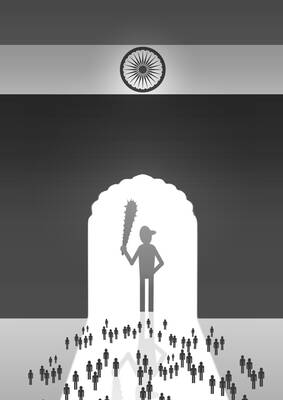
India is getting richer every year, but its cities do not seem to be getting any more livable. Not because the country is too poor, or because leaders lack ambition, but because urban citizens are starved of funds and deprived of representation — and the government is in no hurry to fix it, even though people are dying as a result. Mumbai’s skyline is dotted with opulent glass towers, and it calls itself India’s commercial capital. The civic body, the Brihanmumbai Municipal Corp, is the country’s richest. Yet, residents have lived for years with no say in how their city was


 RSS
RSS