


Once the targets of rioting and insurrection in Africa were European colonial overlords. Today, though, jet-setting Chinese businessmen, arriving in ever greater numbers, are causing a backlash in the world's poorest continent.
Zambia was the scene of the latest trouble early last month, when Chinese shopkeepers in the capital Lusaka were forced to use barricades to protect themselves from looters at the culmination of a bitter election contest fought largely on the issue of China's alleged "exploitation" of the southern African country.
Opposition leader Michael Sata won nearly a third of the vote after accusing the Chinese of making Zambia a "dumping ground for their human beings," and across Africa there is growing alarm, as well as excitement, at China's burgeoning financial and political involvement.
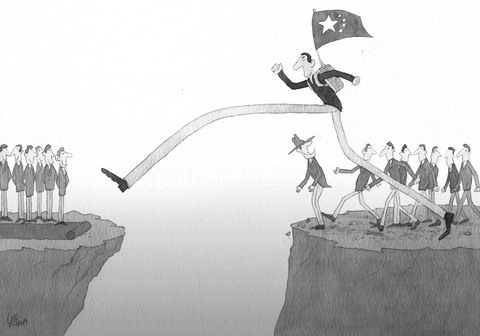
The perils and rewards of Beijing's engagement with Africa are well illustrated in Zambia, where Lusaka's community of Chinese entrepreneurs, diplomats and technicians has grown tenfold to about 30,000 in the past decade.
Investment from China has resurrected the country's moribund Chambishi copper mine, raising the promise of vital revenue. But miners have protested over poor pay and dangerous working conditions, which led to dozens of deaths in an industrial accident earlier this year.
As China aggressively seeks new markets for its exports and new raw materials to feed its explosive economic growth, its involvement in Africa is increasingly the subject of heated international debate.
Just two weeks ago, Paul Wolfowitz, president of the World Bank, criticized China for ignoring human rights and environmental standards when lending to other developing countries.
Beijing, however, shows no signs of being deterred. Today and tomorrow it is hosting leaders from 48 African countries at a summit designed to cement its influence. China's trade with Africa has grown at an astonishing rate, from about US$10 billion in 2000 to an estimated US$50 billion this year.
Wei Jianguo (
He has a point. Chinese investors and state agencies have spent billions on roadbuilding in Kenya, a hydroelectric dam in Ghana and a mobile phone network in Ethiopia. Nigeria, where China has been snapping up oil assets, has a Mandarin-language newspaper serving 50,000 readers -- a community greater in number than the British ever were, even at the height of Empire.
Chinese investment in Africa has overtaken Britain's, and stands only behind that of France and the US.
The opening of new trade and investment corridors between developing countries -- confirmed as a growing phenomenon in UN figures released last week -- is a disconcerting sight for the old powers.
China claims with some credibility to be the champion of developing countries, and Africans are rightly suspicious of finger-wagging lectures from their former colonial masters.
Even so, it is fair to say Beijing is not up with the latest thinking on development. Like Wolfowitz, Bob Geldof, the Live 8 campaigner, has warned that attempts to stamp out corruption in Africa risk being undermined by soft loans and naked mercantilism from China.
The country's banks do not adhere to Western banks' environmentally-conscious "Equator Principles" of lending, and its companies are not required to be transparent about their deals with African dictators.
Beijing cynically sold arms to both sides in the war between Eritrea and Ethiopia. It has swooped on investment opportunities in countries shunned by the West, such as Zimbabwe and Sudan. Its close relationship with Khartoum appears to have played a role in the UN's failure to take serious action against Sudan in relation to massacres in Darfur.
Human Rights Watch has condemned Beijing's attitude.
"China can't continue to protect human rights abusers at the expense of civilians just because it is profitable to do so," says Peter Takirambudde, the group's Africa director.
It is also claimed that some local industries are being snuffed out by cheap Chinese imports. Overall, however, Africa's annual GDP growth is a healthy 6 percent, and some experts suggest the economic benefits that China brings outweigh even the political risks.
"Chinese companies are building roads and hospitals, and generally going where Western companies do not dare to go," says Feng Zhang, an analyst at the Foreign Policy Center think tank in London.
"I understand the concern over human rights but so far China's interest has been very good for Africa," he says.

China’s supreme objective in a war across the Taiwan Strait is to incorporate Taiwan as a province of the People’s Republic. It follows, therefore, that international recognition of Taiwan’s de jure independence is a consummation that China’s leaders devoutly wish to avoid. By the same token, an American strategy to deny China that objective would complicate Beijing’s calculus and deter large-scale hostilities. For decades, China has cautioned “independence means war.” The opposite is also true: “war means independence.” A comprehensive strategy of denial would guarantee an outcome of de jure independence for Taiwan in the event of Chinese invasion or
A recent Taipei Times editorial (“A targeted bilingual policy,” March 12, page 8) questioned how the Ministry of Education can justify spending NT$151 million (US$4.74 million) when the spotlighted achievements are English speech competitions and campus tours. It is a fair question, but it focuses on the wrong issue. The problem is not last year’s outcomes failing to meet the bilingual education vision; the issue is that the ministry has abandoned the program that originally justified such a large expenditure. In the early years of Bilingual 2030, the ministry’s K-12 Administration promoted the Bilingual Instruction in Select Domains Program (部分領域課程雙語教學實施計畫).
Chinese Nationalist Party (KMT) Chairwoman Cheng Li-wun (鄭麗文) earlier this month said it is necessary for her to meet with Chinese President Xi Jinping (習近平) and it would be a “huge boost” to the party’s local election results in November, but many KMT members have expressed different opinions, indicating a struggle between different groups in the party. Since Cheng was elected as party chairwoman in October last year, she has repeatedly expressed support for increased exchanges with China, saying that it would bring peace and prosperity to Taiwan, and that a meeting with Xi in Beijing takes priority over meeting
Philippine Department of Foreign Affairs spokesman for maritime affairs Rogelio Villanueva on Monday said that Manila’s claims in the South China Sea are backed by international law. Villanueva was responding to a social media post by the Chinese embassy alleging that a former Philippine ambassador in 1990 had written a letter to a German radio operator stating that the Scarborough Shoal (Huangyan Island, 黃岩島) did not fall within Manila’s territory. “Sovereignty is not merely claimed, it is exercised,” Villanueva said. The Philippines won a landmark case at the Permanent Court of Arbitration in 2016 that found China’s sweeping claim of sovereignty in


 RSS
RSS