


It has a population approaching 1 million. The "people" there make friends, build homes and run businesses. They also play sports, watch movies and do a lot of other familiar things. They even have their own currency, convertible into US dollars.
But residents also fly around, walk underwater and make themselves look beautiful, or like furry animals, dragons or practically anything -- or anyone -- they wish.
This parallel universe, an online service called Second Life, which allows computer users to create a new and improved digital version of themselves, began in 1999 as a kind of online video game.
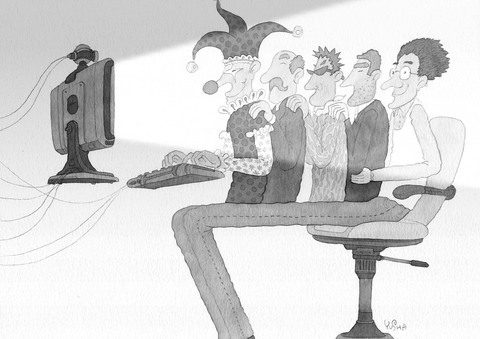
But now, the budding fake world is not only attracting a lot more people, it is taking on a real-world twist: Big business interests are intruding on digital utopia. Second Life is fast becoming a three-dimensional test bed for corporate marketers, including Sony BMG Music, Sun Microsystems, Nissan, Adidas/Reebok, Toyota and Starwood Hotels.
The sudden rush of real companies into so-called virtual worlds mirrors the evolution of the Internet itself, which moved beyond an educational and research network in the 1990s to become a commercial proposition -- but not without complaints from some quarters that the medium's purity would be lost.
Already, the Internet is the fastest-growing advertising medium, as traditional forms of marketing like television commercials and print advertising slow. For businesses, these early forays into virtual worlds could be the next frontier in the blurring of advertising and entertainment.
Unlike other popular online video games like World of War-craft that are competitive fantasy games, sites like Second Life meld elements of the most popular forms of new media -- chat rooms, video games, online stores, user-generated content sites like YouTube.com and social networking sites such as MySpace.com.
Philip Rosedale, the chief executive of Linden Labs, the San Francisco company that operates Second Life, said that until a few months ago only one or two real-world companies had dipped their toes in the synthetic water. Now, more than 30 companies are working on projects there, and dozens more are considering them.
"It's taken off in a way that is kind of surreal," Rosedale said, with no trace of irony.
Beginning a promotional venture in a virtual world is still a relatively inexpensive proposition compared with the millions spent on other media. In Second Life, a company like Nissan or its advertising agency could buy an "island" for a one-time fee of US$1,250 and a monthly rate of US$195. For its new campaign built around its Sentra car, the company then needed to hire some computer programmers to create a gigantic driving course and design digital cars that "in-world" people could actually drive, as well as some billboards and other promotional spots throughout the virtual world that would encourage people to visit Nissan Island.
Virtual world proponents -- including a roster of Linden Labs investors that includes Jeffrey Bezos, the founder of Amazon.com; Mitchell Kapor, the software pioneer; and Pierre Omidyar, the eBay co-founder -- say that the entire Internet is moving toward being a three-dimensional experience that will become more realistic as computing technology advances.
Entering Second Life, people's digital alter-egos -- known as avatars -- are able to move around and do everything they do in the physical world, but without such bothers as the laws of physics.
"When you are at Amazon.com, you are actually there with 10,000 concurrent other people, but you cannot see them or talk to them," Rosedale said. "At Second Life, everything you experience is inherently experienced with others."
Second Life is the largest and best known of several virtual worlds created to attract a crowd. The cable TV network MTV, for example, just began "Virtual Laguna Beach," where fans of its show, Laguna Beach: The Real O.C., can fashion themselves after the show's characters and hang out in their faux settings.
Unlike Second Life, which emphasizes a hands-off approach and has little say over who sets up shop inside its simulated world, MTV's approach is to bring in advertisers as partners.
In Second Life, retailers like Reebok, Nike, Amazon and American Apparel have all set up shops to sell digital as well as real-world versions of their products. Last week, Sun Microsystems unveiled a new pavilion promoting its products and IBM alumni held a virtual world reunion.
This week, performer Ben Folds will promote a new album with two virtual appearances. At one, he will play the opening party for Aloft, an elaborate digital prototype for a new chain of hotels planned by Starwood Hotels and Resorts. The same day, Folds will also "appear" at a new facility his music label's parent company, Sony/BMG, is opening at a complex called Media Island.
Meanwhile, Nissan's promotion features a gigantic vending machine dispensing cars people can "drive" around.
And some of this is likely to be covered for the outside world by such business news outlets as CNET and Reuters, which now have reporters embedded full-time in the virtual realm.
All this attention has some Second Lifers concerned that their digital paradise will never be the same, like a Wal-Mart coming to town or a Starbucks opening in the neighborhood.
"The phase it is in now is just using it as a hype and marketing thing," said Catherine Fitzpatrick, 50, a member of Second Life, who in the real world is a Russian translator in Manhattan.
In her second life, Fitzpatrick's digital alter-ego is called Prokofy Neva, a figure well-known to other participants, who runs a business renting "real estate" to other players.
"The next phase," she said, "will be they try to compete with other domestic products -- the people who made sneakers in the world are now in danger of being crushed by Adidas."
Rosedale says such concerns are overstated, because there are no advantages from economies of scale for big corporations in Second Life and people can avoid places like Nissan Island as easily as they can avoid going to Nissan's Web site. There is no limit to what can be built in Second Life, just as there is no limit to how many Web sites populate the Internet.
Linden Labs makes most of its money leasing "land" to tenants, Rosedale said, at an average of roughly US$40 per month per "hectare" or US$195 a month for a private "island." The land mass of Second Life is growing at about 8 percent a month, a spokeswoman said, and now totals "30,000 hectares," the equivalent of about 246km2 in the physical world. Linden Labs, a private company, does not disclose its revenue.
Despite the surge of outside business activity in Second Life, Linden Labs said corporate interests still owned less than 5 percent of the virtual world's real estate.
As many as 10,000 people are in the virtual world at a time, and they are engaged in a gamut of ventures: everything from holding charity fundraisers to selling virtual helicopters to operating sex clubs. Linden also makes money on exchanging US dollars for what it calls Linden dollars for around 400 Linden dollars for US$1 (people can load up on them with a credit card).
A typical article of clothing -- say a shirt -- would cost around 200 Linden dollars, or US$0.50. As evidence of the growth of its "economy," Second Life's Web site tracks how much money changes hands each day. It recently reached as much as US$500,000 a day and is growing as much as 15 percent a month.
Last Tuesday, a US congressional committee said it was investigating whether virtual assets and incomes should be taxed.
But many inhabitants simply hang out for free. For advertisers worried about the effectiveness of the 30-second TV spot and the clutter of real-world billboards and Internet pop-up ads, Second Life is appealing because it is a place where people literally immerse themselves in their products.
Steve Kerho, director of interactive marketing and media for Nissan USA, said the Second Life campaign was part of a growing interest in online video games.
"We're just trying to follow our consumer, that's where they're spending their time," Kerho said. "But there has to be something in it for them -- it's got to be fun; it's got to be playful."
Projects like the Aloft hotel, an offshoot of Starwood's W Hotels brand, are designed to promote the venture but also to give its designers feedback from prospective guests before the first real hotel opens in 2008.
The new Sony BMG building has rooms devoted to popular musicians like Justin Timberlake and DMX, allowing fans to mingle, listen to tunes or watch videos. Sony BMG is also toying with renting residences in the complex, as well as selling music downloads that people can listen to throughout the simulated world.
Sibley Verbeck, chief executive of the Electric Sheep Co, the consultancy that designed the Aloft and Sony BMG projects, said the flurry of corporate interest stemmed from the 10 to 20 percent growth in the number of people who had gone into virtual worlds each month for the last three years. Though exact numbers are difficult to come by, the figure should top a few million by next year, he said.
The spread of these worlds, however, is limited by access to high-speed Internet connections and, in Second Life's case, software that is challenging to master and only runs on certain models of computers.
"If it doesn't crash and burn then it will become real," he said. "So now's the time to start experimenting and learning ahead of your competition."
As part of that process, businesses are learning that different rules apply when they venture into an arena where audiences are in control.
"Users are the content -- that's the thing that everybody has a hard time getting over," said Michael Wilson, the chief executive of Makena Technologies, which operates the virtual world "There.com" and helped build "Virtual Laguna Beach."
For example, Sun Microsystems kicked off the opening of its Second Life venue with a press conference online hosted by executives and Rosedale of Second Life. But by the time the event was in full swing, several members of the audience had either walked or flown onto the stage, where they were running roughshod over the proceedings.
Even Rosedale got in on the act: He conjured a pair of sunglasses that he superimposed on a video image of a Sun representative talking on a screen behind the stage (in virtual-world lingo, such high jinks are known as "griefing").
Some corporate events have been met with protests by placard-waving avatars. And there is even a group called the Second Life Liberation Army ((SLLA) that has staged faux "attacks" on Reebok and American Apparel stores (the SLLA says it is fighting for voting rights for avatars -- as well as stock in Linden Labs).
Companies in this new environment have to get used to the idea that they may never know exactly who they are dealing with. Most of those in Second Life have chosen their names from a whimsical menu of supplied surnames, resulting in monikers like Snoopybrown Zamboni and Bitmason Pimpernel; males posing as female avatars and vice versa are not uncommon.
Another issue companies have to contend with is that their brands may already be in these virtual worlds, but illegally. Henry Jenkins, a professor at MIT Media Lab, said one Second Life habitue created a virtual reproduction of the Ikea catalog to help people decorate their digital pads.
Verbeck said copyright infringe-ment was rampant. His company runs an online boutique where Second Life residents sell each other pixelized creations of everything from body parts to home furnishings to roller skates -- a good number of them unauthorized knockoffs.
So far, Second Life has not had many requests to stop selling fake products.
But "we did have a request from the Salvador Dali Museum -- which was great," Verbeck said. "Second Life is so surreal that it was perfect."
Recently, China launched another diplomatic offensive against Taiwan, improperly linking its “one China principle” with UN General Assembly Resolution 2758 to constrain Taiwan’s diplomatic space. After Taiwan’s presidential election on Jan. 13, China persuaded Nauru to sever diplomatic ties with Taiwan. Nauru cited Resolution 2758 in its declaration of the diplomatic break. Subsequently, during the WHO Executive Board meeting that month, Beijing rallied countries including Venezuela, Zimbabwe, Belarus, Egypt, Nicaragua, Sri Lanka, Laos, Russia, Syria and Pakistan to reiterate the “one China principle” in their statements, and assert that “Resolution 2758 has settled the status of Taiwan” to hinder Taiwan’s
Singaporean Prime Minister Lee Hsien Loong’s (李顯龍) decision to step down after 19 years and hand power to his deputy, Lawrence Wong (黃循財), on May 15 was expected — though, perhaps, not so soon. Most political analysts had been eyeing an end-of-year handover, to ensure more time for Wong to study and shadow the role, ahead of general elections that must be called by November next year. Wong — who is currently both deputy prime minister and minister of finance — would need a combination of fresh ideas, wisdom and experience as he writes the nation’s next chapter. The world that
Can US dialogue and cooperation with the communist dictatorship in Beijing help avert a Taiwan Strait crisis? Or is US President Joe Biden playing into Chinese President Xi Jinping’s (習近平) hands? With America preoccupied with the wars in Europe and the Middle East, Biden is seeking better relations with Xi’s regime. The goal is to responsibly manage US-China competition and prevent unintended conflict, thereby hoping to create greater space for the two countries to work together in areas where their interests align. The existing wars have already stretched US military resources thin, and the last thing Biden wants is yet another war.
Since the Russian invasion of Ukraine in February 2022, people have been asking if Taiwan is the next Ukraine. At a G7 meeting of national leaders in January, Japanese Prime Minister Fumio Kishida warned that Taiwan “could be the next Ukraine” if Chinese aggression is not checked. NATO Secretary-General Jens Stoltenberg has said that if Russia is not defeated, then “today, it’s Ukraine, tomorrow it can be Taiwan.” China does not like this rhetoric. Its diplomats ask people to stop saying “Ukraine today, Taiwan tomorrow.” However, the rhetoric and stated ambition of Chinese President Xi Jinping (習近平) on Taiwan shows strong parallels with


 RSS
RSS