


Black Friday in the US traditionally is the day after Thanksgiving that signals the start of the holiday season sale. At daybreak, people line up before department stores to get the special "early bird" bargains.
In Europe, black Saturday falls in the last weekend of July, when the French and other Europeans set off in droves for their Mediterranean holiday destinations, and highways get jammed with traffic.
This contrast could serve as a metaphor for the difference in lifestyles on either side of the Atlantic. Americans work more hours per week and have less vacation time, but they have more money to spend. Not only does a higher percentage of American adults work, but they also work more hours per week and more weeks per year.
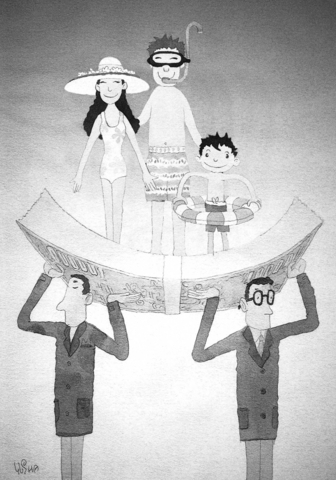
In 2004, the French worked 28 percent fewer hours per person than Americans, and the Germans and Dutch each put in 25 percent fewer hours. The money they earned was correspondingly lower -- almost 30 percent less per person than Americans received.
According to Massachusetts Institute of Technology economist Olivier Blanchard, Europeans simply enjoy leisure more than Americans do, even if it means that they have less money. In his view, this difference in attitude explains the income gap between Europe and the US.
But not everybody agrees with Blanchard. Some economists point out that high tax rates in Europe make work less rewarding -- and thus leisure more attractive. Other economists see Europe's powerful labor unions as an important determinant in European attitudes towards work. After all, employees do not negotiate individually the length of the workweek. During past economic downturns, labor unions in Europe negotiated a reduced workweek or more vacation time with no reduction in wages.
Moreover, Blanchard fails to note that the preference for leisure is not gender-neutral. The trans-Atlantic difference in hours worked can be explained in part by comparing the labor input of European women to the input of American women. While American women work 36 hours per week on average, Dutch women put in only 24 hours per week, while German women work 30 hours. French women with a job work on average 34 hours per week, but the percentage of women who work outside the home in France is almost 20 percent lower than in the US.
Are European females that much lazier than American females? The answer depends on whether one considers the time women in Europe spend on domestic work. The economists Ronald Schettkat and Richard Freeman have calculated that American women spend 10 hours per week less on cooking, cleaning and childcare than European women do. Instead of performing these household jobs themselves, Americans pay other people to do them. Americans eat more often in restaurants, make ample use of laundry, dry cleaning and shopping services, and hire nannies to take care of young infants.
Indeed, in the US, one finds all kinds of personal services that do not exist on a similar scale in Europe. A manicure, carwash or a massage is often only a stone's throw from one's home. Doorman buildings provide round-the-clock service to residents, and dog-
walkers look after pets during the workday. In New York City, one can get help during the weekends to prepare meals for the coming week, with a culinary expert to advise you on the recipes, buy the groceries and do part of the cooking.
In other words, American women work more hours and use the money they make to hire people to do the tasks that they can't do because they're working. By contrast, European women work less and have less money to spend on services. In their "free time," European women are busy cleaning the house and looking after the children. On balance, therefore, European and American women work about the same amount of hours.
Meanwhile, more wealth is created in the US than in Europe. After all, women professionals do not have to choose between a career and children, but can enjoy both. By spending part of their extra income on household jobs and personal services, American women limit their workload while creating demand for service jobs that wouldn't exist otherwise. To put it inelegantly, two birds are killed with one stone.
In Europe, no birds get killed at all. Highly educated European women who have children either stay at home or work part-time and get stuck in low-end jobs. They take care of the household and children themselves. Meanwhile, there are not enough service jobs in Europe to put everybody to work. The social benefits paid to the out-of-work increase the tax burden on labor income, which in turn discourages women from full-time work. The leisure trap thus keeps both the best educated and the least educated out of the workplace.
Heleen Mees is an economist and author of a book on EU law.
Copyright: Project Syndicate
From the Iran war and nuclear weapons to tariffs and artificial intelligence, the agenda for this week’s Beijing summit between US President Donald Trump and Chinese President Xi Jinping (習近平) is packed. Xi would almost certainly bring up Taiwan, if only to demonstrate his inflexibility on the matter. However, no one needs to meet with Xi face-to-face to understand his stance. A visit to the National Museum of China in Beijing — in particular, the “Road to Rejuvenation” exhibition, which chronicles the rise and rule of the Chinese Communist Party — might be even more revealing. Xi took the members
Taiwan’s higher education system is facing an existential crisis. As the demographic drop-off continues to empty classrooms, universities across the island are locked in a desperate battle for survival, international student recruitment and crucial Ministry of Education funding. To win this battle, institutions have turned to what seems like an objective measure of quality: global university rankings. Unfortunately, this chase is a costly illusion, and taxpayers are footing the bill. In the past few years, the goalposts have shifted from pure research output to “sustainability” and “societal impact,” largely driven by commercial metrics such as the UK-based Times Higher Education (THE) Impact
The inter-Korean relationship, long defined by national division, offers the clearest mirror within East Asia for cross-strait relations. Yet even there, reunification language is breaking down. The South Korean government disclosed on Wednesday last week that North Korea’s constitutional revision in March had deleted references to reunification and added a territorial clause defining its border with South Korea. South Korea is also seriously debating whether national reunification with North Korea is still necessary. On April 27, South Korean President Lee Jae-myung marked the eighth anniversary of the Panmunjom Declaration, the 2018 inter-Korean agreement in which the two Koreas pledged to

I wrote this before US President Donald Trump embarked on his uneventful state visit to China on Thursday. So, I shall confine my observations to the joint US-Philippine military exercise of April 20 through May 8, known collectively as “Balikatan 2026.” This year’s Balikatan was notable for its “firsts.” First, it was conducted primarily with Taiwan in mind, not the Philippines or even the South China Sea. It also showed that in the Pacific, America’s alliance network is still robust. Allies are enthusiastic about America’s renewed leadership in the region. Nine decades ago, in 1936, America had neither military strength


 RSS
RSS