


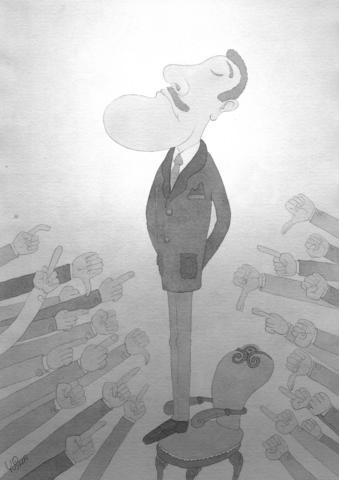
If history seems likely to rank Silvio Berlusconi as an inconsequential prime minister of Italy, it will surely remember him as an extraordinary -- and extraordinarily bizarre -- one. Promising one thing and delivering another was not so much a weakness of his government as its organizing principle.
Given the erratic nature of Berlusconi's rule, it is no surprise that, ever since the 2001 election that returned him to power, the center-left l'Unione coalition has won all subsequent elections -- administrative, regional, and European. Yet the left's prospects in the upcoming parliamentary election are far from certain, and Berlusconi seems far from doomed.
Given the country's economic conditions, one would think that Italy is ripe for decisive change. For the last four years, average growth in incomes has been a mere 0.3 percent, compared to 1.5 percent in the EU, and in the past two years public debt has again started to rise.
Moreover, the strategy of Berlusconi's ruling center-right Casa della Liberte coalition has been to tread water and wait for Europe's economy to pick up instead of tackling Italy's structural difficulties. As a result, the government is criticized not only by the unions, but also by the employers' association, Confindustria, which in 2001 gave Prime Minister Berlusconi strong support.
Then there is the ongoing conflict of interests between Berlusconi-the-premier and Berlusconi-the-magnate, who holds public licenses that make him a semi-monopolist in media and TV advertising. During Berlusconi's tenure in office, his enormous personal assets have tripled. While his parliamentary majority has approved many laws that promote his personal interests and have eased some of his legal difficulties, at the beginning of March, Berlusconi was again accused of corruption and tax fraud.
Berlusconi's ministers have scarcely behaved better. Two were forced to resign within a month of each other. Roberto Calderoli, a prominent official in Lega Nord, the third-largest government party, provoked riots in Libya by wearing a T-shirt printed with the infamous cartoons of the Prophet Mohammed. Francesco Storace, the former Minister of Health and a leading member of Alleanza Nazionale, the second-largest government party, is suspected of organizing political espionage, in an Italian-style Watergate.
But, despite the government's catastrophic economic and ethical record, opinion polls indicate a lead of only about four percentage points for l'Unione -- too small, given the high number of undecided voters, to predict the election's outcome. So what is keeping Berlusconi and his coalition in the race?
Above all, Berlusconi's electoral campaign is aimed, after President George W. Bush's 2004 re-election campaign, at energizing his hard-core supporters and mobilizing the growing number of voters who have abstained in recent years. In doing this he has not hesitated to use his semi-monopoly over television to exalt his government's alleged accomplishments. His campaign rhetoric highlights anti-communism with an emphasis not seen in Italy since 1948, coupled with a defense of the family and values cherished by the Roman Catholic establishment, although the Church has so far resisted being drawn into the campaign.
The Berlusconi coalition also benefits from the weakness of l'Unione. Its leader, Romano Prodi, obtained an extraordinary popular endorsement when more than four million people voted for him in Italy's first-ever primary elections. Yet Prodi continues to be a party-less leader of too many parties. To be sure, the cohesiveness of l'Unione has strengthened: the two major parties (Democratici di Sinistra and Democrazia e Liberte-la Margherita) are united under the symbol of the olive tree, the other parties have endorsed a detailed 280-page government program, and the left-wing Partito della Rifondazione Comunista has given clear signs of moderation and loyalty to the coalition. For voters, however, a perception of fragility remains.
Finally, the uncertainty of the outcome reflects not so much voters' behavior, but a change in the electoral system. During the past decade, Italy has used a majority electoral system corrected by a proportional quota. Under this system, Casa della Liberte translated a small popular majority in 2001 into a decisive parliamentary majority. But, with the same result on the horizon this year for l'Unione, the center-right parliamentary majority changed the electoral law just a few months before the end of its term.
This is reminiscent of an army that, fearing defeat on the battlefield, poisons the wells as it retreats. A proportional system in the absence of individual preferences means that party secretaries, rather than citizens, will choose deputies, and, with no effective electoral threshold, the number of parties will proliferate. Although the election ballot will be 40cm long to accommodate all the symbols of the old and new parties, it won't contain the name of even a single candidate.
But the worst problem is that the majority system for the Senate could lead to a different majority gaining control there than in the Chamber of Deputies (the lower house), which may well cause legislative paralysis. Moreover, President Carlo Azeglio Ciampi's mandate ends at the same time that parliament dissolves, which means that his successor, elected by the new parliament, would have to nominate a government without a majority in both houses.
Berlusconi and Prodi have ruled out a German-style grand coalition -- an outcome that seems especially unlikely following an election campaign in which both contestants have strongly hinted that their opponent has no legitimate right to govern. At the same time, holding another vote would leave the question of the electoral law unresolved.
The puzzle of Berlusconi's survival reflects a wider European conundrum. Many Europeans, not just Italians, are nervous and unsure of where the continent is going. So it is no surprise that an opportunist and charlatan like Berlusconi continues to get a hearing. Italians must decide upon the sort of Italy they want if they are to get the leaders they need.
Ferdinando Targetti is professor of economics at the University of Trento and a former member of the finance committee in the Italian parliament. Copyright: Project Syndicate
Recently, China launched another diplomatic offensive against Taiwan, improperly linking its “one China principle” with UN General Assembly Resolution 2758 to constrain Taiwan’s diplomatic space. After Taiwan’s presidential election on Jan. 13, China persuaded Nauru to sever diplomatic ties with Taiwan. Nauru cited Resolution 2758 in its declaration of the diplomatic break. Subsequently, during the WHO Executive Board meeting that month, Beijing rallied countries including Venezuela, Zimbabwe, Belarus, Egypt, Nicaragua, Sri Lanka, Laos, Russia, Syria and Pakistan to reiterate the “one China principle” in their statements, and assert that “Resolution 2758 has settled the status of Taiwan” to hinder Taiwan’s
Singaporean Prime Minister Lee Hsien Loong’s (李顯龍) decision to step down after 19 years and hand power to his deputy, Lawrence Wong (黃循財), on May 15 was expected — though, perhaps, not so soon. Most political analysts had been eyeing an end-of-year handover, to ensure more time for Wong to study and shadow the role, ahead of general elections that must be called by November next year. Wong — who is currently both deputy prime minister and minister of finance — would need a combination of fresh ideas, wisdom and experience as he writes the nation’s next chapter. The world that
Can US dialogue and cooperation with the communist dictatorship in Beijing help avert a Taiwan Strait crisis? Or is US President Joe Biden playing into Chinese President Xi Jinping’s (習近平) hands? With America preoccupied with the wars in Europe and the Middle East, Biden is seeking better relations with Xi’s regime. The goal is to responsibly manage US-China competition and prevent unintended conflict, thereby hoping to create greater space for the two countries to work together in areas where their interests align. The existing wars have already stretched US military resources thin, and the last thing Biden wants is yet another war.
Since the Russian invasion of Ukraine in February 2022, people have been asking if Taiwan is the next Ukraine. At a G7 meeting of national leaders in January, Japanese Prime Minister Fumio Kishida warned that Taiwan “could be the next Ukraine” if Chinese aggression is not checked. NATO Secretary-General Jens Stoltenberg has said that if Russia is not defeated, then “today, it’s Ukraine, tomorrow it can be Taiwan.” China does not like this rhetoric. Its diplomats ask people to stop saying “Ukraine today, Taiwan tomorrow.” However, the rhetoric and stated ambition of Chinese President Xi Jinping (習近平) on Taiwan shows strong parallels with


 RSS
RSS