


These aren't the hide-in-the-hills leftists of yesteryear, ready to take up arms against the oppressor.
A new wave of Latin American leaders -- variously labeled leftist, populist, nationalist or socialist -- is redefining politics in a region where US-backed, right-wing dictatorships spent decades crushing their mostly leftist opponents and supporting corporate interests amid fears of inroads by the Soviet Union and its Cuban proxy.
That struggle, fought everywhere from the mountains of Guatemala to the streets of Argentina, has given way to a new generation of politicians as the Cold War recedes into history -- a more pragmatic left that embraces its own flavor of free-market policies while vowing to champion the poor and forgotten.

The wave has carried leftist leaders to power in South America's largest and richest nations, as well as impoverished Bolivia. And while once-dominant conservatives haven't vanished altogether -- right-leaning candidates are popular in Peru and Colombia -- the trend is likely to intensify with elections still to come this year in Peru, Colombia, Mexico, Brazil, Nicaragua and Venezuela.
Once-reliable allies can no longer be counted on to support the US in international disputes, and have refused to sign trade deals that preserve subsidies for US industries. Standing up to perceived US bullying is a reliable way to win votes, and the White House has delivered a tailor-made issue by threatening to cut aid to Latin American countries that refuse to make US citizens immune to prosecution in the new International Criminal Court.
The election with the biggest impact on US policy may be in Mexico, where the front-runner, Andres Manuel Lopez Obrador, could end a 24-year run of conservative leadership that has moved the southern neighbor steadily to the right. Like all Mexican politicians, he has reacted angrily to the US crackdown on illegal immigration.
And while Lopez Obrador has good relations with most of Mexico's business community, he worries some US business interests. A former leader of rowdy labor protests whose left-center party absorbed Mexico's old communists, Lopez Obrador was noted as Mexico City's mayor for handouts to the poor and big-ticket public works projects, an approach to governing that earned him the label many politicians dread: populist.
The term has come to mean short-term pandering to the masses at the expense of the long-term good for all. Similar policies left many Latin American nations deeply in debt and doomed to boom-and-bust economic cycles.
Then there's "socialist," a vague term if there ever was one in Latin America, where only Cuban communist Fidel Castro advocates full-on socialist-style public ownership of the means of production. The socialist label is also proudly shared by Chilean free-trader Michelle Bachelet, Venezuelan firebrand Hugo Chavez and Bolivian coca farmer-turned-President Evo Morales.
But under Chavez's brand of "Bolivarian Socialism," the state has tried to maintain a vibrant private sector while claiming an ever-larger role in managing the economy. Morales' Movement Toward Socialism party is trying to impose the same changes on Bolivia. And while Peru's outsider presidential candidate Ollanta Humala says he's a "nationalist" and not a "socialist," he too would impose greater state control over a free market he considers a "utopia."
Some Latin leftists -- Chavez and Humala, for example -- rose through military ranks. Others came up through Marxist-influenced politics of protest. But aside from Castro, all now seem unified in the belief that private business remains essential to economic growth that can in turn ease the region's widespread poverty.
And that has made for some intriguing twists on the old political labels.
Lopez Obrador has maintained such cozy relations with Latin America's richest businessman, Carlos Slim, that the Zapatista rebels attack him for not being leftist enough. Argentina's Nestor Kirchner and Luiz Inacio Lula da Silva, a former radical union leader who has embraced conservative economic policies as Brazil's first leftist president, face similar complaints.
Both Silva and Kirchner orchestrated early payoffs of their nations' International Monetary Fund debts, saving billions in interest and restoring some national pride.
And in Chile, the Socialist-led government just won re-election with promises to maintain a fiscal discipline unmatched by the free-spending conservatives in charge in Washington.
While most of these leaders talk about a common Latin American identity -- an idea much in evidence when Morales was celebrated at his inauguration as an example for all of Latin America's Indians -- they also insist on defending their countries' sovereignty, an attitude increasingly labeled nationalist, particularly when it means standing up to the US.
Humala, a retired army lieutenant colonel, labels his outsider campaign a "nationalist project" for Peru, and while he says he wouldn't seize property or limit free speech, he's gained a strong following among voters seeking a tough leader to punish the corrupt and impose order.
Leftist, populist, socialist, nationalist -- these can be fighting words, especially when the US defense secretary joins in the rhetorical battle.
"We've seen some populist leadership appealing to masses of people, and elections like Evo Morales in Bolivia take place that clearly are worrisome," Donald Rumsfeld warned in a recent speech.
He also compared the nationalist, socialist Chavez to the original National Socialist, Adolf Hitler.
Chavez's quick response: "The imperialist, mass murdering, fascist attitude of the president of the United States doesn't have limits. I think Hitler could be a nursery baby next to George W. Bush."
Imperialist? Fascist? Many Latin Americans attach these terms to the US, especially after President George W. Bush and Mexican President Vicente Fox were rejected as bullies for pushing a Free Trade Area of the Americas deal that critics said would preserve huge subsidies for US industries.
These acts of nationalist defiance -- along with policies to do more for the poor and a general revulsion against the bloodshed of past decades -- have sapped public enthusiasm for the scattered groups of armed leftists that remain in Latin America.
Mexico's Zapatistas have refused to give up their guns and masks, and other small rebel bands sometimes attack Mexican police. Peru's once-feared Maoist Shining Path is down to a few hundred rebels protecting drug traffickers and occasionally killing police in the jungle. And the Revolutionary Armed Forces of Colombia has been reduced, after nearly half a century, to a peasant army of 12,000 with scarce public support. Right-wing assassins decimated its political wing decades ago, and Colombia's peaceful left has weakened under the tenure of right-wing President Alvaro Uribe.
All this goes to show that the old labels are increasingly misleading in Latin America -- a point made recently by Carlos Fuentes, a famed Mexican novelist, moderate leftist and frequent critic of US policies.
Fuentes wrote that while Lopez Obrador has been unfairly "demonized" as a populist demagogue, Chavez is a "tropical Mussolini" trying to pass himself off as a leftist.
His recommendation: Latin leftists should follow the Chilean socialist model, a real genre-bender that mixes free-market economics and fiscal restraint with poverty-reduction programs.
In most cases, that is what they are already doing. These new leaders have found electoral success by walking a fine line between fiscally sound policies that please international markets and creating social programs for their long-ignored populations.
"I don't see how we can be opposed to that if it helps stabilize democratic systems," said Riordan Roett, director of Western Hemisphere Studies at Johns Hopkins University.
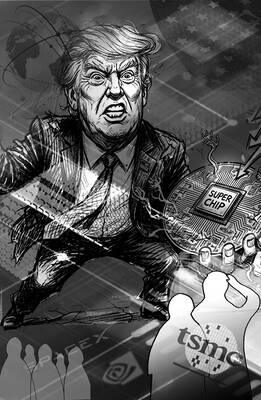
The White House’s decision to take a 9.9 percent stake in Intel Corp is looking like very shrewd business indeed. Since the government bought in at US$20.47 a share last August, the US chipmaker’s surging stock price has delivered the US a US$43 billion return. One of the reasons the investment has so far proved so sound is that the White House has made sure of it. According to The Wall Street Journal, Howard personally pushed deals on Intel’s behalf with some of the most lucrative clients imaginable. They include Nvidia Corp, the company at the heart of the AI
A single photograph can cut through a lot of noise, but it can also be used to misrepresent the truth. At the very least, it can concentrate the mind on something that requires further investigation. On Monday last week, Ma Ying-jeou Foundation CEO Tai Hsia-ling (戴遐齡) and former National Security Council secretary-general King Pu-tsung (金溥聰) held a news conference in which they showed a photograph of former foundation CEO Hsiao Hsu-tsen (蕭旭岑), now Chinese Nationalist Party (KMT) deputy chairman. In the image Hsiao is seated next to Xiamen Taiwan Businessmen Association chairman Han Ying-huan (韓螢煥). The two men were holding
I first met Professor Ray Jiing (井迎瑞) as a film and documentary student at Shih Hsin University’s (SHU) Department of Radio Television and Film in 1988. The following year, he went on to become the director of the Chinese Taipei Film Archive — forerunner of the Taiwan Film and Audiovisual Institute (TFAI). Over his eight-year tenure, Jiing rescued and restored over 200 classic Taiwanese films. In 1997, he established the Graduate Institute of Studies in Documentary and Film Archiving at Tainan National University of the Arts (TNNUA), and I joined the program in his third cohort of students. Beyond a
President William Lai Ching-te’s (賴清德) May 20 second-anniversary address was not just a routine policy review; it was damage control. US President Donald Trump’s remarks — that he did not want to see anyone move toward independence and that the delivery of a major Taiwan arms package could depend on the progress of US-China relations — unsettled Taiwan’s public and created an opening for opposition parties to question whether Taiwan was being treated as a bargaining chip in Washington’s dealings with Beijing. Lai’s speech was designed to close that opening. The address covered the expected ground: sovereignty, cross-strait relations, defense spending,


 RSS
RSS