


The National Development Council (NDC) yesterday unveiled details of new regulations that ease restrictions on foreigners working or living in Taiwan, as part of a bid to attract skilled workers from abroad.
The regulations, which could go into effect in the first quarter of next year, stem from amendments to the Act for the Recruitment and Employment of Foreign Professionals (外國專業人才延攬及僱用法) passed by lawmakers on Aug. 29.
Students categorized as “overseas compatriots” would be allowed to stay and work in Taiwan in the two years after their graduation without obtaining additional permits, doing away with the evaluation process that is currently required, the council said.
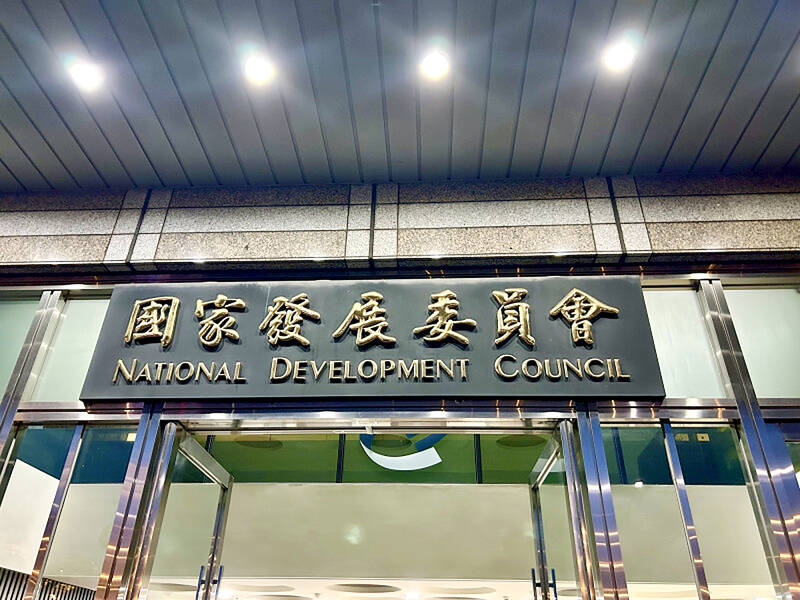
Photo: Wu Hsin-tien, Taipei Times
Foreigners who have graduated from a university globally ranked in the top 200 could obtain a work permit without meeting other requirements under the revised rules, it said.
Foreigners who graduated from a university ranked in the top 1,500 globally could work in a specialized or technical field without meeting a requirement of two years’ work experience, the council said.
Currently, they are required to graduate from a university ranked in the top 500 globally to waive the two-year requirement, it said, adding that the change targets skilled workers from nations included in the New Southbound Policy, it said.
Foreigners with a master’s degree from a Taiwanese university would be able to waive one to three years from the mandatory period of continuous residency in Taiwan toward obtaining an Alien Permanent Resident Certificate (APRC), it said.
Highly skilled foreign professionals earning NT$6 million (US$197,954) or more annually would be able to request an APRC after continuously living in Taiwan for one year, it said.
High-skilled workers who lose their jobs would qualify for unemployment benefits, vocational retraining stipends and natal subsidies, it said.
Those in that category who do not have an APRC and lose their job would still qualify for a labor pension, it added.
Labor pension calculations for workers without an APRC who switch jobs would not exclude their time with former employers, it said.
The amendment would make it easier for foreigners to work in Taiwan with the aim of retiring in the nation, it said.
The “digital nomad” visa’s valid period would be increased to two years, up from six months, the NDC said.
Foreigners with APRCs who have lived in Taiwan for 10 or more years would be eligible for mandated services available for handicapped Taiwanese, should they sustain a debilitating injury or condition, it said.
APRC-holding foreigners older than 65 who have lived in Taiwan for more than 10 years could qualify to stay in an assisted-living facility, while those living with family could receive the same long-term care perks as elderly Taiwanese, it said.

CREDIT-GRABBER: China said its coast guard rescued the crew of a fishing vessel that caught fire, who were actually rescued by a nearby Taiwanese boat and the CGA Maritime search and rescue operations do not have borders, and China should not use a shipwreck to infringe upon Taiwanese sovereignty, the Coast Guard Administration (CGA) said yesterday. The coast guard made the statement in response to the China Coast Guard (CCG) saying it saved a Taiwanese fishing boat. The Chuan Yu No. 6 (全漁6號), a fishing vessel registered in Keelung, on Thursday caught fire and sank in waters northeast of Diaoyutai Islands (釣魚台). The vessel left Keelung’s Badouzih Fishing Harbor (八斗子漁港) at 3:35pm on Sunday last week, with seven people on board — a 62-year-old Taiwanese captain surnamed Chang (張) and six

RISKY BUSINESS: The ‘incentives’ include initiatives that get suspended for no reason, creating uncertainty and resulting in considerable losses for Taiwanese, the MAC said China’s “incentives” failed to sway sentiment in Taiwan, as willingness to work in China hit a record low of 1.6 percent, a Ministry of Labor survey showed. The Directorate-General of Budget, Accounting and Statistics (DGBAS) also reported that the number of Taiwanese workers in China has nearly halved from a peak of 430,000 in 2012 to an estimated 231,000 in 2024. That marked a new low in the proportion of Taiwanese going abroad to work. The ministry’s annual survey on “Labor Life and Employment Status” includes questions respondents’ willingness to seek employment overseas. Willingness to work in China has steadily declined from

The Legislative Yuan’s Finance Committee yesterday approved proposed amendments to the Amusement Tax Act (娛樂稅法) that would abolish taxes on films, cultural activities and competitive sporting events, retaining the fee only for dance halls and golf courses. The proposed changes would set the maximum tax rate for dance halls and golf courses at 50 and 20 percent respectively, with local governments authorized to suspend the levies. Article 2 of the act says that “amusement tax shall be levied on tickets sold or fees charged by amusement places, facilities or activities” in six categories: “Cinema; professional singing, story-telling, dancing, circus, magic show, acrobatics

INFLATION UP? The IMF said CPI would increase to 1.5 percent this year, while the DGBAS projected it would rise to 1.68 percent, with GDP per capita of US$44,181 The IMF projected Taiwan’s real GDP would grow 5.2 percent this year, up from its 2.1 percent outlook in January, despite fears of global economic disruptions sparked by the US-Iran conflict. Taiwan’s consumer price index (CPI) is projected to increase to 1.5 percent, while unemployment would be 3.4 percent, roughly in line with estimates for Asia as a whole, the international body wrote in its Global Economic Outlook Report published in the US on Monday. The figures are comparatively better than the IMF outlook for the rest of the world, which pegged real GDP growth at 3.1 percent, down from 3.3 percent


 RSS
RSS