


The Chien Feng IV (勁蜂, Mighty Hornet) loitering munition is on track to enter flight tests next month in connection with potential adoption by Taiwanese and US armed forces, a government source said yesterday.
The kamikaze drone, which boasts a range of 1,000km, debuted at the Taipei Aerospace and Defense Technology Exhibition in September, the official said on condition of anonymity.
The Chungshan Institute of Science and Technology and US-based Kratos Defense jointly developed the platform by leveraging the engine and airframe of the latter’s MQM-178 Firejet target drone, they said.
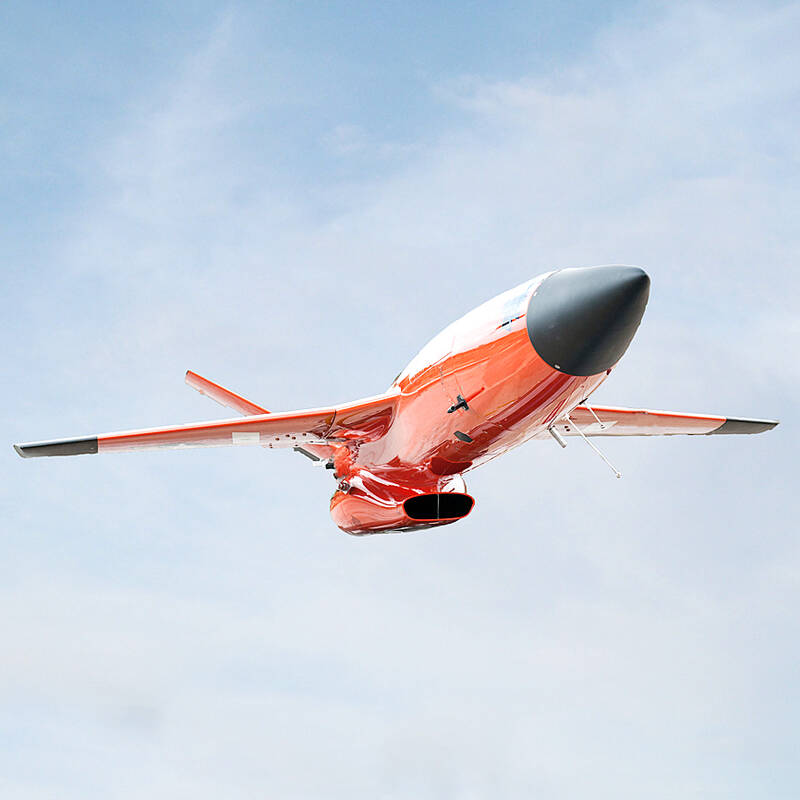
Photo from the Kratos Defense Web site
The uncrewed aerial vehicle is designed to utilize an artificial intelligence computer and a data link system, the institute said.
This implies the loitering munition could feature autonomous targeting and swarming capabilities, the defense Web site War Zone said in a report in September.
The Chien Feng IV’s targeting and navigation systems and airframes would be manufactured in Taiwan, while the engines would be furnished by the US, the official said.
The upcoming trials would test the platform’s suitability for Taiwanese and US operational requirements ahead of mass production, they said, adding that sales to other foreign militaries are possible.
Sales to governments other than Taiwan and the US would be handled by Kratos Defense, the official added.
The Chien Feng IV program is meeting project milestones as scheduled, the institute said.
The MQM-178 target drone is primarily used to simulate subsonic sea-skimming anti-ship cruise missiles with a maximum altitude of 10,670m and a near-transonic top speed during the terminal approach to target, Kratos Defense said.
Combining the aerodynamic performance of the Krato Defense target drones and the institute’s 30kg high-performance warhead would result in a drone capable of highly lethal top attacks against ships, the official said.
The Chien Feng IV is the latest in the institute’s slew of initiatives with foreign partners, including deals with Anduril Industries to develop drone control software on its Lattice platform and acquiring Altius-600M kamikaze drones.

South Korea has adjusted its electronic arrival card system to no longer list Taiwan as a part of China, a move that the Ministry of Foreign Affairs said would help facilitate exchanges between the two sides. South Korea previously listed “Taiwan” as “Taiwan (China)” in the drop-down menus of its online arrival card system, where people had to fill out where they came from and their next destination. The ministry had requested South Korea make a revision and said it would change South Korea’s name on Taiwan’s online immigration system from “Republic of Korea” to “Korea (South),” should the issue not be

Tainan, Taipei and New Taipei City recorded the highest fines nationwide for illegal accommodations in the first quarter of this year, with fines issued in the three cities each exceeding NT$7 million (US$220,639), Tourism Administration data showed. Among them, Taipei had the highest number of illegal short-term rental units, with 410. There were 3,280 legally registered hotels nationwide in the first quarter, down by 14 properties, or 0.43 percent, from a year earlier, likely indicating operators exiting the market, the agency said. However, the number of unregistered properties rose to 1,174, including 314 illegal hotels and 860 illegal short-term rental

ECONOMIC COERCION: Such actions are often inconsistently applied, sometimes resumed, and sometimes just halted, the Presidential Office spokeswoman said The government backs healthy and orderly cross-strait exchanges, but such arrangements should not be made with political conditions attached and never be used as leverage for political maneuvering or partisan agendas, Presidential Office spokeswoman Karen Kuo (郭雅慧) said yesterday. Kuo made the remarks after China earlier in the day announced 10 new “incentive measures” for Taiwan, following a landmark meeting between Chinese President Xi Jinping (習近平) and Chinese Nationalist Party (KMT) Chairwoman Cheng Li-wun (鄭麗文) in Beijing on Friday. The measures, unveiled by China’s Xinhua news agency, include plans to resume individual travel by residents of Shanghai and China’s Fujian

Chinese President Xi Jinping (習近平) and Chinese Nationalist Party (KMT) Chairwoman Cheng Li-wun (鄭麗文) met in Beijing yesterday, where they vowed to bring people on both sides of the Taiwan Strait closer to facilitate the “great rejuvenation of the Chinese nation.” The meeting was held in the East Hall of the Great Hall of the People, a venue typically reserved for meetings between Xi and foreign heads of state. In public remarks prior to a closed-door meeting, Xi, in his role as head of the Chinese Communist Party (CCP), said that Taiwan is historically part of China, and remains an “inalienable” and


 RSS
RSS