


Children often play a game where they sit in a circle. One whispers something to his neighbor, who then whispers that information to the next child, and so on, around the circle. By the time the last child whispers the information to the first, it is totally different from what was originally said.
Something like that seems to have happened within Islam. The Prophet of Islam, Muhammad, brought one -- and only one -- religion. Yet today we have perhaps a thousand religions that all claim to be Islam.
Divided by their different interpretations, Muslims do not play the role they once did in the world; instead, they are weakened and victimized.
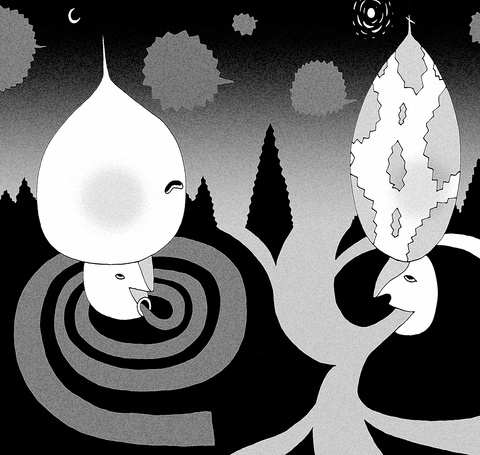
PHOTO: MOUNTAIN PEOPLE
The Shia/Sunni schism is so deep that each side condemns followers of the other as apostates, kafir. The belief that the other's religion is not Islam, and its followers not Muslim, has underpinned internecine wars in which millions have died -- and continue to die. Even among the Sunnis and Shias there are further divisions. The Sunnis have four imams and the Shias have 12; their teachings all differ. Then there are other divisions, including the Druze, the Alawites and the Wahabis.
We are also taught by our ulamas (religious instructors) that their teachings must not be questioned. Islam is a faith. It must be believed. Logic and reason play no part in it. But what is it that we must believe when each branch of Islam thinks the other one is wrong? The Koran, after all, is one book, not two or three, or a thousand.
According to the Koran, a Muslim is anyone who bears witness that "there is no God [Allah] but Allah, and that Muhammad is his Rasul [messenger]." If no other qualification is added, then all those who subscribe to these precepts must be regarded as Muslims. But because we Muslims like to add qualifications that often derive from sources other than the Koran, our religion's unity has been broken.
But perhaps the greatest problem is the progressive isolation of Islamic scholarship -- and much of Islamic life -- from the rest of the modern world. We live in an age of science in which people can see around corners, hear and see things happening in outer space and clone animals. And all of these things seem to contradict our belief in the Koran.
This is so because those who interpret the Koran are learned only in religion, in its laws and practices, and thus are usually unable to understand today's scientific miracles. The fatwas (legal opinions on Islamic law) that they issue appear unreasonable and cannot be accepted by those with scientific knowledge.
One learned religious teacher, for example, refused to believe that a man had landed on the moon. Others assert that the world was created 2,000 years ago. The age of the universe and its size measured in light years -- these are things that the purely religiously trained ulamas cannot comprehend.
This failure is largely responsible for the sad plight of so many Muslims. Today's oppression, the killings and the humiliations of Muslims, occurs because we are weak, unlike the Muslims of the past. We can feel victimized and criticize the oppressors, but to stop them we need to look at ourselves. We must change for our own good. We cannot ask our detractors to change, so that Muslims benefit.
So what do we need to do? In the past, Muslims were strong because they were learned. Muhammad's injunction was to read, but the Koran does not say what to read. Indeed, there was no "Muslim scholarship" at the time, so to read meant to read whatever was available. The early Muslims read the works of the great Greek scientists, mathematicians and philosophers. They also studied the works of the Persians, the Indians and the Chinese.
The result was a flowering of science and mathematics. Muslim scholars added to the body of knowledge and developed new disciplines, such as astronomy, geography and new branches of mathematics. They introduced numerals, enabling simple and limitless calculations.
But around the 15th century, the learned in Islam began to curb scientific study. They began to study religion alone, insisting that only those who study religion -- particularly Islamic jurisprudence -- gain merit in the afterlife. The result was intellectual regression at the very moment that Europe began embracing scientific and mathematical knowledge.
And so, as Muslims were intellectually regressing, Europeans began their renaissance, developing improved ways of meeting their needs, including the manufacture of weapons that eventually allowed them to dominate the world.
By contrast, Muslims fatally weakened their ability to defend themselves by neglecting, even rejecting, the study of allegedly secular science and mathematics, and this myopia remains a fundamental source of the oppression suffered by Muslims today.
Many Muslims still condemn the founder of modern Turkey, Mustafa Kamal, because he tried to modernize his country. But would Turkey be Muslim today without Ataturk? Mustafa Kamal's clear-sightedness saved Islam in Turkey and saved Turkey for Islam.
Failure to understand and interpret the true and fundamental message of the Koran has brought only misfortune to Muslims. By limiting our reading to religious works and neglecting modern science, we destroyed Islamic civilization and lost our way in the world.
The Koran says that "Allah will not change our unfortunate situation unless we make the effort to change it." Many Muslims continue to ignore this and, instead, merely pray to Allah to save us, to bring back our lost glory. But the Koran is not a talisman to be hung around the neck for protection against evil. Allah helps those who improve their minds.
Mahathir Mohamad was prime minister of Malaysia from 1981 to 2003.
Copyright: Project Syndicate
Taiwan’s higher education system is facing an existential crisis. As the demographic drop-off continues to empty classrooms, universities across the island are locked in a desperate battle for survival, international student recruitment and crucial Ministry of Education funding. To win this battle, institutions have turned to what seems like an objective measure of quality: global university rankings. Unfortunately, this chase is a costly illusion, and taxpayers are footing the bill. In the past few years, the goalposts have shifted from pure research output to “sustainability” and “societal impact,” largely driven by commercial metrics such as the UK-based Times Higher Education (THE) Impact
History might remember 2026, not 2022, as the year artificial intelligence (AI) truly changed everything. ChatGPT’s launch was a product moment. What is happening now is an anthropological moment: AI is no longer merely answering questions. It is now taking initiative and learning from others to get things done, behaving less like software and more like a colleague. The economic consequence is the rise of the one-person company — a structure anticipated in the 2024 book The Choices Amid Great Changes, which I coauthored. The real target of AI is not labor. It is hierarchy. When AI sharply reduces the cost
I wrote this before US President Donald Trump embarked on his uneventful state visit to China on Thursday. So, I shall confine my observations to the joint US-Philippine military exercise of April 20 through May 8, known collectively as “Balikatan 2026.” This year’s Balikatan was notable for its “firsts.” First, it was conducted primarily with Taiwan in mind, not the Philippines or even the South China Sea. It also showed that in the Pacific, America’s alliance network is still robust. Allies are enthusiastic about America’s renewed leadership in the region. Nine decades ago, in 1936, America had neither military strength
The Presidential Office on Saturday reiterated that Taiwan is a sovereign, independent nation after US President Donald Trump said that Taiwan should not “go independent.” “We’re not looking to have somebody say: ‘Let’s go independence because the United States is backing us,’” Trump said in an interview with Fox News aired on Friday. President William Lai (賴清德) on Monday said that the Republic of China (ROC) — Taiwan’s official name — and the People’s Republic of China (PRC) are not subordinate to each other. Speaking at an event marking the 40th anniversary of the establishment of the Democratic Progressive Party (DPP), Lai said


 RSS
RSS