


As the international political year begins anew, the democratic election season has arrived with a vengeance. This fact would not necessarily please the playwright, George Bernard Shaw. In his view, "Democracy substitutes election by the incompetent many for appointment by the corrupt few."
US President George W Bush, the beneficiary of a 2000 election that opponents deemed both incompetent and corrupt, may have a marginally stronger claim to speak for the contemporary world -- Shaw died in 1950. The US president is all in favor of democratic representation, which for him is synonymous with liberty.
"The advance of freedom is the great story of our age," Bush declared in Latvia in May. "We have learned that governments accountable to citizens are peaceful, while dictatorships stir resentment and hatred to cover their failings."
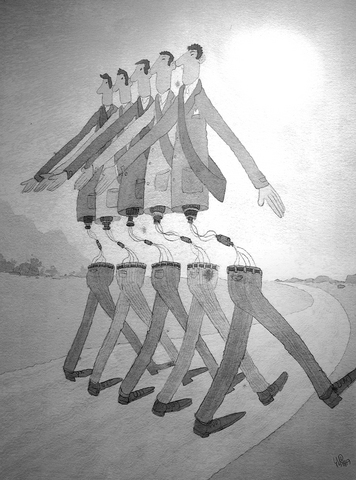
ILLUSTRATION: YU SHA
This is hardly a new American refrain. Woodrow Wilson expressed it for example in 1917 when he portentously declared that "the world must be made safe for democracy."
Winston Churchill was famously more jaded in 1947.
"Many forms of government have been tried and will be tried in this world of woe and sin," he said. "No one pretends that democracy is perfect or all-wise. Indeed, it has been said that democracy is the worst form of government except for all other forms."
But whether incompetent or virtuous, idealistic or gullible, millions of voters will nevertheless head towards polling stations in the coming weeks from Poland, Afghanistan and Haiti to Liberia and Azerbaijan. And nowhere will the process and the outcome be more closely watched than in Germany, Japan and Egypt, which all vote this month.
These latter polls, while differing in numerous respects, have three salient points in common. One is that in each country, a powerful and long-established incumbent is facing unusual challenges from potential usurpers.
In Germany, two-term Social Democrat Chancellor Gerhard Schroder is being squeezed by Angela Merkel's conservatives and a revitalized left wing alliance. Opinion polls suggest he is destined to lose.
If that happens, it will be only the second time in German postwar history that voters, rather than resignations or shifting parliamentary coalitions, have sent a chancellor packing -- the other occasion was Schroder's defeat of Helmut Kohl in 1998.
In Japan, Prime Minister Junichiro Koizumi is primarily engaged in a personal tussle with members of his own Liberal Democratic party and Japan's self-lubricating political machine, rather than the opposition. Determined to break the grip of the "reactionaries," Koizumi has all but turned the poll into a referendum on himself.
Gratifyingly for him, polls currently suggest he will win.
In Egypt, meanwhile, the chances that President Hosni Mubarak will fail to gain a fifth and final six-year term seem remote. But what is different this time around -- indeed, what is unprecedented in modern Egyptian history -- is that opposition candidates are contesting the poll.
Mubarak is not exactly fighting for his political life, as is Schroder. But like Koizumi, his personal prestige is on the line to an unusual extent. And liberal Arab commentators hope he has started something that cannot be stopped: the progressive democratization of political life.
The idea of reform is the second shared characteristic of these three countries' elections. In Germany, the Merkel-Schroder battleground sets ecostate provision against protection. Similar arguments are currently raging in France, over "Blairite" neo-liberalism versus social justice.
In Japan, Koizumi has staked his future on his thwarted efforts to privatize the Japanese postal service, a US$3 trillion business that fuels Japan's money politics. It was the opposition of 37 members of his own party that led him to call a snap poll. Now Koizumi has turned his guns on "the forces of resistance" and sacked the renegades. His campaign slogan? "Don't Stop Reform!"
In Egypt, by way of contrast, everybody is in favour of reform. The problem is what is actually meant by the term. Were he to be elected, Mubarak's principal opponent, Ayman Nour, might begin by curbing the state's powers of arbitrary arrest, to which he personally fell victim earlier this year.
The president's campaign Web site meanwhile, promises all manner of enticing changes such as enhanced powers for parliament and reform of the hated emergency law.
But as students of democracy everywhere know only too well, election promises are made to be broken -- which leads to the third similarity between these three poll contests. If she wins, Merkel's policies may not ultimately differ greatly from those of her predecessor. Whoever is in charge of the economy, Germany has only limited room for maneuver.
If Koizumi wins, will there be a Japanese revolution? Hardly. His privatization plan has already been so watered down that it may not make a fundamental difference. And if Mubarak is triumphant? "Plus ca change, plus c'est la meme chose," as the French say.
While such outcomes may smack of anti-climax, they also represent peaceful continuity -- one of democracy's great strengths. As for its shortcomings, the poet Oscar Wilde issued his own health warning long ago by parodying Abraham Lincoln.
"Democracy means simply the bludgeoning of the people by the people for the people," Wilde wrote.
In other words, don't expect too much.
Recently, China launched another diplomatic offensive against Taiwan, improperly linking its “one China principle” with UN General Assembly Resolution 2758 to constrain Taiwan’s diplomatic space. After Taiwan’s presidential election on Jan. 13, China persuaded Nauru to sever diplomatic ties with Taiwan. Nauru cited Resolution 2758 in its declaration of the diplomatic break. Subsequently, during the WHO Executive Board meeting that month, Beijing rallied countries including Venezuela, Zimbabwe, Belarus, Egypt, Nicaragua, Sri Lanka, Laos, Russia, Syria and Pakistan to reiterate the “one China principle” in their statements, and assert that “Resolution 2758 has settled the status of Taiwan” to hinder Taiwan’s
Singaporean Prime Minister Lee Hsien Loong’s (李顯龍) decision to step down after 19 years and hand power to his deputy, Lawrence Wong (黃循財), on May 15 was expected — though, perhaps, not so soon. Most political analysts had been eyeing an end-of-year handover, to ensure more time for Wong to study and shadow the role, ahead of general elections that must be called by November next year. Wong — who is currently both deputy prime minister and minister of finance — would need a combination of fresh ideas, wisdom and experience as he writes the nation’s next chapter. The world that
Can US dialogue and cooperation with the communist dictatorship in Beijing help avert a Taiwan Strait crisis? Or is US President Joe Biden playing into Chinese President Xi Jinping’s (習近平) hands? With America preoccupied with the wars in Europe and the Middle East, Biden is seeking better relations with Xi’s regime. The goal is to responsibly manage US-China competition and prevent unintended conflict, thereby hoping to create greater space for the two countries to work together in areas where their interests align. The existing wars have already stretched US military resources thin, and the last thing Biden wants is yet another war.
Since the Russian invasion of Ukraine in February 2022, people have been asking if Taiwan is the next Ukraine. At a G7 meeting of national leaders in January, Japanese Prime Minister Fumio Kishida warned that Taiwan “could be the next Ukraine” if Chinese aggression is not checked. NATO Secretary-General Jens Stoltenberg has said that if Russia is not defeated, then “today, it’s Ukraine, tomorrow it can be Taiwan.” China does not like this rhetoric. Its diplomats ask people to stop saying “Ukraine today, Taiwan tomorrow.” However, the rhetoric and stated ambition of Chinese President Xi Jinping (習近平) on Taiwan shows strong parallels with


 RSS
RSS